Emotions don’t always come with clear words. Sometimes when you ask yourself, “How am I feeling?” the answer is: “I don’t know.” Sometimes it’s: “I feel overwhelmed.” “I feel heaviness in my body.” “My chest feels tight.” “My head feels heavy.” “I feel zoned out.” And sometimes, it’s just silence. If you’ve ever struggled to …

Emotions don’t always come with clear words.
Sometimes when you ask yourself, “How am I feeling?” the answer is:
“I don’t know.”
Sometimes it’s:
“I feel overwhelmed.”
“I feel heaviness in my body.”
“My chest feels tight.”
“My head feels heavy.”
“I feel zoned out.”
And sometimes, it’s just silence.
If you’ve ever struggled to explain your trauma, anxiety, or emotional pain — you’re not broken. You may simply need a body-based approach to healing.
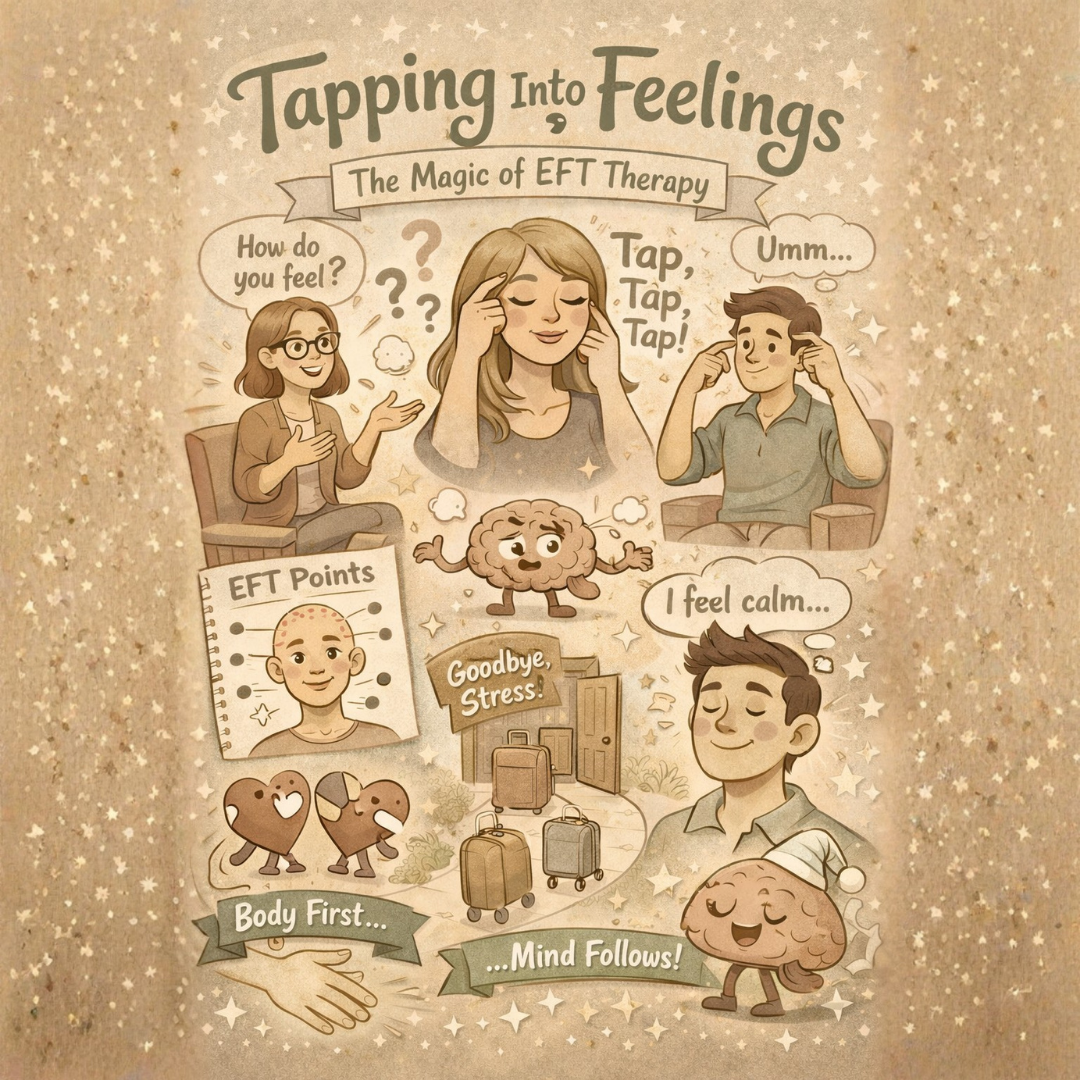
This is where Emotional Freedom Techniques (EFT tapping) can make a profound difference.
What is Emotional Freedom Techniques (EFT)?
Emotional Freedom Techniques (EFT), often called tapping therapy, is a somatic (body-based) psychological intervention that combines:
- Cognitive processing
- Exposure principles
- Acupressure stimulation of meridian points
- Nervous system regulation
During EFT, you gently tap on specific acupressure points on the face and upper body while focusing on a distressing emotion, traumatic memory, anxiety trigger, or overwhelming bodily sensation.
Unlike traditional talk therapy, EFT does not require elaborate explanations. It works directly through the body.
Research over the past two decades has increasingly supported EFT as an evidence-informed intervention for trauma, anxiety, depression, and stress reduction (Church et al., 2012; Clond, 2016).
Why EFT Works for Trauma and Anxiety
Trauma and anxiety are not just psychological experiences — they are neurobiological and physiological states.
People living with trauma often experience:
- Emotional flooding (panic, overwhelm, racing thoughts)
- Chronic anxiety
- Heaviness in the chest or heart area
- Pressure in the head
- Tight jaw or shoulders
- Dissociation or feeling zoned out
- Emotional numbness
These symptoms reflect nervous system dysregulation — particularly overactivation of the amygdala (the brain’s alarm system) (LeDoux, 2000).
Studies suggest that EFT may reduce amygdala activation and lower stress hormones such as cortisol (Church et al., 2012). In a randomized controlled trial, participants who received EFT demonstrated significant reductions in cortisol levels compared to supportive counseling controls.
When the nervous system feels safe, emotional intensity naturally decreases.
EFT facilitates that safety.
EFT for Trauma: When You Can Talk About It, But Can’t Feel It
Some individuals can describe their trauma clearly — almost like narrating a documentary. The story is organized.
But emotionally, they feel disconnected.
Others say:
- “I feel overwhelmed and heavy in my chest.”
- “My head feels tight.”
- “I feel anxious all the time.”
- “I feel numb.”
- “I just feel zoned out.”
EFT gently bridges the gap between cognition and sensation.
Instead of overanalyzing, you:
- Identify the emotion or bodily sensation.
- Rate the intensity (0–10).
- Tap while staying present with the experience.
Meta-analyses have shown EFT to be effective in reducing symptoms of anxiety (Clond, 2016) and depression (Nelms & Castel, 2016), with effect sizes comparable to established therapies.
The shift often happens quickly — not because insight was forced, but because the nervous system recalibrated.
How EFT Reduces Emotional Overwhelm and Heaviness in the Body
Trauma lives in the body.
This is consistent with contemporary trauma research emphasizing somatic memory and implicit processing (van der Kolk, 2014).
Common physical experiences of trauma and anxiety include:
- Heaviness in the body
- Tight chest or shallow breathing
- Knot in the stomach
- Frozen or collapsed posture
- Feeling detached or dissociated
EFT keeps the body engaged while safely revisiting the emotional trigger.
By pairing mindful exposure with acupressure stimulation, EFT appears to reduce the emotional intensity associated with traumatic memories (Feinstein, 2012).
Over time, the brain learns:
“This memory is not happening now.”
And the body begins to relax.
The Science Behind EFT Tapping
Emerging research suggests that EFT:
- Reduces cortisol levels (Church et al., 2012)
- Significantly lowers anxiety symptoms (Clond, 2016)
- Improves depression outcomes (Nelms & Castel, 2016)
- Shows promise in PTSD treatment (Sebastian & Nelms, 2017)
- Enhances emotional regulation
A 2012 review by Feinstein proposed that stimulating acupressure points while recalling traumatic memories may rapidly downregulate limbic arousal.
While research is ongoing, current findings indicate that EFT is an evidence-supported adjunctive treatment for trauma and anxiety disorders.
EFT focuses on:
- Nervous system regulation
- Somatic integration
- Emotional desensitization
When someone is overwhelmed, anxious, dissociated, or stuck in repetitive mental loops, regulation must come before insight.
EFT offers a bottom-up approach — starting with the body.
Who Can Benefit from EFT?
EFT may be helpful for individuals experiencing:
- Trauma (childhood trauma, relational trauma, acute stress)
- Generalized anxiety disorder
- Panic attacks
- Emotional overwhelm
- Chronic stress
- Heaviness in chest or body
- Feeling zoned out or dissociated
- Emotional numbness
- Persistent negative thought loops
It is particularly useful for people who say:
- “I overthink my feelings.”
- “I can talk about it, but I don’t feel it.”
- “I don’t know what I’m feeling.”
- “I feel constantly overwhelmed.”
One of the most powerful aspects of EFT is this:
You don’t need to fully understand your trauma to begin healing it.
Insight is valuable.
But regulation comes first.
Sometimes healing begins not with articulation — but with permission.
A few steady taps.
A few conscious breaths.
A little space for the body to soften.
And emotional freedom begins.
You can explore an EFT session with our in house EFT based therapist Ms. Sonal Kishnani by booking a session with her.

References
LeDoux, J. (2000). Emotion circuits in the brain. Annual Review of Neuroscience, 23, 155–184.
Nelms, J., & Castel, D. (2016). A systematic review and meta-analysis of randomized and nonrandomized trials of Emotional Freedom Techniques for the treatment of depression. Explore: The Journal of Science and Healing, 12(6), 416–426.
Sebastian, B., & Nelms, J. (2017). The effectiveness of Emotional Freedom Techniques in the treatment of posttraumatic stress disorder: A meta-analysis. Explore: The Journal of Science and Healing, 13(1), 16–25.