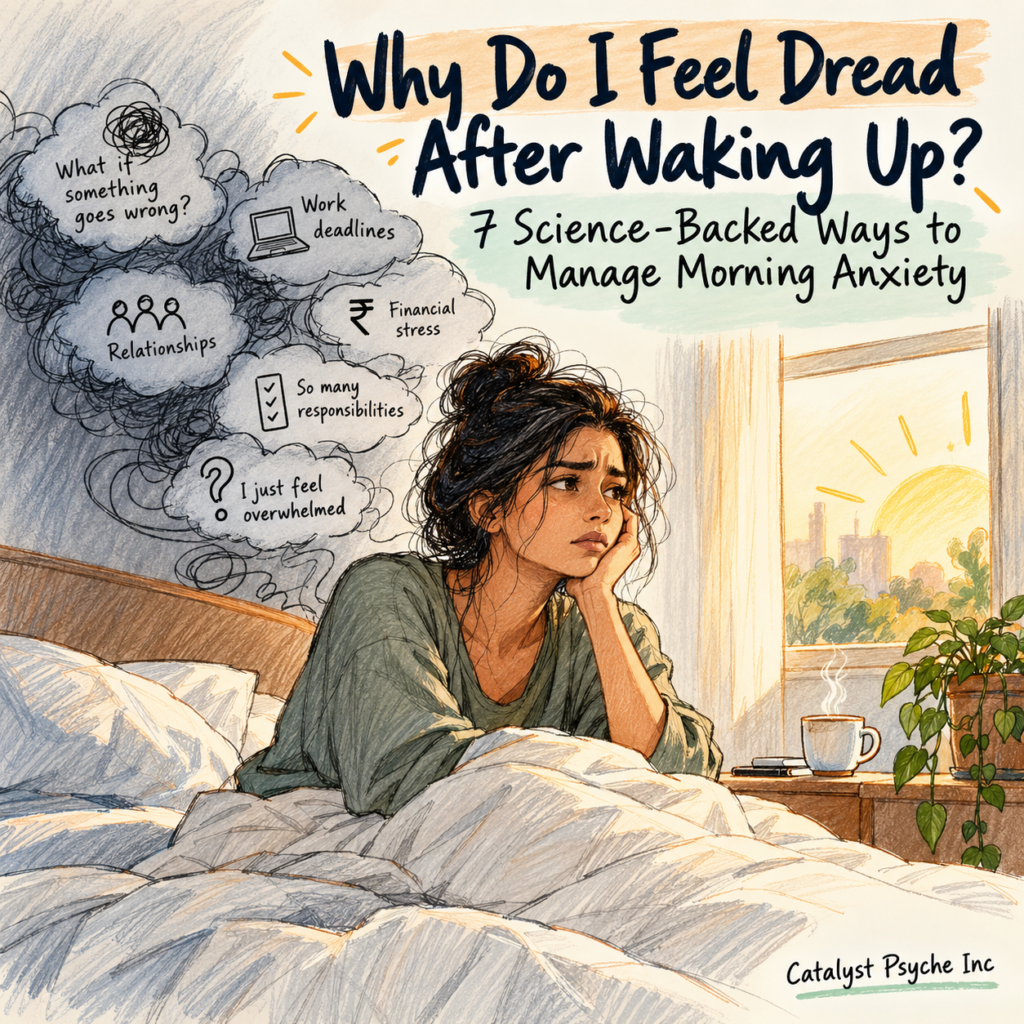
Struggling or trying to Understanding OCD - Why Can’t I Stop Washing Hands/Body? Learn how OCD works, why it happens, and how therapy helps young adults in India break the cycle. “I’ve already washed my hands… so why do I feel like doing it again?” You wash your hands. You dry them. You walk away. …

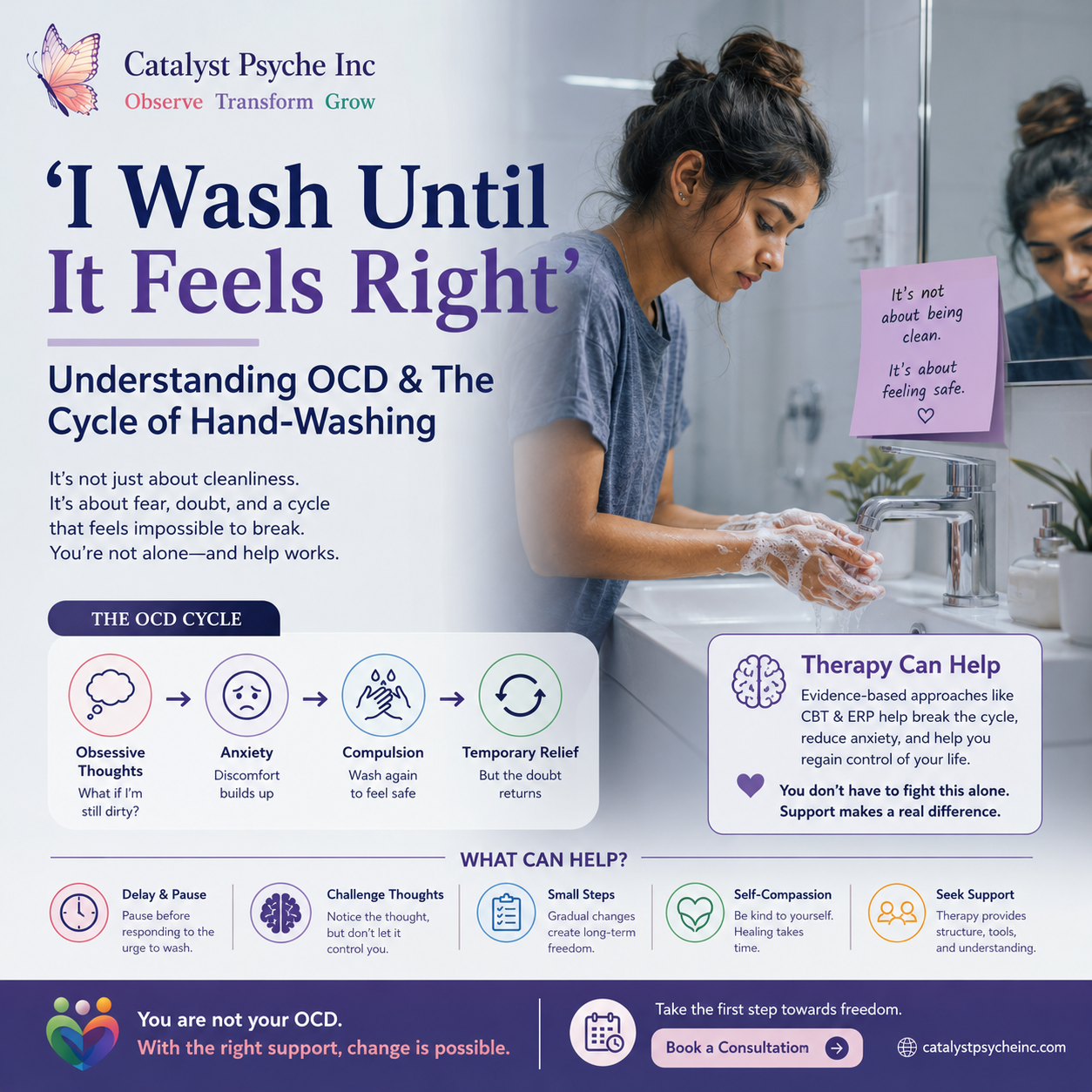
Struggling or trying to Understanding OCD – Why Can’t I Stop Washing Hands/Body? Learn how OCD works, why it happens, and how therapy helps young adults in India break the cycle.
“I’ve already washed my hands… so why do I feel like doing it again?”
You wash your hands.
You dry them.
You walk away.
And then the thought comes back:
“What if they’re still not clean?”
So you go back. Again & again…
If this feels familiar, you may be experiencing something more than just a habit.
This is how hand-washing OCD (Obsessive-Compulsive Disorder) often begins — quietly, repeatedly, and frustratingly.
What Is Hand-Washing OCD?
Hand-washing OCD is a common form of contamination OCD, where the brain repeatedly signals that something is dirty, unsafe, or incomplete.
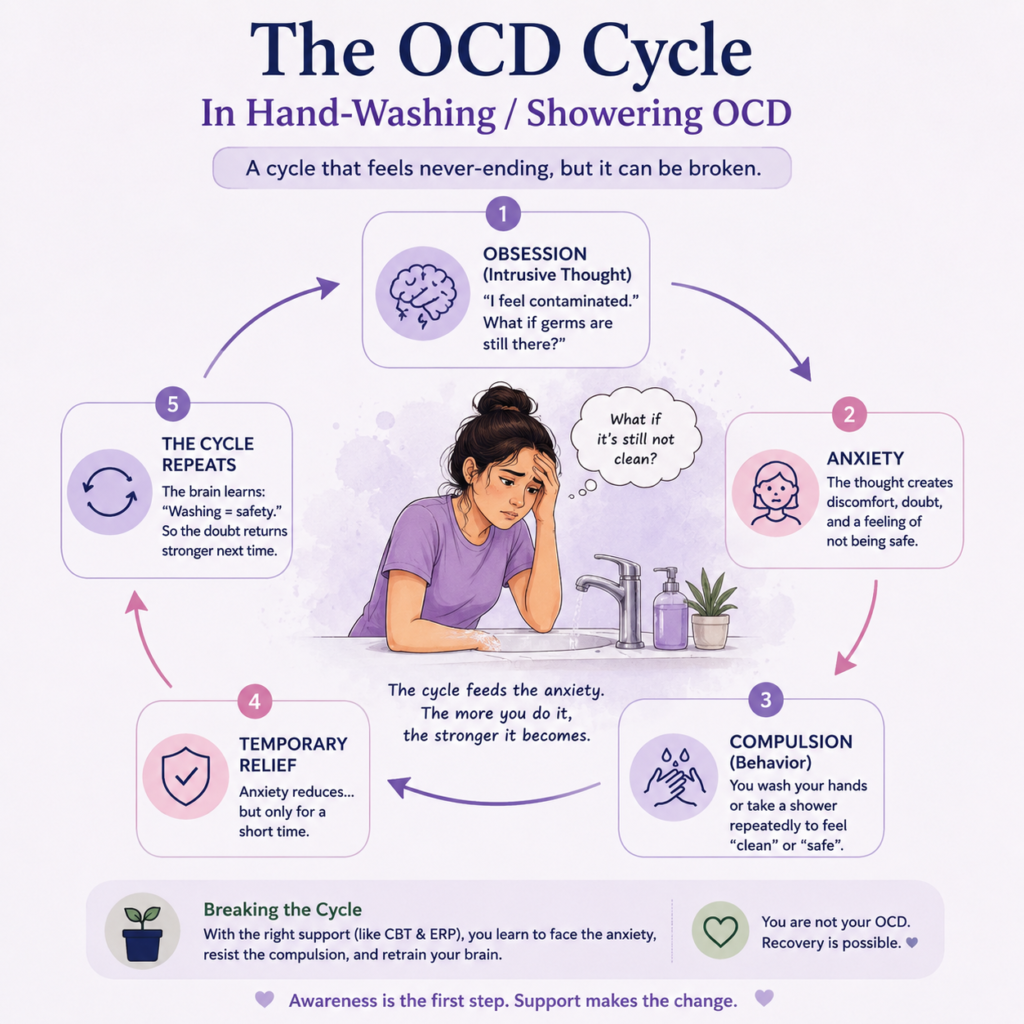
It creates a cycle:
Thought: “This doesn’t feel clean.”
Anxiety: Uneasiness, discomfort, fear
Compulsion: Washing hands or taking a shower again
Relief: Temporary calm… until the thought returns
Over time, this loop becomes automatic.
And that’s what makes OCD exhausting.
Why Hand Washing OCD Feels So Confusing
In India, cleanliness is deeply connected to culture, routine, and upbringing.
Most of us grow up hearing:
“Bahaar se aaye ho, haath dholo.” “Proper safai rakho.”
These are healthy habits.
But OCD slowly changes the experience.
What begins as cleanliness starts becoming fear.
You stop washing because you want to — and start washing because your mind refuses to feel settled otherwise. That’s the difference.
What OCD Washing Actually Looks Like
A 23-year-old student preparing for competitive exams once shared:
“If I touch my study table after coming from outside, I feel like everything is contaminated. I end up cleaning it repeatedly… and by then I’ve lost hours.”
Another young adult described their shower routine:
“I go in thinking it’ll take 10 minutes. Somehow it becomes 40. I keep feeling like I need one more rinse before I can leave.” It starts to affect family and all other areas of life.
The common feeling underneath is usually this:
“Something still doesn’t feel right.”
Why I Can’t “Just Stop” Washing My Hands or Body
This is one of the most misunderstood parts of OCD. Most people with OCD already know their fear is excessive. They often say things like:
“I know it doesn’t logically make sense.”
But OCD is not a logic problem. It’s a brain-and-anxiety loop. Your brain keeps asking:
“Are you absolutely sure?”
And washing becomes the way your mind tries to feel safe.
Unfortunately, every time you respond immediately, the brain learns:
“Good. Do that again next time.” That’s how the cycle grows stronger.
How Recovery Actually Begins
Recovery usually does not start with suddenly stopping all compulsions. It begins with small moments of awareness. Like noticing the urge to wash… and pausing before reacting.
Even a short pause matters. Because slowly, your brain starts learning:
“I can tolerate this discomfort without immediately fixing it.”
At first, this feels uncomfortable. But over time, the urgency begins reducing.
Why Therapy Is Important for OCD
Many young adults try to manage OCD alone for years. Often because they feel embarrassed, judged, or misunderstood.
Some hear things like:
“Just control it.” “You’re overthinking.”
But OCD is not about weak willpower. It is a psychological condition that responds best to structured, evidence-based support.
One of the most effective approaches is CBT with Exposure and Response Prevention (ERP).
Therapy helps you:
- Understand the OCD cycle
- Reduce compulsive behaviours gradually
- Build tolerance toward anxiety and uncertainty
- Regain control over daily life
Most importantly, therapy helps you realise:
You are not your OCD.
You’re Not “Crazy” or Weak
If you’ve been struggling with repeated hand washing or excessively long showers, chances are you’ve already judged yourself harshly. But OCD is not a personality flaw. Your brain learned a fear-based pattern. And patterns can be changed.
You Don’t Have to Deal With This Alone
If this blog felt uncomfortably relatable, it may be a sign that your mind has been stuck in this cycle for longer than necessary.
At Catalyst Psyche Inc, we work with OCD using evidence-based approaches like:
- CBT (Cognitive Behaviour Therapy)
- ERP (Exposure and Response Prevention)
- Anxiety regulation strategies
- Trauma-informed approaches where needed
We understand that OCD is not “just a habit.” And recovery does not happen through shame. If you know someone who is living with a partner who has OCD traits may be you would be interesting in reading this blog as well – How to Live with a Partner Who Has OCD: A Compassionate Guide
[bookly-form]
References
American Psychiatric Association. (2013). Diagnostic and statistical manual of mental disorders (5th ed.).
Veale, D., & Roberts, A. (2014). Obsessive-compulsive disorder. BMJ, 348, g2183.