Why Saying “No” Feels So Guilty: Understanding Emotional Boundaries in Indian Families By Catalyst Psyche Inc | Mental Health & Wellbeing Part 1 of the Boundaries Series Why do boundaries feel so uncomfortable? Learn how emotional boundaries are shaped in Indian families, why saying no creates guilt, and how therapy can help build healthier relationships. …

Why Saying “No” Feels So Guilty: Understanding Emotional Boundaries in Indian Families
By Catalyst Psyche Inc | Mental Health & Wellbeing
Part 1 of the Boundaries Series
Why do boundaries feel so uncomfortable? Learn how emotional boundaries are shaped in Indian families, why saying no creates guilt, and how therapy can help build healthier relationships.
“I didn’t want to do it… but I still said yes.”
A 26-year-old client once spoke about cancelling her own plans because a relative needed help.
Not an emergency. Not something only she could do. Just something that was expected of her!
And while saying yes, she noticed something uncomfortable underneath the politeness: Resentment.
Not towards the other person, but towards Herself.
Because somewhere inside, she already knew: “I don’t actually want to do this.” But saying no felt impossible…Not because she lacked confidence….Not because she didn’t know how to communicate. But because guilt arrived almost immediately.
The kind of guilt many people raised in Indian families know deeply:
“What will they think?”
“Am I being selfish?”
“Good people don’t say no like this.”
And so, instead of disappointing someone else, she disappointed herself.
Again.
Table of Contents
ToggleWhat Emotional Boundaries Actually Are
When people hear the word boundaries, they often imagine distance – Coldness. Walls. Detachment!
But emotional boundaries are not about pushing people away. They are about recognising:
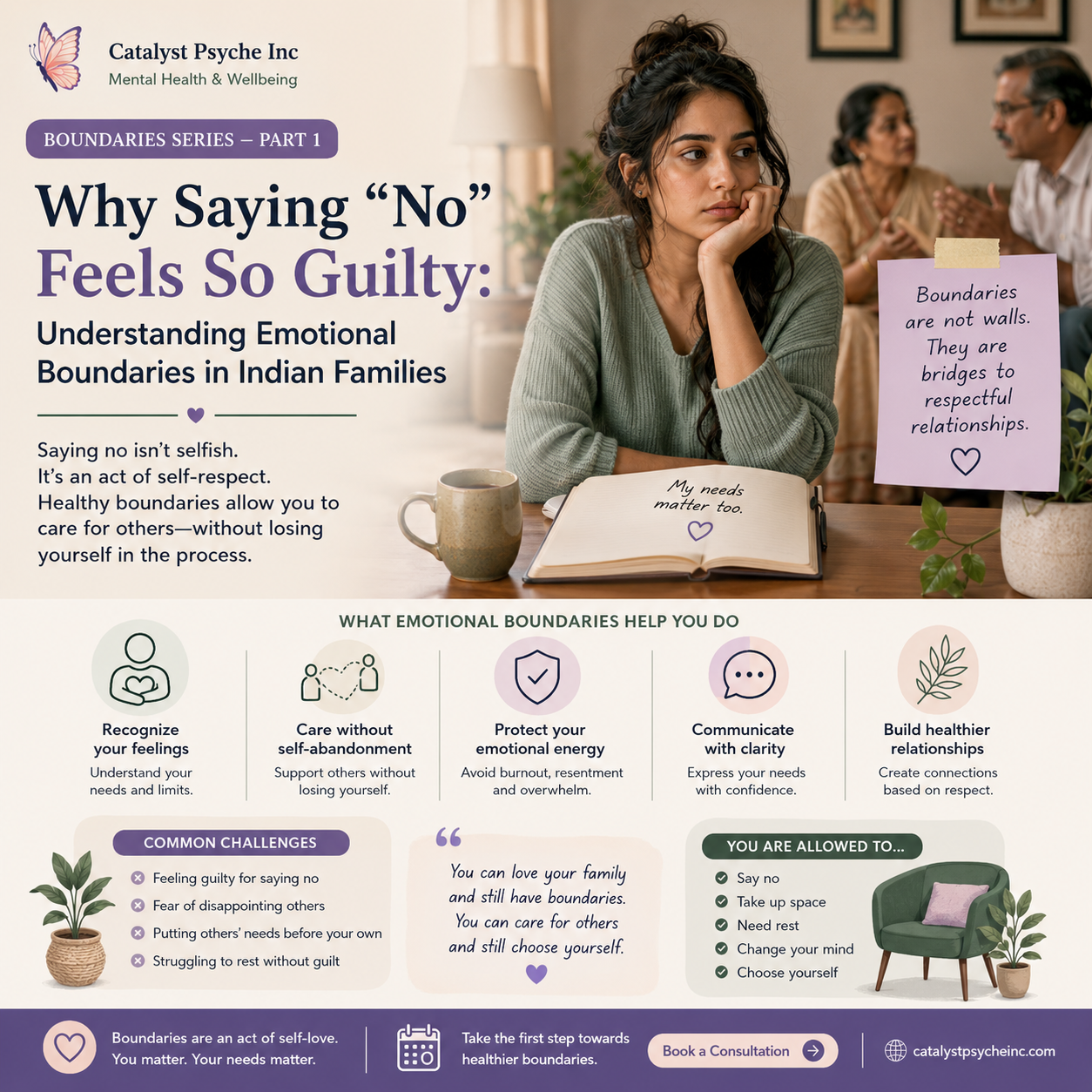
“My emotions, needs, limits, and energy matter too.”
Healthy emotional boundaries allow us to stay connected to others without abandoning ourselves in the process. Without boundaries, relationships slowly stop feeling like connection and start feeling like emotional obligation or burden.
Why So Many People Struggle With Boundaries in Indian Families
In many Indian households, love and sacrifice are deeply intertwined. From a young age, people are subtly taught:
“adjust.
don’t upset elders.
compromise.
think about others first.
If you put your needs first, you are selfist “
Care, interdependence, and family closeness can be beautiful parts of collectivistic cultures. However, problems begin when:
love becomes conditional on self-abandonment.
A lot of adults today grew up learning that keeping peace was more important than expressing discomfort.
So instead of asking:
“What do I need?”
they learned to ask:
“What will make everyone else okay?”
Over time, this creates adults who:
- feel responsible for everyone’s emotions
- struggle to say no without overexplaining
- feel guilty resting
- feel anxious disappointing people
- confuse self-sacrifice with emotional maturity or love or care
And because these patterns are so normalised socially, they often don’t look unhealthy at first.
They just look like:
“being understanding.”
“being available.”
“being family-oriented.”
Until exhaustion starts showing up.
The Invisible Exhaustion of Always Being Available
One of the hardest things about weak emotional boundaries is that the exhaustion is often invisible.
You may still appear:
- helpful
- caring
- emotionally strong
while internally feeling:
- drained
- resentful
- emotionally overwhelmed
A young professional once shared:
“I can spend the entire day emotionally supporting people… and then feel strangely empty at night.”
This is the difficult part about poor emotional boundaries: people often notice the guilt before they notice the exhaustion.
Why Saying “No” Feels Emotionally Unsafe
For many people, saying no is not just uncomfortable. It feels emotionally dangerous and unsafe.
Because somewhere internally, boundaries may feel connected to:
- rejection
- conflict
- abandonment
- guilt
- loss of love
Especially if growing up:
- disagreement was punished
- emotions were dismissed
- silence followed conflict
- approval depended on obedience
In these environments, boundaries do not feel like healthy communication. They feel unsafe.
So people learn survival strategies instead:
- people pleasing
- emotional over-functioning
- conflict avoidance
- constantly staying available
Not because they are weak. But because at some point, these behaviors protected connection.
What Healthy Emotional Boundaries Actually Look Like
Healthy boundaries are usually much quieter than social media makes them seem. Sometimes they look like:
“I want to help, but I don’t have the emotional capacity today.”
Or:
“I need some time before we continue this conversation.”
Or even:
“I understand you’re upset, but I cannot carry responsibility for your emotions alone.”
Healthy boundaries are not about becoming emotionally unavailable. They are about learning:
“Connection should not require self-erasure.”
Why Boundaries Feel Uncomfortable Before They Feel Healthy
One of the most confusing parts of boundary work is this: At first, healthy boundaries can feel wrong.
Not because they are wrong. But because they are unfamiliar. A person who spent years overexplaining may feel guilty giving a simple answer.
Someone who constantly stayed emotionally available may feel anxious taking space. And people around them may react too as they are not used to of you respecting your own emotions, time and energy…Sometimes they react with disappointment, sometimes with guilt-tripping, sometimes by calling them “different or you have changed”
Because boundaries often disrupt relationship dynamics people became comfortable with.
How Therapy Helps With Emotional Boundaries
Boundary difficulties are rarely just communication problems. Often, they are connected to:
- attachment patterns
- fear of rejection
- childhood conditioning
- emotional neglect
- anxiety
- people-pleasing tendencies
Therapy helps people recognise:
- where their guilt comes from
- why saying no feels unsafe
- how emotional exhaustion develops
- how to communicate limits without shame
Most importantly, therapy helps people understand:
Boundaries are not acts of rejection.
They are acts of emotional honesty.
You Are Allowed to Exist Without Constantly Earning Your Space
A lot of people move through relationships feeling like they must continuously:
- prove they care
- stay useful
- remain emotionally available
- avoid disappointing others
But relationships built only on self-sacrifice eventually become emotional burden.
You are allowed to:
- need rest
- say no
- disappoint people sometimes
- protect your emotional energy
And none of that makes you selfish.
You Don’t Have to Learn Boundaries Alone
At Catalyst Psyche Inc, we work with individuals struggling with:
- people pleasing
- emotional burnout
- guilt around saying no
- relationship overwhelm
- family pressure
- emotional boundary difficulties
using evidence-based and trauma-informed approaches.
If this blog felt uncomfortably relatable, support can help you understand where these patterns come from — and how to slowly change them. If this resonates with you might want to explore
Why do I keep overthinking every conversation?
The Conflict Within: To Connect vs. To Disconnect
[bookly-form]
References (APA Style)
Bowen, M. (1978). Family therapy in clinical practice. Jason Aronson.