Coming Out in India: Understanding the 6 Stages of Queer Identity Estimated reading time: 7–8 minutes “Could this be who I am… or am I overthinking it?” A 20-year-old client from Delhi once said this in session, almost hesitantly. She had known, in some quiet corner of herself, for years. But knowing something internally and …

Coming Out in India: Understanding the 6 Stages of Queer Identity
Estimated reading time: 7–8 minutes
“Could this be who I am… or am I overthinking it?”
A 20-year-old client from Delhi once said this in session, almost hesitantly.
She had known, in some quiet corner of herself, for years. But knowing something internally and allowing it to exist in your life are two very different things — especially in India.
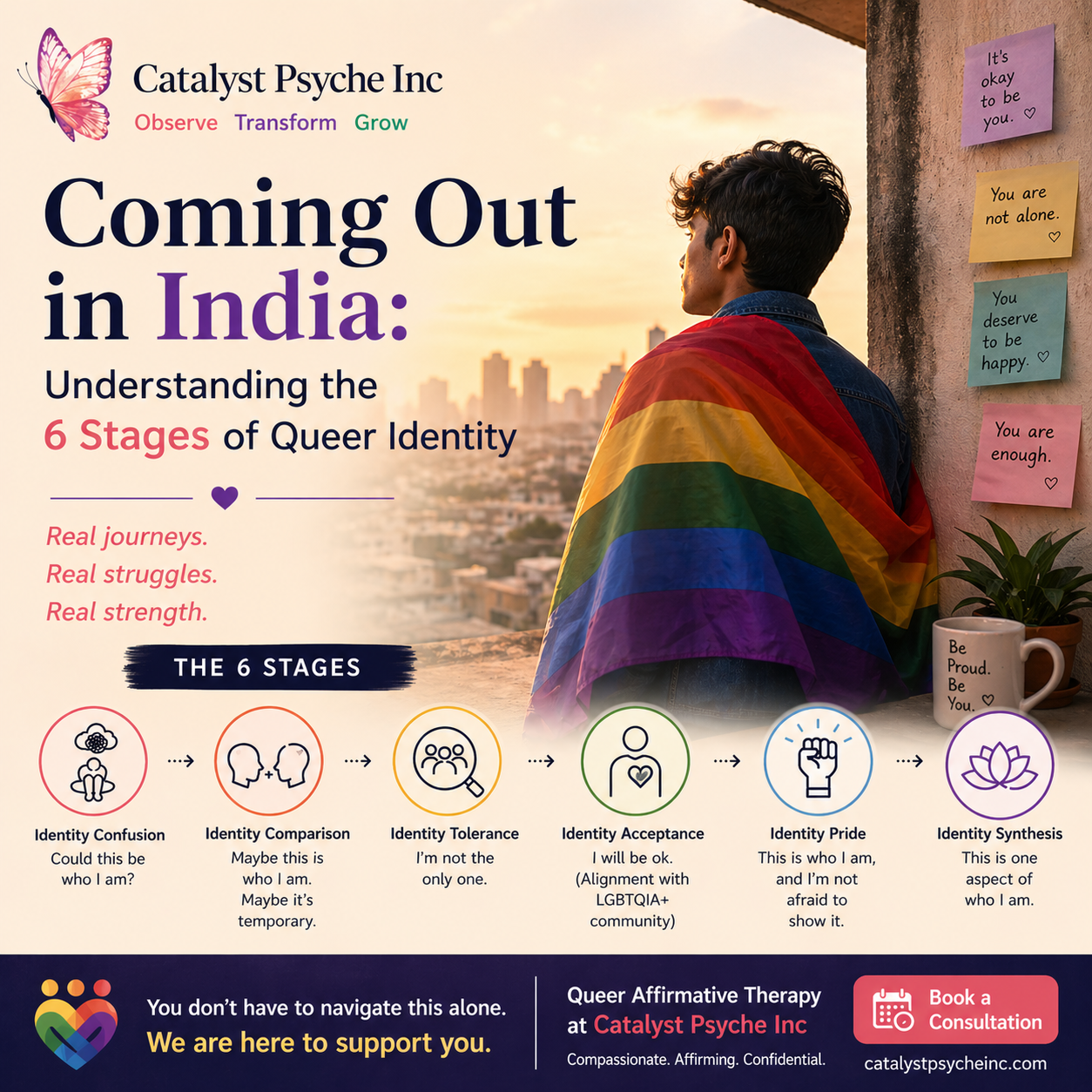
Psychology has tried to map this journey. One of the earliest frameworks is the Cass Model (1979), which outlines six stages of coming out and identity formation. While helpful, it was developed in a Western context where individuality often takes precedence over family systems.
In India, the journey is rarely linear, rarely visible, and almost never simple.
Let’s walk through these six stages — not as rigid steps, but as lived experiences.
Table of Contents
Toggle01 Coming Out – Identity Confusion: Could this be who I am?
For many, this stage does not begin with clarity — it begins with discomfort.
A student from Delhi once described how, while his friends spoke easily about crushes on women, he felt something different. He noticed it as early as school. It didn’t feel wrong, just unfamiliar. He tried to dismiss it — sometimes even agreeing with friends just to fit in, while internally knowing it wasn’t true.
In the Indian context, this confusion often stretches longer. There is limited language in schools, minimal representation growing up, and an almost assumed life script — education, career, marriage.
The question “Could this be who I am?” doesn’t just challenge identity — it quietly challenges an entire imagined future.
02 Coming Out – Identity Comparison: Maybe this is who I am. Maybe it’s temporary.
As awareness grows, so does comparison.
A young woman from Mumbai shared how her emotional connections with women felt deeper and more meaningful. Yet she held onto the idea that it might pass — that maybe she simply hadn’t met the “right man” yet.
This stage often carries a quiet loneliness — being part of the same world, but feeling slightly out of sync.
In India, where many young adults continue living with family, this becomes more intense. The home becomes a space where identity is performed rather than explored. Conversations around marriage, relatives asking “When will we hear good news?”, and subtle expectations reinforce that this is not just a personal experience — it is a social one.
One client recalled watching Dostana, hoping it might open conversations at home. Instead, a parent remarked, “People like this should die.” That moment didn’t just hurt — it created deep internal conflict.
Today, this person is out to friends and siblings — but still unsure how to come out to their parents.
03 Coming Out – Identity Tolerance: I’m not the only one.
This stage often brings relief — slowly, cautiously.
A 25-year-old trans woman shared how discovering queer creators on Instagram and reading anonymous stories online was the first time she felt seen.
Before any real-world disclosure, there is a quiet realisation:
“There are others like me.”
In India, this stage often unfolds privately — through online communities, anonymous profiles, or safe organisations like the Naz Foundation. These spaces offer something many people have never experienced before: being understood without explanation.
This phase is not just exploration. It is a mix of survival and hope.
04 Coming Out – Identity Acceptance: I will be ok (Alignment with LGBTQIA+ community)
Acceptance rarely arrives dramatically. It settles in — slowly.
A corporate professional from Noida shared that she stopped trying to “fix” herself. For the first time, she allowed herself to imagine a life outside compulsory heterosexual expectations.
Often, this stage involves telling someone — usually a trusted friend. Not because it is easy, but because holding it alone becomes heavier.
In India, acceptance is rarely uniform. Someone may feel fully authentic with friends while remaining silent at home.
This is not hypocrisy. It is adaptation.
05 Coming Out – Identity Pride: This is who I am, and I’m not afraid to show it.
Pride in India is often quieter than it looks.
It may mean attending a Pride march — not to make a statement, but to experience a space where you don’t have to hide.
It may mean gently correcting a homophobic comment. Or choosing not to laugh at something that once felt easier to ignore.
There is often anger here — not as aggression, but as clarity. A recognition of how systems, expectations, and silence have shaped one’s experience.
And yet, expression remains negotiated. Authenticity and safety are constantly balanced.
06 Coming Out – Identity Synthesis: This is one aspect of who I am
This is not a final stage — but a more integrated way of being.
A queer professional of Indian origin in France described it as:
“I’m not just my sexuality. But I’m not hiding it either.”
Over time, identity becomes one part of a larger self. The focus slowly expands — toward career, purpose, relationships, and growth.
In India, synthesis does not always mean being out everywhere. It often means feeling internally aligned while continuing to navigate external realities.
It is about coherence — not perfection.
So What Does This Mean in Real Life?
The Cass Model offers language — but not a fixed path.
You may move back and forth. You may experience multiple stages at once. You may feel confident in one space and uncertain in another.
In India especially, it is common to live between worlds — open in some spaces, guarded in others.
This is not failure. It is navigation.
You Don’t Have to Navigate This Alone
If you are somewhere in this journey — questioning, exploring, or feeling stuck — support can make a meaningful difference.
At Catalyst Psyche Inc, we offer Queer Affirmative Therapy.
This means we don’t treat your identity as a problem. We understand the complexities of Indian family systems, cultural expectations, and internal conflict. And we support you in finding a way to live that feels both authentic and sustainable.
Book a confidential consultation
[bookly-form category_id=”1″ service_id=”14″ staff_member_id=”1″]
References
1. Cass, V. (1979). Homosexual identity formation
https://doi.org/10.1300/J082v04n03_01
2. Meyer, I. H. (2003). Minority stress and mental health
https://doi.org/10.1037/0033-2909.129.5.674