You scroll through a hundred faces and still feel unseen. You cancel plans — and feel both relieved and hollow. What is really going on? 9 min read We live in a paradox. We scroll endlessly, surrounded by faces — yet feel unseen. We cancel plans and feel relief — then sit with a quiet …

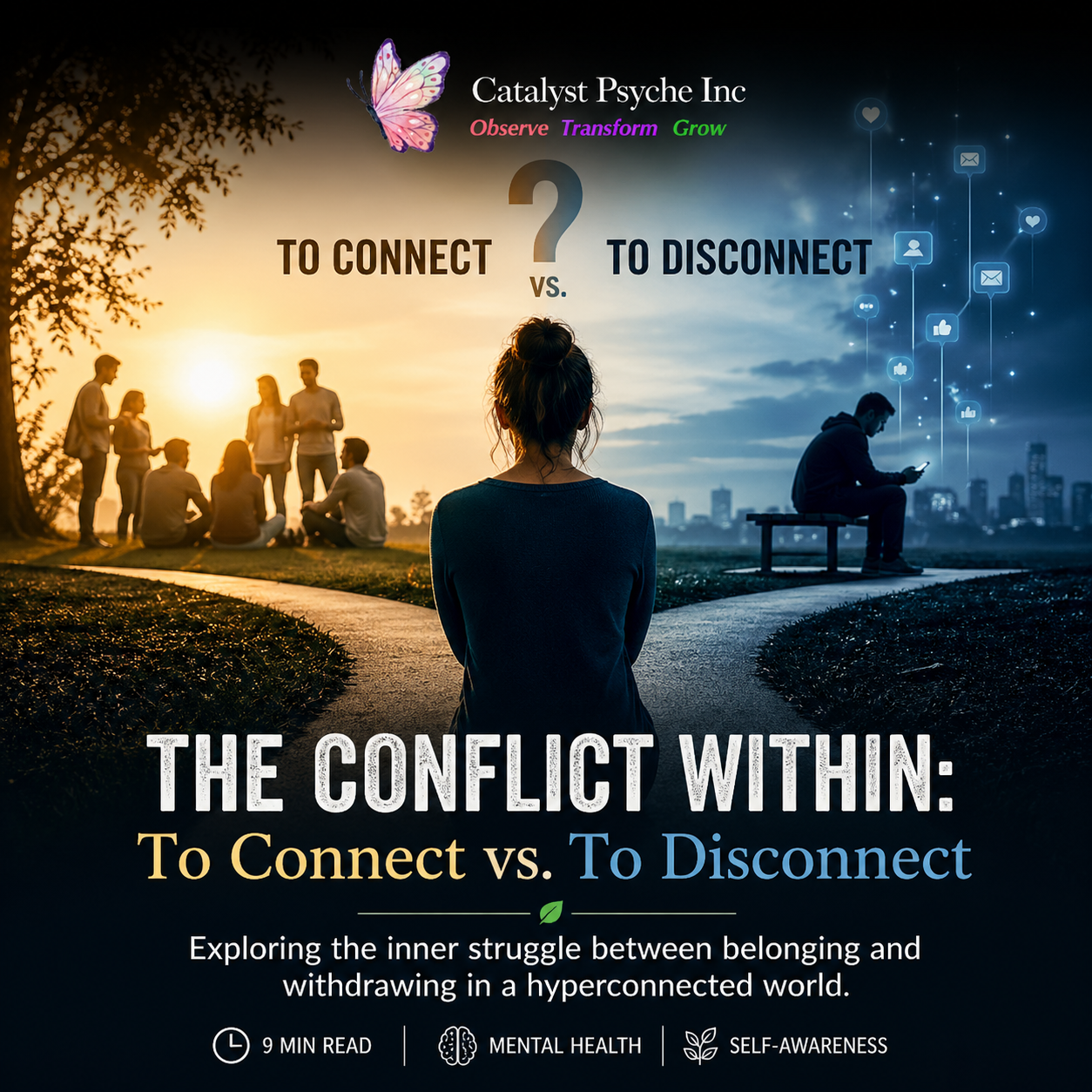
You scroll through a hundred faces and still feel unseen. You cancel plans — and feel both relieved and hollow. What is really going on?
9 min read
We live in a paradox.
We scroll endlessly, surrounded by faces — yet feel unseen.
We cancel plans and feel relief — then sit with a quiet restlessness.
We say we need space, but sometimes what we really mean is: we no longer know how to show up in it.
This is the conflict within: to connect, or to disconnect?
It’s not a new question. But in an age of constant digital presence, rising anxiety, and a growing loneliness epidemic, it has become deeply personal.
Table of Contents
Toggle01 — What Does It Mean to Feel Connected?
Connection is not about being surrounded by people.
At its core, it is about being known — seen, heard, and responded to in ways that affirm your existence matters.
Psychologically, social connection refers to a subjective sense of closeness, belonging, and emotional safety. It is not measured in followers or contacts.
It lives in:
- A conversation where you don’t have to filter yourself
- A silence that feels safe, not awkward
- The certainty that someone would pick up your call at 11 PM
Neuroscience reinforces this truth: we are wired for connection.
Social bonding activates reward circuits similar to food and safety.
Rejection activates the same brain regions as physical pain.
Connection is not optional. It is biological.
02 — Why Humans Need Belonging
For most of human history, belonging was survival.
Early humans lived in tightly interdependent groups. Being part of a tribe meant access to food, protection, and shared knowledge. Being excluded often meant death.
Your nervous system still carries this blueprint.
It does not distinguish between:
- Being rejected by a tribe 10,000 years ago
- Being ignored in a WhatsApp group today
Across cultures, communities created intentional spaces for connection:
- Greek symposiums
- Indian baithaks
- Community gatherings and shared meals
- The philosophy of Ubuntu: “I am because we are”
These were not luxuries. They were psychological infrastructure.
Research shows:
- Strong social ties increase survival likelihood by ~50%
- Close relationships improve resilience and life satisfaction
A social circle is not for extroverts. It is a pillar of wellbeing.
03 — Solitude vs. Loneliness
Not all time alone is the same.
Solitude
Chosen. Restorative. Intentional.
A space for reflection, creativity, and emotional regulation.
Loneliness
Unwanted. Painful.
The gap between the connection you need and what you have.
And here’s the key:
You can be surrounded by people and still feel lonely.
Why Are More People Withdrawing?
- Performance Culture: Social interaction feels curated and exhausting
- Social Anxiety: Avoidance reduces discomfort short-term, but increases it long-term
- Productivity Pressure: Unstructured connection feels “unproductive”
- Digital Substitutes: Scrolling simulates connection without real intimacy
- Relational Wounds: Past hurt makes connection feel unsafe
The result?
We call it solitude — but often, it is loneliness in disguise.
“The need for meaning and the need for connection are not separable.”
— Viktor Frankl
04 — Gen Z and the Loneliness Epidemic
Generation Z is the most connected — and the most lonely — generation we have documented.
Rates of anxiety, depression, and isolation have sharply increased among young adults.
What’s Driving This?
- Developmental Disruption: A critical bonding phase shaped by digital comparison
- Friendship Decline: Fewer close friendships, especially among young men
- Relational Skill Gap: Digital fluency, but difficulty with in-person vulnerability
- Anxiety Loop: Anxiety → Avoidance → Less practice → More anxiety
When connection weakens, something deeper is affected:
Purpose.
Belonging and meaning are not separate needs — they are deeply intertwined.
So Where Does This Leave You?
This inner conflict is not a flaw.
It is a reflection of a world that has changed faster than our emotional systems can adapt.
Ask yourself:
“Is this solitude — or loneliness wearing solitude’s clothes?”
Choosing solitude intentionally is healthy.
But withdrawing because connection feels unsafe — that deserves attention, not reinforcement.
The answer you arrive at may change how you relate to yourself — and others.
References –
Lieberman, M. D. (2013). Social: Why Our Brains Are Wired to Connect. Crown Publishers.
Eisenberger, N. I., Lieberman, M. D., & Williams, K. D. (2003). Does Rejection Hurt? An fMRI Study of
Social Exclusion. Science, 302(5643), 290–292.
Holt-Lunstad, J., Smith, T. B., Baker, M., Harris, T., & Stephenson, D. (2015). Loneliness and Social
Isolation as Risk Factors for Mortality: A Meta-Analytic Review. Perspectives on Psychological Science, 10(2), 227–237.
Murthy, V. H. (U.S. Surgeon General) (2023). Our Epidemic of Loneliness and Isolation: The U.S. Surgeon
General’s Advisory. U.S. Department of Health and Human Services
Talk to Someone
Catalyst Psyche Inc works at the intersection of behavioural science, trauma-informed therapy, and human flourishing.
If this resonates with you, you don’t have to figure it out alone.
Keywords: loneliness, social connection, solitude vs loneliness, Gen Z mental health, social anxiety, belonging, emotional wellbeing, digital age relationships