Disability, Gender & Sexuality in India: The Conversations We Still Avoid By Catalyst Psyche Inc | Mental Health & Wellbeing Why disability, gender, sexuality, and mental health cannot be understood separately in India — and why these conversations matter now more than ever. In India, conversations around mental health have become more visible over the …

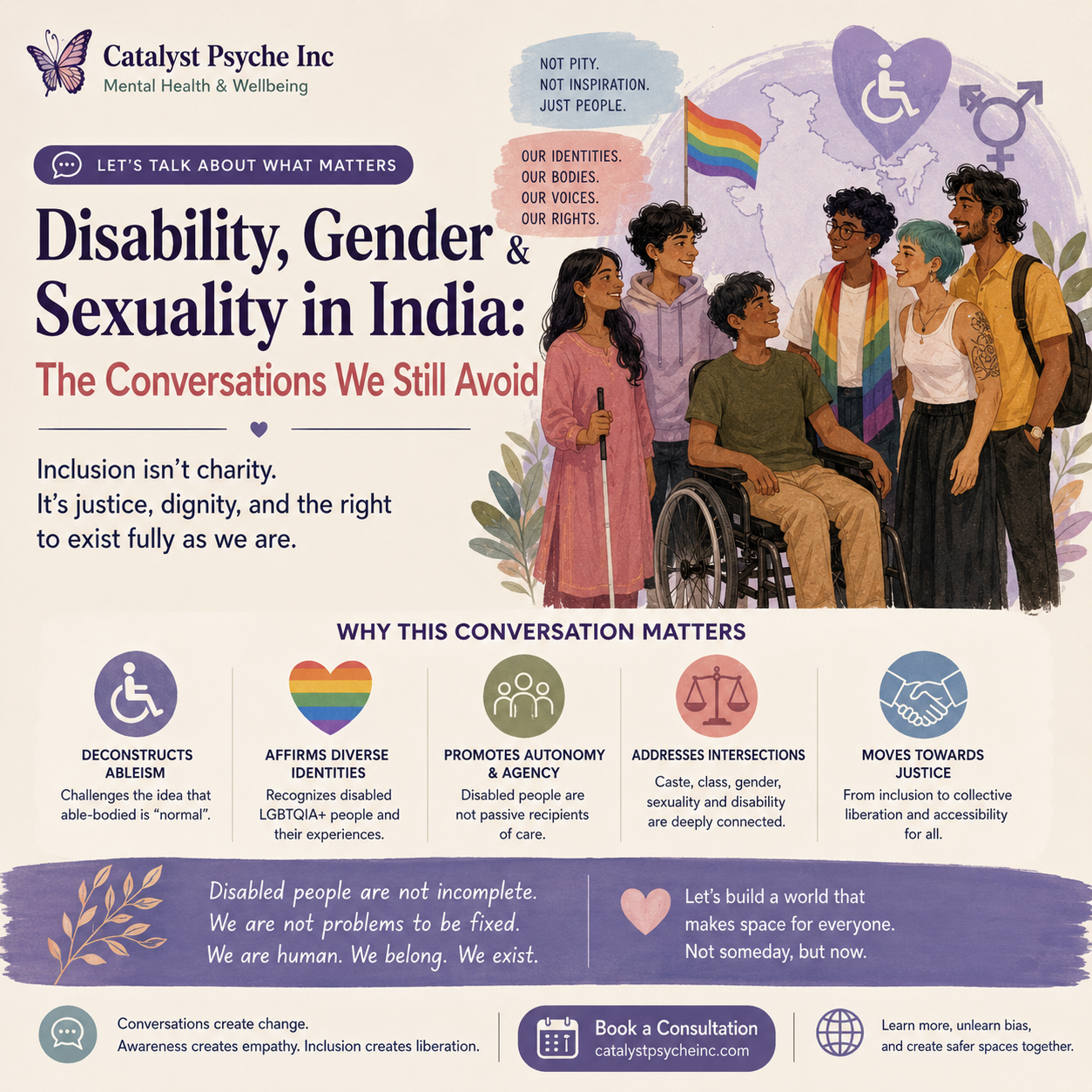
Disability, Gender & Sexuality in India: The Conversations We Still Avoid
By Catalyst Psyche Inc | Mental Health & Wellbeing
Why disability, gender, sexuality, and mental health cannot be understood separately in India — and why these conversations matter now more than ever.
In India, conversations around mental health have become more visible over the past decade.
People speak more openly about therapy now. Anxiety, burnout, trauma, and depression have slowly entered public conversations. Discussions around gender and sexuality have also become more visible after the decriminalization of Section 377.
But when disability enters the conversation, the silence often returns.
We rarely talk about disabled LGBTQIA+ individuals. We rarely recognise disabled people as relational beings. And we rarely examine how Indian social systems — including healthcare, education, family structures, religion, and even psychotherapy — continue to marginalize them.
“This silence is not accidental. It is structural.”
Disability in India: Beyond the Medical Model
For a long time, disability in India has largely been understood through a medical or charity lens. Disabled individuals are often viewed as:
– people to be “fixed”
– dependent on care
– inspirational for surviving
– or objects of sympathy
Rarely are they seen as individuals with full:
– agency
– identity
– desire
– autonomy
– sexuality
– emotional complexity
This is where disability scholar Michael Oliver’s social model of disability becomes important. Oliver argued that disability is not created only by physical or cognitive impairments, but also by inaccessible environments and oppressive social systems. This model recognized the role society plays through attitudinal, environment and structural barriers which instils the disability limitation in the person rather than their impairments. This highlights the need for a paradigm shift in focus to shift from fixing individuals to recognize them as human beings.
In India, this becomes visible in deeply ordinary ways. It looks like:
– inaccessible public spaces
– limited inclusive education
– employment discrimination
– marriage stigma
– overprotective family systems
– lack of disability-inclusive healthcare
– and the near absence of disabled voices in conversations around sexuality and relationships
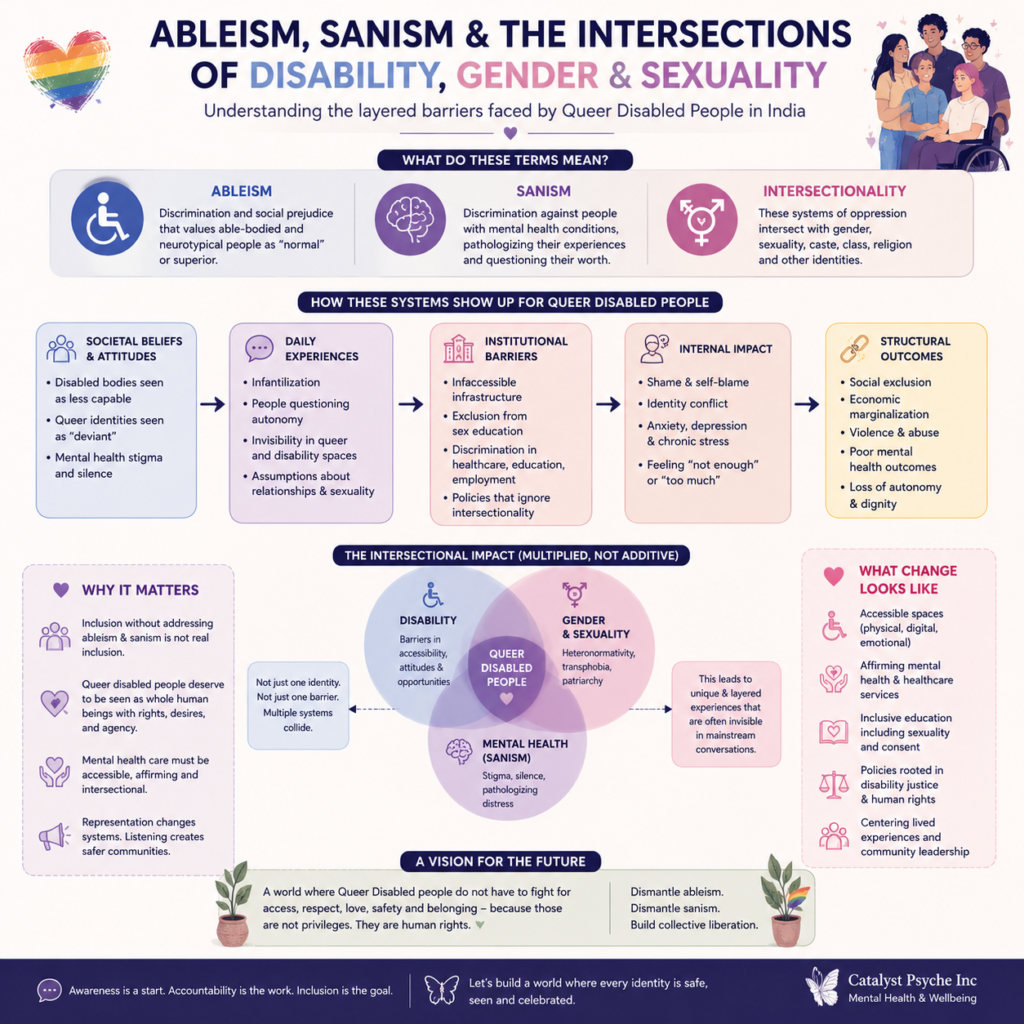
For queer and trans disabled individuals, these realities become even more layered. Because now disability intersects with:
– heteronormativity
– transphobia
– caste
– class
– religion
– geography
– and economic inequality
Research initiatives in India are increasingly recognising these intersections and exploring this through collective efforts.
Disability, Gender & Sexuality in India: When “Care” Slowly Becomes Control
One of the most normalised yet rarely discussed experiences among disabled individuals in India is “infantilization“. Many disabled adults are treated as though they are incapable of making independent decisions regarding:
- relationships
- sexuality
- gender identity
- marriage
- career choices
- financial independence
- healthcare decisions
Families may genuinely believe they are protecting their loved ones. And often, the intention does come from care. But over time, care without autonomy can quietly become control.
A disabled adult may constantly hear:
“You won’t be able to manage.”
“People will take advantage of you.”
“Who will marry you?”
And slowly, the person’s identity becomes shaped more by limitation than possibility.
Research by Björnsdóttir et al. (2017) highlights how disabled individuals constantly negotiate autonomy, sexuality, and identity within systems that undermine their agency.
In collectivistic family structures like those common in India, this negotiation can become even more emotionally complex.
Because saying:
“I want independence”
may also feel like saying:
“I am rejecting my family.”
Disability, Gender and Sexuality: The Conversation India Still Avoids
Indian society is already deeply uncomfortable discussing sexuality openly. When disability and sexuality intersect, that discomfort often becomes invisibility.
Disabled individuals are frequently:
- desexualized
- excluded from sex education
- denied privacy
- treated as incapable of intimacy
- viewed as “unfit” for relationships or marriage
- societal perspective barrier to employment and education
Research in disability and sexuality studies shows that this desexualization contributes significantly to shame, isolation, and vulnerability to abuse. And in India, where discussions around consent, pleasure, queer identities, and reproductive rights are already heavily stigmatized, disabled individuals often find themselves excluded from these conversations entirely.
The silence becomes even more painful for disabled LGBTQIA+ individuals. Because many experience erasure in multiple spaces at once…Sometimes they feel invisible in mainstream society, sometimes excluded within disability spaces.
Disability, Gender and Sexuality: Ableism, Sanism and Mental Health Practice in India
As mental health professionals, we also need to ask difficult questions about our own field.
How much disability-affirmative training do psychology students in India actually receive? How often are disability and sexuality discussed together in therapy training?
How accessible are therapy spaces:
– physically
– financially
– linguistically
– culturally?
And how many disabled therapists are represented within mental health institutions themselves?
The concepts of ableism and sanism become especially important here.
Ableism refers to an ubiquitous ideology according to which cis-white-abled bodyminds are the norm. In Indian context, this might imply upper-caste, patriachal values kind of decide the norms. This means that anyone who doesnt fall within this norm is seen as somehow “lacking” or “less than” those bodyminds that fit within the norm. Ableism can manifest in a range of ways and it can be implicit or explicit.
Sanism is a widespread invisible ideology that views bodyminds without any mental health issues as normative. This implies that people with menta health issues are seen “lacking” and experience discrimination against individuals who do not have these issues.. These biases do not always appear aggressively.
Sometimes they appear subtly through:
– pathologizing identities
– questioning autonomy
– assuming dependence
– infantilizing clients
– ignoring accessibility needs
– overmedicalizing emotional distress
The field of psychology in India still requires deeper engagement with:
– disability justice
– intersectionality
– accessibility
– and queer-affirmative care
Why Disability Justice Matters in India
Disability Justice, developed by queer disabled activists of color, asks us to move beyond token inclusion. It asks deeper questions about:
– dignity
– sustainability
– interdependence
– collective access
– and structural inequality
Its principles include:
- intersectionality
- collective liberation
- interdependence
- sustainability
- collective access
This framework becomes especially important in India because disability rarely exists separately from caste, class, gender, religion, sexuality, or geography.
Accessibility is not only about ramps and elevators. It is also about:
– representation
– language
– education
– healthcare
– financial access
– emotional safety
– and the right to exist without constantly justifying your humanity
Encouragingly, India is slowly witnessing more conversations around these intersections through LGBTQIA+ collectives, disability activism, community organisations, and inclusive research initiatives.
But there is still a long way to go.
Disability, Gender and Sexuality : Beyond Sympathy Toward Dignity
Disabled people are not incomplete humans waiting to be fixed. They are full human beings with:
– emotional lives
– intellectual lives
– creative lives
– relational lives
– sexual lives
– and deeply personal identities
Perhaps the question is no longer:
“How do we help disabled people fit into society?”
But rather:
“How do we build a society where disabled people do not have to constantly fight for dignity, accessibility, autonomy, and humanity?”
Because inclusion without dignity is not inclusion at all.
You Don’t Have to Navigate These Conversations Alone
At Catalyst Psyche Inc, we believe mental health care must be trauma-informed, queer-affirmative, disability-sensitive, and culturally aware.
We recognise that identities do not exist separately from systems, family structures, social stigma, and lived realities.
If you are navigating questions around disability, identity, relationships, sexuality, or emotional well-being, support can help create safer spaces for exploration and healing.
You can also read – Coming Out in India: Understanding the 6 Stages of Queer Identity, Mental Health: A Universal Right
[bookly-form category_id=”1″ service_id=”14″ staff_member_id=”1″]