Relationship Repair: How Apology, Love, Connection and Changed Behaviour Help Couples Heal After Conflict “I said sorry. What else do you want me to do?” It is a sentence many couples hear after an argument. Sometimes, the person genuinely wants to repair the relationship. Yet the apology does not seem to work. The hurt partner …

Relationship Repair: How Apology, Love, Connection and Changed Behaviour Help Couples Heal After Conflict
“I said sorry. What else do you want me to do?”
It is a sentence many couples hear after an argument. Sometimes, the person genuinely wants to repair the relationship. Yet the apology does not seem to work. The hurt partner may respond, “You don’t understand why I am hurt,” or “You are saying sorry, but nothing is going to change.”
This raises an important question: What actually repairs a relationship after it has been hurt?
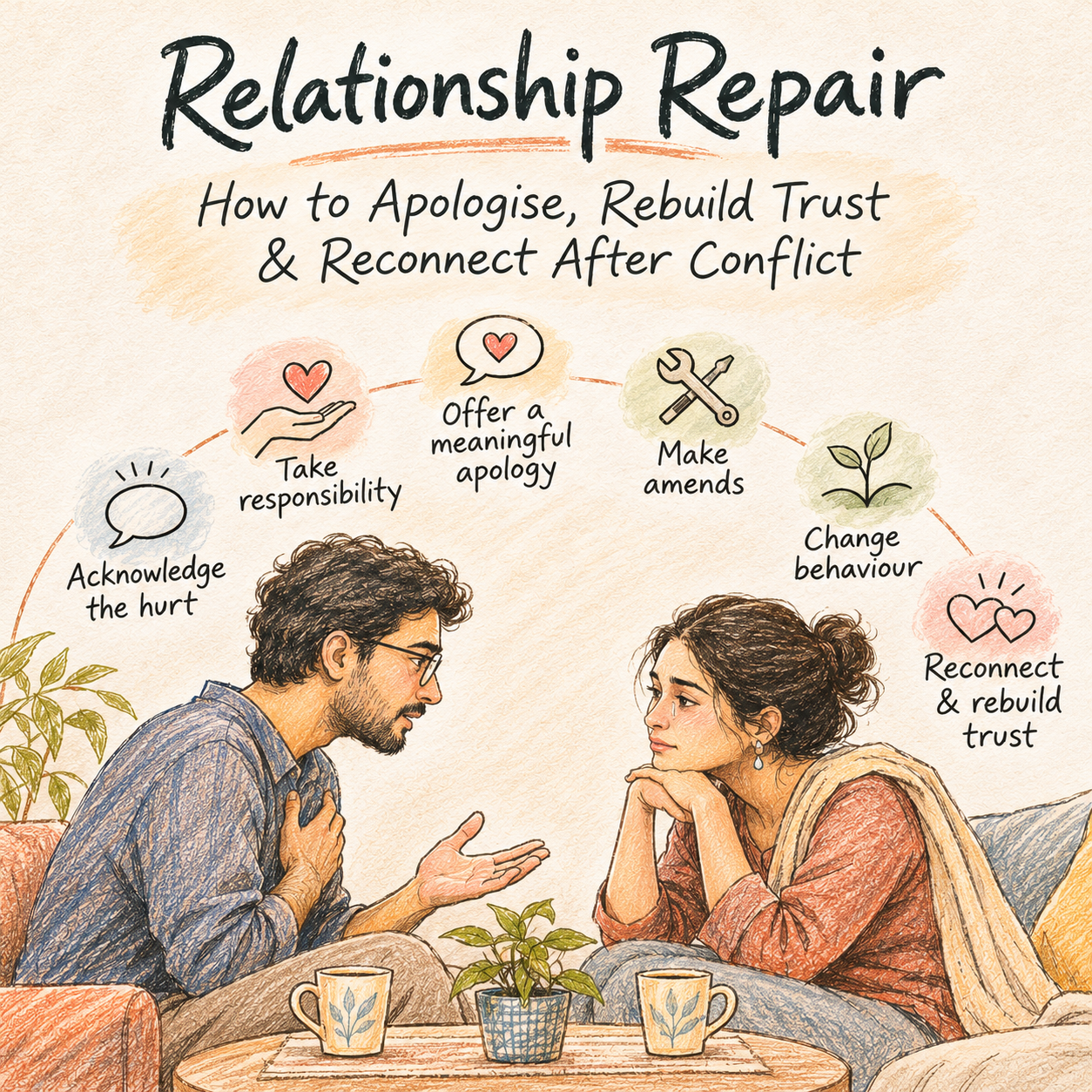
Research on romantic relationships suggests that repair is not a single conversation or a magic phrase. It is a process involving acknowledgement of the hurt, responsibility, emotional understanding, corrective action, rebuilding trust, and eventually reconnecting with one another.
Apology is an important part of this process—but it is only one part.
For couples, especially after repeated arguments, betrayal, emotional neglect or moments of abandonment, the goal is not simply to end the conflict. The deeper goal is to restore the sense that:
“You matter to me. I understand what happened. I understand how it affected you. I take responsibility for my part. I am willing to do something differently. And I want us to feel connected again.”
What is relationship repair?
Relationship repair refers to the processes through which partners attempt to restore connection, trust, emotional safety and cooperation after conflict, disappointment or relational injury.
Repair can happen after something relatively small:
- snapping at your partner
- forgetting something important
- being dismissive
- cancelling plans
- speaking harshly
- failing to listen
It can also become much more important after significant injuries such as:
- abandonment during a crisis
- lying
- infidelity
- financial betrayal
- humiliation
- violations of important boundaries
- repeated emotional neglect
Research on relationship maintenance suggests that keeping a relationship healthy is not simply about avoiding conflict. Couples continually engage in behaviours that maintain connection, intimacy, commitment and satisfaction. A large review of relationship-maintenance research found that behaviours such as positivity, openness, assurances and sharing responsibilities are associated with important relationship outcomes including satisfaction, commitment and love (Ogolsky et al., 2017).
In other words:
Healthy relationships are not maintained because couples never hurt each other. They are maintained because partners develop ways of responding when hurt happens.
Why “I’m sorry” is sometimes not enough
Imagine this conversation:
A: “I’m sorry I shouted at you.”
B: “You always shout at me.”
A: “But I said sorry!”
The problem is that the apology may have addressed the speaker’s discomfort rather than the injured partner’s experience. An apology can become an attempt to close the conversation rather than an attempt to repair the relationship.
Research on apologies suggests that effective apologies involve more than an expression of regret. Lewicki, Polin and Lount (2016), for example, identified six components that can make apologies more effective:
- Expression of regret
- Explanation of what happened
- Acknowledgement of responsibility
- Commitment not to repeat the behaviour
- Offer of repair
- Request for forgiveness
Their experimental studies found that apologies containing more of these components were generally perceived as more effective, although some components were more influential than others. Earlier work by Schneider (2000) described a genuine apology in terms of three broader elements: acknowledgement, affect and vulnerability. In other words, the person apologising needs to recognise the injury, show that they are emotionally affected by what happened, and be willing to apologise without immediately defending themselves.
This gives us an important distinction:
An apology is not simply saying “I am sorry.”!
An apology communicates: “I understand what I did, I understand that it hurt you, I accept my responsibility, and I am willing to participate in repairing the damage.”
The anatomy of a meaningful apology
A useful apology can be thought of as having several layers.
- Name what you did: Avoid vague statements such as: “I’m sorry for whatever happened.” Instead: “I’m sorry that I raised my voice and called you selfish.” Specificity matters because it demonstrates that you understand what behaviour is actually being discussed.
Research on apology structure has consistently emphasised acknowledgement of the specific violation rather than a vague expression of regret (Lewicki et al., 2016; Schneider, 2000).
- Acknowledge the impact: The next question is: “What did my behaviour do to my partner?” For example: “I can see that when I dismissed your concerns and walked away, you felt like your feelings did not matter to me.” This is different from agreeing with every interpretation your partner has. You can disagree about the intention while acknowledging the impact. “I didn’t intend to make you feel unimportant. But I can understand that my behaviour made you feel that way.” That distinction is particularly important in couples work.
Intent explains behaviour. It does not erase impact.
- Take responsibility without adding a “but”: One of the fastest ways to weaken an apology is: “I’m sorry, but you also…” or “I’m sorry you felt hurt.” The first shifts responsibility back to the other person. The second can make the apology sound as though the problem is their emotional reaction rather than your behaviour. Compare:
Defensive:
“I’m sorry I shouted, but you kept provoking me.”
Accountable:
“I was angry, but shouting at you was my responsibility. I could have handled my anger differently.”
Taking responsibility does not mean accepting blame for everything that happened in the relationship.
It means being able to say: “This part is mine.”
- Explain without excusing: An explanation can be useful. An excuse is different. For example: “I had a terrible day at work and was already overwhelmed.” This may help your partner understand the context. But: “I had a terrible day, so you should understand why I shouted.” turns explanation into justification.
Research on apologies suggests that explanations can contribute to effective repair, but responsibility remains central.
A useful structure is: Context without escape from responsibility. “I was overwhelmed, which explains why I was already on edge. It doesn’t justify speaking to you that way.”
- Show remorse: A meaningful apology also communicates: “I care that I hurt you.” This is the emotional component of an apology. For example: “It genuinely bothers me that I made you feel alone when you were already struggling.” This matters because an apology is relational. The injured partner is not only asking: “Do you know what you did?” They may also be asking: “Does my pain matter to you?”
Research has found that apologies can promote forgiveness partly because they communicate information about the value placed on the relationship. Experimental research by Forster and colleagues found evidence that apologies can increase forgiveness by communicating relationship value.
So sometimes what the hurt partner needs to hear is not simply: “I was wrong.” but: “You matter to me, and I don’t want my behaviour to damage what we have.”
- Offer repair: This is where an apology becomes behavioural. Ask: “What can I do to make this better?” The answer will depend on the injury. If you forgot an important commitment: “I’ll put it in my calendar and make sure I don’t repeat this.”If you embarrassed your partner in front of family: “I will acknowledge what happened and apologise to you without expecting you to simply move on.” If trust was damaged: “I understand that trust may take time to rebuild. I’m willing to demonstrate consistency rather than asking you to trust me immediately.”
This is particularly important because repair is not only verbal.
Schneider’s work on apology emphasises the reparative opportunity created when a person acknowledges injury, while later research on trust repair has similarly highlighted the importance of corrective action.
- Commit to changed behaviour: Perhaps the most important question after an apology is: “What will be different next time?” An apology without behavioural change can eventually lose credibility. If the same injury happens repeatedly, the partner may stop hearing: “I’m sorry.” and start hearing: “This is going to happen again.” This is why relationship repair is better understood as a process of rebuilding evidence. You do not rebuild trust by repeatedly asking: “Why don’t you trust me?” You rebuild it by behaving in ways that gradually make trust reasonable again.
Research on trust repair supports this distinction: verbal apologies can help, but their effectiveness is influenced by factors such as sincerity, personal responsibility, the nature of the violation and whether the violation is an isolated event or part of a pattern.
Love is not the opposite of conflict Many couples worry when they discover that they argue frequently. But conflict itself is not necessarily evidence that love is absent.
The more useful question is:
What happens after the conflict?
Do partners become curious about each other’s experience?
Can they acknowledge harm?
Can they soften?
Can they apologise?
Can they accept an apology?
Can they return to affection?
Can they learn something from the disagreement?
Research on newlywed couples has examined repair attempts during marital conflict, defining successful repair partly in terms of reducing negative affect or increasing positive affect during the interaction.
More recent research similarly suggests that what couples do around and after conflict matters. A 2024 study of 217 cohabiting couples found that attentive listening during everyday conflict predicted greater helpfulness of subsequent reconciliation efforts.
So love is not simply: “We don’t fight.”
It can also look like:
“Even when we are angry, I am still trying to stay connected to you.”
Connection: “Do you understand me?”
One of the most important ideas in relationship research is perceived partner responsiveness.
In simple language, this refers to the experience of feeling that your partner:
- understands you,
- validates what matters to you, and
- cares about your wellbeing.
Research considers perceived responsiveness a fundamental part of intimacy in romantic relationships. This helps explain why two partners can have the same disagreement repeatedly. The surface issue may be: “You didn’t call me.” But the deeper issue may be: “I don’t feel important to you.” Or: “I feel like I have to manage everything alone.” Or: “When I need you, I don’t know whether you’ll be there.”
This is especially relevant to attachment injuries.
Johnson, Makinen and Millikin (2001) described –
an attachment injury as an event in which one partner violates the other’s expectation of comfort, care or dependability during a critical moment of need. Such events can become recurring reference points for future conflict because the injured partner continues to use the event as evidence about whether the partner is dependable.
This is why a couple may continue fighting about something that happened years ago. They may not actually be fighting about the past. They may be asking: “Can I trust you now?”
Sometimes the real repair is emotional, not practical!
Consider a couple who experienced a difficult pregnancy. One partner says: “You weren’t there for me when I needed you.” The other responds: “But I took you to every appointment.” The second partner is talking about tasks. The first partner is talking about emotional presence. Both may be factually correct.
But repair requires understanding the emotional meaning of the event. A deeper response might be: “I can see that even though I was physically present, you felt emotionally alone. I wish I had understood that at the time.” This distinction between doing something and being emotionally available is central to relationship repair.
Research on attachment injuries and Emotionally Focused Therapy suggests that resolution involves deeper emotional engagement and affiliative responses, rather than merely solving the surface disagreement. In one study, couples whose attachment injuries were resolved in EFT showed improvements in relationship satisfaction and forgiveness compared with couples whose injuries were not resolved.
Forgiveness is not the same as forgetting
Another common misunderstanding is: “If you really love me, you should forgive me.” Forgiveness cannot be demanded. It is a process. And forgiveness does not necessarily mean:
- pretending the event did not happen,
- trusting immediately,
- allowing the behaviour to continue,
- abandoning boundaries,
- refusing to discuss the injury,
- or staying in a harmful relationship.
Research on forgiveness in close relationships suggests that post-transgression trust plays an important role in whether forgiveness develops. A person may therefore say: “I want to forgive you, but I need time to trust you again.” That is not necessarily rejection. It may be part of repair.
The Indian context: repair is rarely only between two people
Relationship repair in India can have another layer. Marriage may involve:
- parents and in-laws,
- financial responsibilities,
- childcare,
- expectations around gender roles,
- family reputation,
- living arrangements,
- religious or cultural expectations,
- and decisions about whose needs take priority.
Research specifically examining Indian couples has found that relationship quality cannot always be understood through the couple alone. Family structures, social expectations and broader cultural contexts can shape communication, conflict and intimacy.
Research with urban Indian couples has also found that happy couples reported greater agreement, empathy, validation, support and fulfilment of expectations, while conflict was negatively associated with marital happiness.
Similarly, research on stable middle-class Indian marriages has found that common sources of conflict include everyday problems, finances, children and in-laws. Couples also described approaches involving problem-solving, prioritising the partner and maintaining harmony in the relationship.
This means that relationship repair in an Indian context may sometimes require asking: “What are we repairing between us?”
but also: “What external pressure is repeatedly putting us against each other?”
For example, a couple may repeatedly fight about household work when the deeper issue is unequal expectations about gender roles.
Or they may fight about visiting parents when the deeper issue is: “Do you prioritise our relationship when your family has a different expectation?”
In such situations, better communication alone may not solve the problem. The couple may need boundaries, negotiation, redistribution of responsibilities and a shared position.
Love after conflict: reconnecting matters
Repair should not end with: “Okay, problem solved.” Human beings need connection as well as resolution. After a difficult conversation, couples may need to return to:
- affection,
- humour,
- physical closeness,
- shared activities,
- appreciation,
- reassurance,
- sexual intimacy,
- or simply spending relaxed time together.
Research on relationship maintenance consistently shows that relationships are sustained through ongoing behaviours that communicate positivity, openness, reassurance, shared responsibility and connection. This is why a relationship cannot survive only on conflict management.
A couple also needs moments of: “I like being with you.” “I appreciate you.” “I am proud of us.” “Let’s do something together.” “Come, sit with me.”
Repair closes the wound. Connection helps the relationship become more than the wound.
A simple framework for relationship repair
A practical way of remembering the process is:
- STOP
Before trying to repair, regulate yourself. If both partners are highly activated, the first task may be to pause. “I don’t want to say something hurtful. Can we take 30 minutes and come back to this?” A pause should be a return agreement, not abandonment.
- ACKNOWLEDGE
Name what happened. “I interrupted you repeatedly.” “I dismissed what you were saying.”“I broke the agreement we had made.”
- UNDERSTAND
Ask: “What was that like for you?” And listen without immediately correcting the story. The goal is not necessarily to agree with every interpretation. The goal is to understand the experience.
- TAKE RESPONSIBILITY
Ask yourself: “What part of this is mine?” Then say it clearly. “I was wrong to speak to you that way.” No “but.” No counterattack. No immediate demand that the other person acknowledge their part.
- APOLOGISE
A meaningful apology can include: What I did + what it caused + my responsibility + my regret.
For example: “I’m sorry that I dismissed your concerns and walked away. I understand that it made you feel alone and unimportant. I was responsible for how I handled that conversation, and I regret hurting you.”
- REPAIR
Ask: “What would help repair this?” Sometimes the answer is practical. Sometimes emotional.Sometimes both.
- CHANGE
Decide what will be different. “Next time we disagree, I’ll tell you I need 20 minutes rather than walking away without saying anything.” Then actually do it.
- RECONNECT
Once the immediate injury has been addressed, return to the relationship.
Talk.
Sit together.
Have tea.
Take a walk.
Hug—if both people want that.
Do something ordinary together.
The message is:
“The conflict happened. But the relationship is still here.”
That is much more than the words “I’m sorry.”
A simple relationship-repair checklist
After a conflict, ask yourself:
Did I…
☐ Name what I did?
☐ Acknowledge its impact?
☐ Take responsibility for my part?
☐ Listen to my partner’s experience?
☐ Avoid defending myself immediately?
☐ Express genuine regret?
☐ Ask what would help repair the situation?
☐ Identify what I will do differently?
☐ Follow through on that change?
☐ Reconnect with my partner afterwards?
If the answer to several of these is “no,” the conflict may have ended —but the relationship may not yet have been repaired.
Final thought
An apology can open the door to repair.
Accountability makes the door trustworthy.
Empathy helps the other person feel seen.
Changed behaviour rebuilds trust.
And love and connection help the relationship become safe again.
A healthy relationship is not one where nobody ever causes hurt. It is one where both people are willing to notice the hurt, take responsibility for their part, make amends, learn from it—and find their way back to each other.
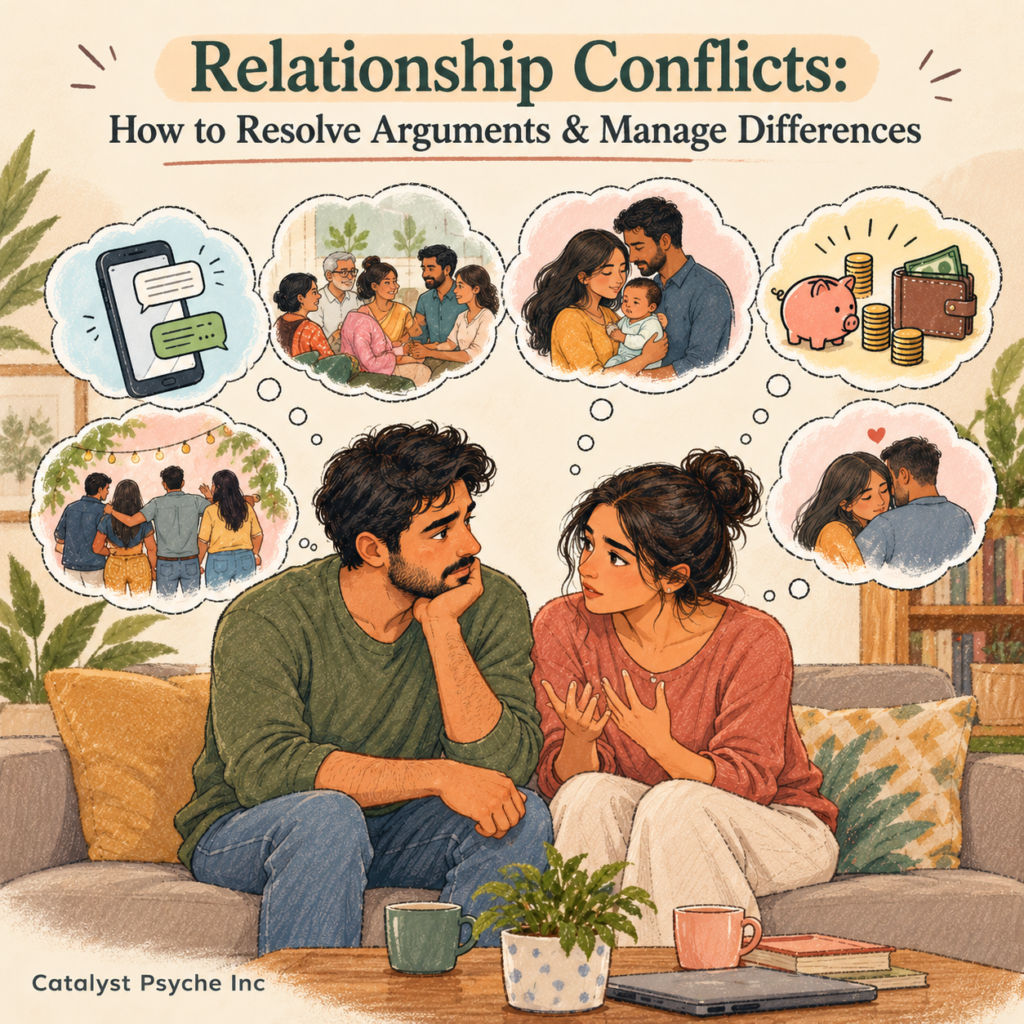
READ MORE – Gottman’s Four Horsemen: Criticism, Contempt, Defensiveness & Stonewalling & An IFS Perspective on Relationship Conflict; Relationship Conflicts: How to Resolve Arguments & Manage Differences
References
Bippus, A. M., & Young, S. L. (2020). How to say “I’m sorry:” Ideal apology elements for common interpersonal transgressions. Western Journal of Communication, 84(1), 43–57. https://doi.org/10.1080/10570314.2019.1610787.
Crasta, D., Rogge, R. D., Maniaci, M. R., & Reis, H. T. (2021). Toward an optimized measure of perceived partner responsiveness: Development and validation of the perceived responsiveness and insensitivity scale. Psychological Assessment, 33(4), 338–355. https://doi.org/10.1037/pas0000986.
Forster, D. E., Billingsley, J., Burnette, J. L., Lieberman, D., Ohtsubo, Y., & McCullough, M. E. (2021). Experimental evidence that apologies promote forgiveness by communicating relationship value. Scientific Reports, 11, 13107. https://doi.org/10.1038/s41598-021-92373-y.
Gottman, J. M., Driver, J., & Tabares, A. (2015). Repair during marital conflict in newlyweds: How couples move from attack–defend to collaboration. Journal of Family Psychotherapy, 26(2), 85–108. https://doi.org/10.1080/08975353.2015.1038962.
Johnson, S. M., Makinen, J. A., & Millikin, J. W. (2001). Attachment injuries in couple relationships: A new perspective on impasses in couples therapy. Journal of Marital and Family Therapy, 27(2), 145–155. https://doi.org/10.1111/j.1752-0606.2001.tb01152.x.
Lewicki, R. J., Polin, B., & Lount, R. B., Jr. (2016). An exploration of the structure of effective apologies. Negotiation and Conflict Management Research, 9(2), 177–196. https://doi.org/10.1111/ncmr.12073.
Lewis, J. T., Parra, G. R., & Cohen, R. (2015). Apologies in close relationships: A review of theory and research. Journal of Family Theory & Review, 7(1), 47–61. https://doi.org/10.1111/jftr.12060.
Makinen, J. A., & Johnson, S. M. (2006). Resolving attachment injuries in couples using emotionally focused therapy: Steps toward forgiveness and reconciliation. Journal of Consulting and Clinical Psychology, 74(6), 1055–1064. https://doi.org/10.1037/0022-006X.74.6.1055.
Mendiratta, A., Singh, P., & Kumar, N. (2026). Relationship quality among married Indian couples: A narrative review. Annals of Neurosciences. https://doi.org/10.1177/09727531261491529.
Ogolsky, B. G., Monk, J. K., Rice, T. M., Theisen, J. C., & Maniotes, C. R. (2017). Relationship maintenance: A review of research on romantic relationships. Journal of Family Theory & Review, 9(3), 275–306. https://doi.org/10.1111/jftr.12205.
Ogolsky, B. G., & Bowers, J. R. (2013). A meta-analytic review of relationship maintenance and its correlates. Journal of Social and Personal Relationships, 30(3), 343–367. https://doi.org/10.1177/0265407512463338.
Sandhya, S. (2009). The social context of marital happiness in urban Indian couples: Interplay of intimacy and conflict. Journal of Marital and Family Therapy, 35(1), 74–96. https://doi.org/10.1111/j.1752-0606.2008.00103.x.
Schneider, C. D. (2000). What it means to be sorry: The power of apology in mediation. Mediation Quarterly, 17(3), 265–280. https://doi.org/10.1002/crq.3900170305.
Slocum, D., & Allan, A. (2011). An emerging theory of apology. Australian Journal of Psychology, 63, 83–92. https://doi.org/10.1111/j.1742-9536.2011.00013.x.
Strelan, P., Krieg, J., & Karremans, J. C. (2017). What determines forgiveness in close relationships? The role of post-transgression trust. British Journal of Social Psychology, 56(1), 161–180. https://doi.org/10.1111/bjso.12173.
Wilder, S., et al. (2024). But I said I’m sorry: Helpfulness of romantic couples’ efforts to reconcile after conflict. Personal Relationships, 31(3), 836–854. https://doi.org/10.1111/pere.12565.
Additional research reviewed
Robinson, J. D. (2006). Managing trouble responsibility and relationships during conversational repair. Communication Monographs, 73(2), 137–161. https://doi.org/10.1080/03637750600581206.
This paper is particularly useful for understanding why repair is not merely about correcting information or ending disagreement—it also manages responsibility and the relationship itself.