
Gottman’s Four Horsemen and Their Antidotes: An IFS Perspective on Relationship Conflict Criticism, contempt, defensiveness, and stonewalling aren’t the real problem. The frightened parts beneath them are. Gottman’s Four Horsemen are four communication patterns — criticism, contempt, defensiveness, and stonewalling — that the psychologist John Gottman found to reliably predict relationship breakdown. Each one has …

Gottman’s Four Horsemen and Their Antidotes: An IFS Perspective on Relationship Conflict
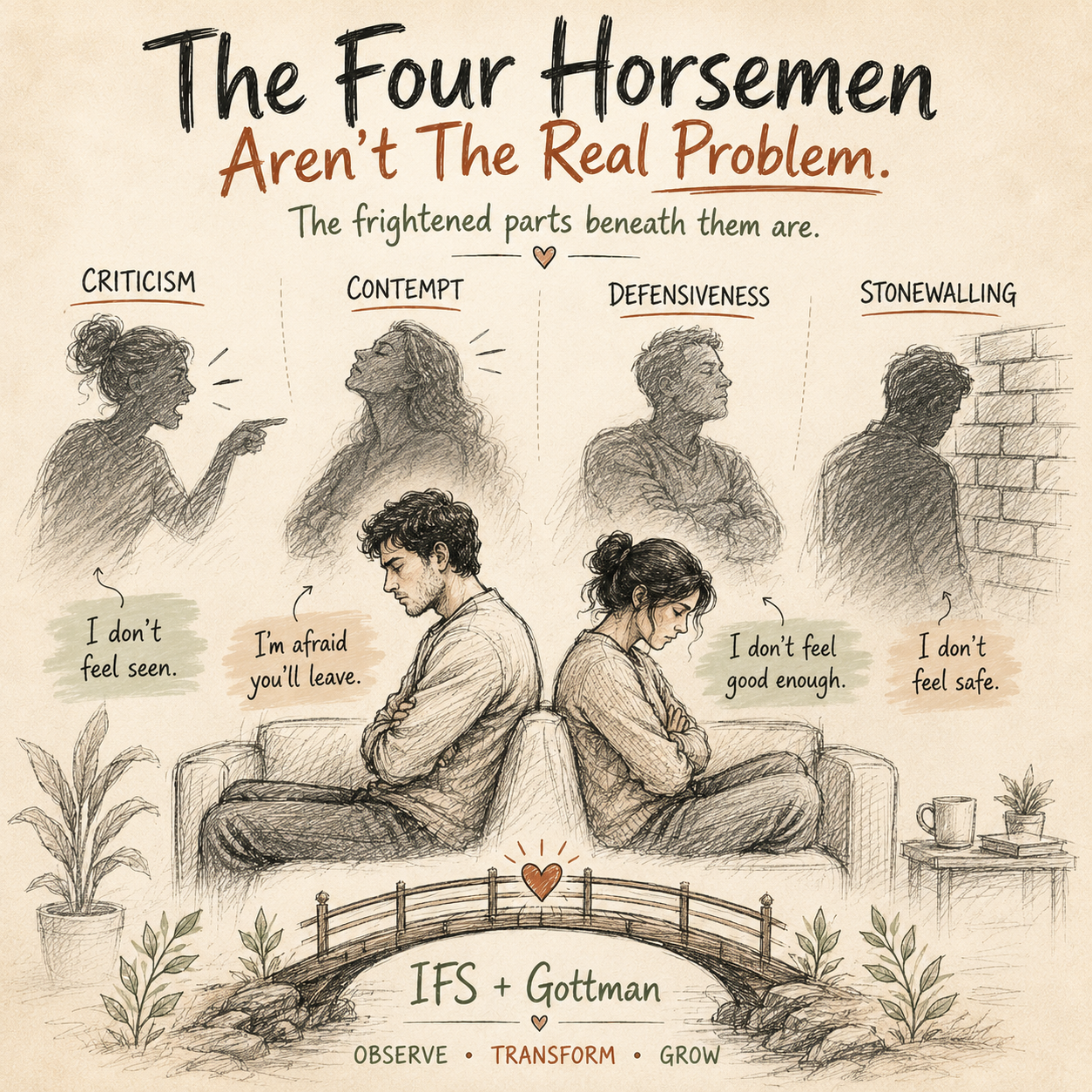
Criticism, contempt, defensiveness, and stonewalling aren’t the real problem. The frightened parts beneath them are.
Gottman’s Four Horsemen are four communication patterns — criticism, contempt, defensiveness, and stonewalling — that the psychologist John Gottman found to reliably predict relationship breakdown. Each one has a research-backed antidote. But knowing the antidotes is rarely enough, and this is where Internal Family Systems (IFS) offers something deeper: a way of understanding the wounded, protective parts of us that ride these horsemen into battle — and how to lead from a calmer place instead.
It usually starts small. “You never think about anyone but yourself.” A sigh. An eye-roll. “Here we go again.” Then silence — the kind that fills a whole house. By bedtime, two people who genuinely love each other are lying back-to-back, each certain they are the wronged one. If you’ve lived this, you already know the choreography. What you may not know is the way out.
Key Takeaways
The Four Horsemen are criticism, contempt, defensiveness, and stonewalling. Their antidotes are the gentle start-up, building appreciation, taking responsibility, and physiological self-soothing.
Contempt is the single strongest predictor of divorce in Gottman’s research, which forecast relationship outcomes with over 90% accuracy.
An IFS lens reframes each horseman as a protective part guarding a vulnerable “exile” — shame, fear of abandonment, or feeling unseen.
You can’t use the antidotes while “blended” with a reactive part. The first move is returning to Self — a calm, grounded centre — from which healthy responses become possible.
Table of Contents
ToggleWhat Are the Gottman’s Four Horsemen of the Apocalypse?
Over decades of observing couples in his “Love Lab,” John Gottman identified four communication patterns so corrosive that their presence predicts relationship breakdown. He named them, with deliberate drama, the Four Horsemen of the Apocalypse. In his observational studies, watching just a short conflict conversation, he and his colleagues could forecast which couples would eventually divorce with well over ninety percent accuracy.
The Gottman Institute also names a specific antidote for each horseman — a healthier behaviour to put in its place. Naming the patterns is the first step. But it leaves one question open, the question most couples actually get stuck on: why is it so hard to use the antidotes, even when we know them by heart?
The Gottman’s Four Horsemen and Their Antidotes
1. Criticism — and the Gentle Start-Up
Criticism is the move from “I have a complaint about something you did” to “there is something wrong with who you are.” A complaint says, “I felt hurt when you didn’t call.” Criticism says, “You’re so selfish, you never think of me.” One points at a behaviour; the other indicts a person. The antidote is the gentle start-up — naming your feeling and your need without the character attack: “I felt anxious when I didn’t hear from you. I’d love a quick message next time.”
2. Contempt — and Building a Culture of Appreciation
Contempt is criticism delivered from a perch of superiority: mockery, sarcasm, name-calling, the eye-roll, the scornful laugh. It tells the other person they are not just wrong but beneath you. Gottman found contempt to be the single strongest predictor of divorce or relationship breakup, and it even correlates with the targeted partner falling ill more often, as though disdain weakens the immune system itself. Its antidote is slow, daily work: building a culture of appreciation, deliberately noticing and naming what your partner does right.
3. Defensiveness — and Taking Responsibility
Defensiveness usually arrives as a reflex to criticism. We feel accused, so we make excuses or flip the blame: “Well, if you hadn’t…” It feels like self-protection, but it reads as “I won’t take you seriously.” The antidote is taking responsibility — even for just your slice of the problem.
4. Stonewalling — and Physiological Self-Soothing
Stonewalling is the shutdown: the wall goes up, the responses stop, the partner turns to the phone or leaves the room. It tends to come later in the cycle, once someone is so physiologically flooded — heart pounding, system overwhelmed — that they can no longer think straight. The antidote is physiological self-soothing: stopping, taking a real break of twenty minutes or more, and letting the nervous system settle before returning.
Why Knowing the Antidotes Isn’t Enough
Anyone who has tried to use this map in a real fight knows the defeating truth: you can recite all four antidotes and still, ten seconds into an argument, do the exact opposite. You know you should offer a gentle start-up. Your mouth, somehow, produces contempt.
Couples often tell their therapist, with real anguish, “I know exactly what I’m supposed to do, and I can’t do it.” They are not weak or insincere. They are trying to run a calm, generous behaviour from inside a flooded, frightened state — and it simply cannot be done. This is exactly the gap that Internal Family Systems helps explain.
The IFS Perspective: The Gottman’s Four Horsemen Are Protective Parts
Internal Family Systems begins with the idea that the mind is not a single voice but an inner family of “parts,” each with its own fears and jobs. Crucially, IFS holds that no part is bad. Even the ones that behave destructively are protectors — trying, in the only way they know, to keep something tender inside us from being hurt. Seen this way, the Four Horsemen stop being evidence that you are a bad partner. They become protective parts leaping in to guard a wound:
- Criticism is often a manager part trying to control an unpredictable situation — or to name the flaw in your partner before anyone names the flaw in you. Beneath it is usually a part that feels unseen and uncared for.
- Contempt climbs onto its high horse precisely because, underneath, a part feels small and not good enough. Superiority is a costume worn over shame.
- Defensiveness is a bodyguard standing in front of a part that cannot bear to be blamed — because long ago, blame may have meant rejection or punishment.
- Stonewalling is the emergency shutdown — what IFS calls a firefighter — slamming the doors when the system floods, protecting an exile who is terrified of conflict.
Underneath all four horsemen sits something vulnerable — what IFS calls an exile: the shame of not being enough, the fear of abandonment, the childhood ache of not having mattered. The horsemen gallop in so that we never have to feel that raw thing directly. In their clumsy way, they are devoted.
What Is “Blending,” and Why Does It Hijack Conflict?
When a part takes you over completely, IFS calls this blending. You don’t experience it as “a part of me is being contemptuous.” You simply are contempt, and from inside that part the eye-roll feels not only justified but true. In that state, “build a culture of appreciation” is not available to you. There is no calm, curious you present to choose it. The part is driving.
This is why willpower alone fails. You cannot offer a gentle start-up while your defensive bodyguard has the wheel. Something has to come first.
How to Return to Self During an Argument
What has to come first is what IFS calls returning to Self — the calm, grounded centre beneath all our parts, marked by qualities like curiosity, compassion, calm, and clarity. When even a sliver of Self comes back online, the reactive part softens and steps back. From that place, the antidote becomes genuinely possible — not forced, but arising naturally.
In practice, that looks like noticing which part has taken over and gently helping it unblend. “I notice a really critical part of me is fired up right now — give me a moment.” “I’m flooded and about to shut down; I need twenty minutes, and I’ll come back.” This is Gottman’s gentle start-up and self-soothing break — but now powered from the inside, by someone speaking for their part rather than from it.
The two models fit together beautifully. Gottman tells you what healthy conflict looks like. IFS tells you how to become the person who can actually do it in the heat of the moment.
The Gottman’s Four Horsemen in Indian Relationships
There’s a cultural layer worth naming, especially in Indian homes. Many of us grew up where criticism was simply how care got expressed (“I’m only saying this for your good”), where contempt flowed down the hierarchies of age and gender as a matter of course, and where stonewalling had an almost ceremonial status — the days-long silence, the ‘maun vrat’ of a wounded spouse or parent, everyone waiting for the storm to pass without a single word of repair. Taking responsibility can feel nearly impossible when admitting fault is bound up with losing face in front of family.
If those were the patterns we absorbed, they are not character flaws. They are inherited protectors, passed down a chain of people each doing their best with what they had. That recognition changes everything: you can stop fighting your own contempt as an enemy and get curious about the frightened part it defends. Most of our worst arguments are two protectors shouting over two scared children who, underneath, want the very same reassurance — Do I matter to you? Am I safe with you?
Frequently Asked Questions
What are Gottman’s Four Horsemen?
The Four Horsemen are four destructive communication patterns identified by John Gottman: criticism (attacking character rather than behaviour), contempt (disrespect and superiority), defensiveness (excuses and counter-blame), and stonewalling (shutting down and withdrawing). Their consistent presence predicts relationship breakdown.
Which Gottman’s four horseman is the biggest predictor of divorce?
Contempt. Gottman’s research identifies contempt — mockery, sarcasm, name-calling, and eye-rolling delivered from a sense of superiority — as the single strongest predictor of divorce. It has also been linked to poorer physical health in the partner on the receiving end.
What are the antidotes to the Gottman’s Four Horsemen?
Each horseman has a research-backed antidote: the gentle start-up replaces criticism, building a culture of appreciation replaces contempt, taking responsibility replaces defensiveness, and physiological self-soothing (taking a calming break) replaces stonewalling.
How does Internal Family Systems (IFS) explain the Gottman’s Four Horsemen?
IFS views each horseman as a protective “part” rather than your true character. Criticism, contempt, defensiveness, and stonewalling are protectors guarding a vulnerable, wounded part (an “exile”) that carries shame, fear of abandonment, or the pain of feeling unseen.
Why can’t I use the antidotes during a fight?
Because you are “blended” with a reactive part — it has taken over your perception and choices. Calm techniques can’t be performed from inside a flooded, frightened state. IFS suggests first returning to Self, a calm and grounded centre, after which the antidotes become naturally accessible.
Can a relationship recover from the Four Horsemen?
Yes. The Gottman’s Four Horsemen appear in most relationships to some degree; what matters is whether they become the dominant pattern. With awareness, the antidotes, and support — often through couples therapy — couples can interrupt the cycle and rebuild connection.
At Catalyst Psyche Inc., we work with individuals and couples to recognise the patterns running their relationships — and to discover that a more Self-led way of loving is a real and available choice. If these patterns feel familiar, reach out to begin. Click: Book a Session
Read More – The Science Behind Building Healthy Relationships (Backed by Psychology) Relationship Counseling : When Love Feels Stuck, Therapy Can HelpBalancing Individuality and Togetherness in a Relationship
References
- Gottman, J. M. (1994). Why Marriages Succeed or Fail: And How You Can Make Yours Last. Simon & Schuster.
- Gottman, J. M., & Silver, N. (1999). The Seven Principles for Making Marriage Work. Crown.
- Gottman, J. M., & Levenson, R. W. (2000). The timing of divorce: Predicting when a couple will divorce over a 14-year period. Journal of Marriage and Family, 62(3), 737–745. https://doi.org/10.1111/j.1741-3737.2000.00737.x
- Lisitsa, E. The Four Horsemen: Criticism, Contempt, Defensiveness, and Stonewalling. The Gottman Institute. https://www.gottman.com/blog/the-four-horsemen-recognizing-criticism-contempt-defensiveness-and-stonewalling/
- The Gottman Institute. The Four Horsemen: The Antidotes. https://www.gottman.com/blog/the-four-horsemen-the-antidotes/
- Schwartz, R. C., & Sweezy, M. (2020). Internal Family Systems Therapy (2nd ed.). Guilford Press.
- Schwartz, R. C. (2021). No Bad Parts: Healing Trauma and Restoring Wholeness with the Internal Family Systems Model. Sounds True.
Note: Gottman’s reported divorce-prediction accuracy varies across studies (roughly 90–94%), depending on the sample and predictors measured.