Have you ever felt like you are always waiting for something bad to happen — even in safe situations? Do you find it hard to trust people, feel numb most of the time, or experience sudden emotional outbursts that you cannot explain? If yes, you may be experiencing something called Complex PTSD (C-PTSD) — and …

Have you ever felt like you are always waiting for something bad to happen — even in safe situations? Do you find it hard to trust people, feel numb most of the time, or experience sudden emotional outbursts that you cannot explain? If yes, you may be experiencing something called Complex PTSD (C-PTSD) — and you are not alone.
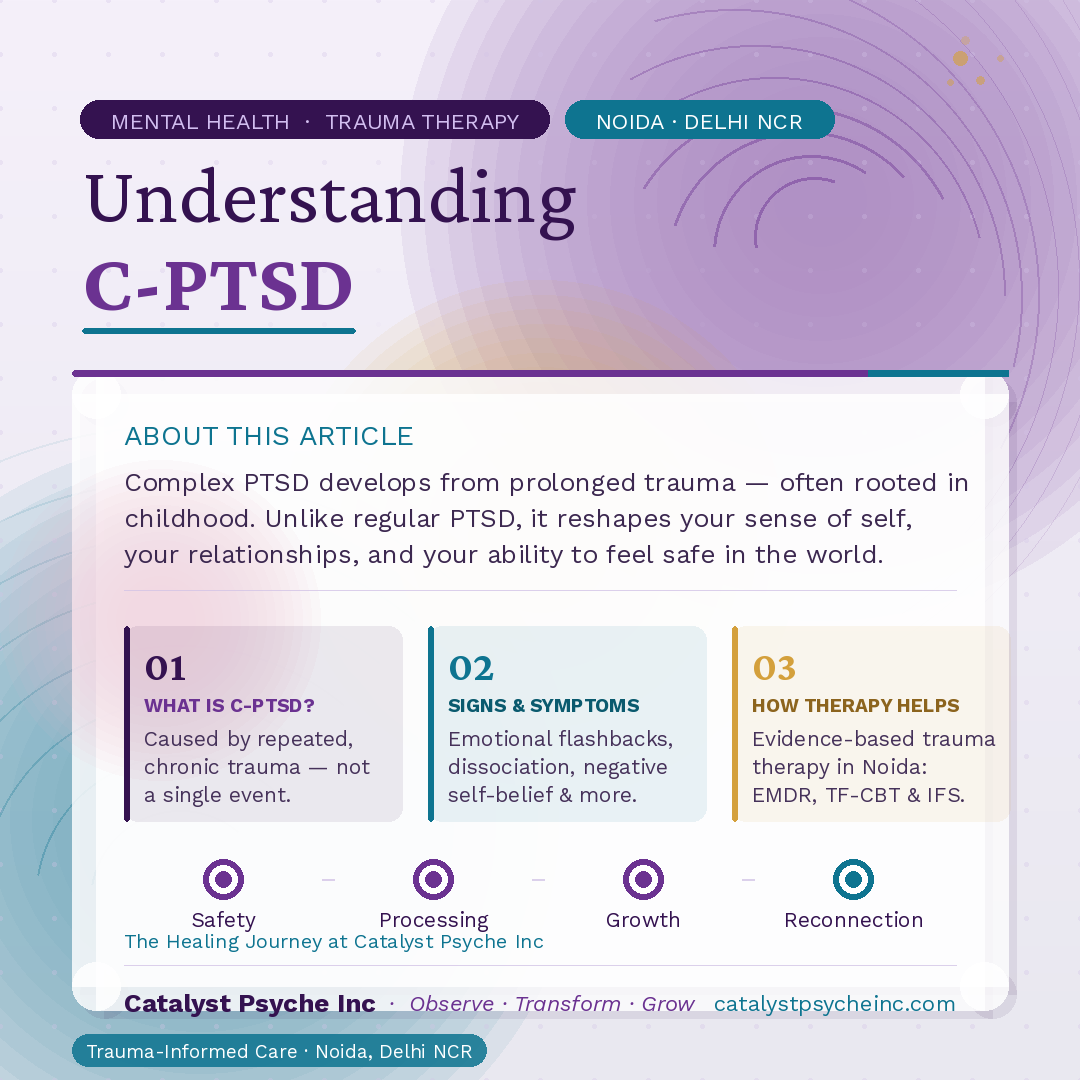
Unlike regular PTSD, which typically follows a single traumatic event, C-PTSD develops after prolonged or repeated trauma — often beginning in childhood. It is more complex, more misunderstood, and unfortunately, very common.
At Catalyst Psyche Inc in Noida, our psychologists specialise in trauma therapy (like IFS , EFT, EMDR) and work with many individuals who have been living with unrecognised C-PTSD for years. This guide will help you understand what C-PTSD is, how it differs from PTSD, and how the right trauma therapy in Noida can help you heal.
Table of Contents
ToggleWhat Is C-PTSD or Complex Trauma? A Simple Explanation
C-PTSD stands for Complex Post-Traumatic Stress Disorder. It is a psychological condition that develops in response to chronic, repeated trauma — especially when the person felt trapped or powerless to escape.
The term was first proposed by psychiatrist Dr. Judith Herman in 1992 to describe trauma survivors whose experiences did not fit the standard PTSD diagnosis. It was officially recognised in the ICD-11 (International Classification of Diseases) in 2018.
| 📌 Key Definition
C-PTSD is a condition that arises from prolonged exposure to traumatic situations — such as childhood abuse, domestic violence, or repeated neglect — where the person had little or no control over what was happening to them. |
C-PTSD vs. PTSD — What Is the Difference?
Many people confuse C-PTSD with regular PTSD. While they share some symptoms, there are important differences:
| PTSD | C-PTSD | |
| Cause | Single traumatic event | Repeated/prolonged trauma |
| Duration | Can develop quickly | Develops over months/years |
| Core symptoms | Flashbacks, nightmares, avoidance | All PTSD symptoms + emotional dysregulation, negative self-perception |
| Self-image | Usually intact | Severely damaged — shame, worthlessness |
| Relationships | Some impact | Deeply affected — difficulty trusting others |
| Treatment | Standard trauma therapy | Longer, more specialised therapy |
What Causes C-PTSD?
C-PTSD is caused by prolonged trauma — especially situations where the person felt they could not escape. Common causes include:
- Childhood physical, emotional, or sexual abuse
- Neglect or emotional unavailability from caregivers
- Growing up in a household with domestic violence or addiction
- Living in a war zone or refugee camp for extended periods
- Prolonged emotional abuse in adult relationships
- Being a victim of human trafficking or cult involvement
| In The Indian Context
In India, C-PTSD often goes undiagnosed because many of its causes — such as strict parenting, emotional suppression, or domestic violence — are normalised. Many adults carry deep trauma without ever recognising it as such. Seeking therapy is a powerful first step. |
7 Signs You May Be Living with C-PTSD
C-PTSD symptoms are wide-ranging and often misunderstood. Here are the most common signs:
1. Emotional Flashbacks
You suddenly feel intense shame, fear, or worthlessness without knowing why — as if you have been transported back to a childhood emotional state, even without a visual memory.
2. Persistent Negative Self-Belief
A deep-seated belief that you are broken, worthless, unlovable, or fundamentally different from other people.
3. Difficulty Trusting Others
Even in safe relationships, you find yourself constantly waiting to be abandoned, betrayed, or hurt.
4. Emotional Dysregulation
Intense mood swings, sudden crying, rage episodes, or feeling completely numb — often triggered by seemingly small events.
5. Dissociation
Feeling disconnected from your own body, mind, or surroundings — like watching your life from outside yourself.
6. Hypervigilance
Constantly scanning for danger, difficulty relaxing, trouble sleeping, or always feeling on edge — even in calm environments.
7. Avoidance of Relationships
Pulling away from people to avoid getting hurt, or on the other extreme, clinging to relationships out of fear of abandonment.
How Trauma Therapy in Noida Can Help
At Catalyst Psyche Inc, Noida, our psychologists use evidence-based trauma therapy approaches tailored to each individual. Here is what the healing process typically looks like:
Phase 1 — Safety and Stabilisation
Before processing trauma, the therapist works with you to build a sense of safety. This includes grounding techniques, emotional regulation tools, and establishing trust within the therapeutic relationship.
Phase 2 — Trauma Processing
Using approaches such as Trauma-Focused EFT (Emotional Freedom Technique), EMDR (Eye Movement Desensitisation and Reprocessing), or somatic therapy, the therapist helps you gently process and integrate traumatic memories so they lose their emotional charge.
Phase 3 — Reconnection and Growth
The final phase focuses on rebuilding a positive sense of self, improving relationships, and developing a hopeful vision for the future. Many clients describe this as feeling like themselves for the first time.
| ✅ What to Expect at Catalyst Psyche Inc
We offer individual trauma therapy, online sessions, and LGBTQ+ affirmative care. All sessions are completely confidential. Our psychologists are trained in C-PTSD and work at your pace — there is no pressure to share more than you are ready to. We use evidence approaches like IFS and EFT for trauma informed care. You can read more about them by clicking on the ‘IFS’ or ‘EFT‘ |
Frequently Asked Questions
| ❓ Can C-PTSD be cured completely?
C-PTSD cannot always be “cured” in the traditional sense, but it can be significantly healed. With the right trauma therapy, most people experience a dramatic reduction in symptoms and go on to live full, meaningful lives. Recovery is real — it just takes time and the right support. |
| ❓ How is C-PTSD treated differently from regular PTSD?
C-PTSD requires a longer, more phased approach. Because the trauma is deeply embedded in a person’s sense of self and relationships, therapy must first build safety and trust before directly processing the trauma. Standard PTSD treatments like short-term CBT are often not enough on their own. |
| ❓ How long does trauma therapy take for C-PTSD?
Trauma therapy for C-PTSD typically takes anywhere from 6 months to 2 years, depending on the severity of the trauma and the individual’s pace. At Catalyst Psyche Inc, we work at your comfort level — there is no fixed timeline. |
| ❓ Is trauma therapy available online in Noida?
Yes. Catalyst Psyche Inc offers both in-person sessions at our Sector 75 clinic in Noida and online therapy sessions. Online therapy for C-PTSD is just as effective as in-person therapy when delivered by a trained trauma-focused psychologist. |
| ❓ How much does trauma therapy cost in Noida?
Session fees at Catalyst Psyche Inc vary by therapist. We offer transparent pricing on our website with no hidden charges. We also offer a free 15-minute initial consultation so you can find the right fit before committing. |
| ❓ Is therapy for trauma confidential in India?
Yes. All therapy sessions at Catalyst Psyche Inc are strictly confidential. Information is only shared in rare circumstances required by law — such as immediate risk to your life or others. Your therapist will explain this fully in the first session. |
You Deserve to Heal — Take the First Step Today
Living with C-PTSD can feel isolating, exhausting, and hopeless — but it does not have to stay that way. Thousands of people have found relief, rebuilt their sense of self, and learned to experience joy and connection again through trauma therapy.
If any of the signs in this article resonated with you, we warmly invite you to reach out to our team at Catalyst Psyche Inc in Noida. Whether you are looking for in-person therapy in Sector 75 or an online session from the comfort of your home, we are here for you.
| Book a Free 15-Minute Consultation
WhatsApp us to book your free initial consultation. No pressure. No judgement. Just a safe conversation with a trained psychologist who understands trauma. |
About the Author
| Written & Reviewed by the Psychologist Team at Catalyst Psyche Inc
Catalyst Psyche Inc is a trauma-informed mental health practice based in Sector 75, Noida (Delhi NCR). Our team of RCI-registered psychologists specialises in anxiety, depression, trauma, C-PTSD, relationship counselling, and LGBTQ+ affirmative therapy. We offer both in-person and online therapy sessions across India. 🌐 catalystpsycheinc.com | 📍 Sector 75, Noida, Uttar Pradesh |