
IFS × Gottman · After the Affair · Part 2
Part 2 of “After the Affair — A Path Through Betrayal,” an IFS × Gottman series.
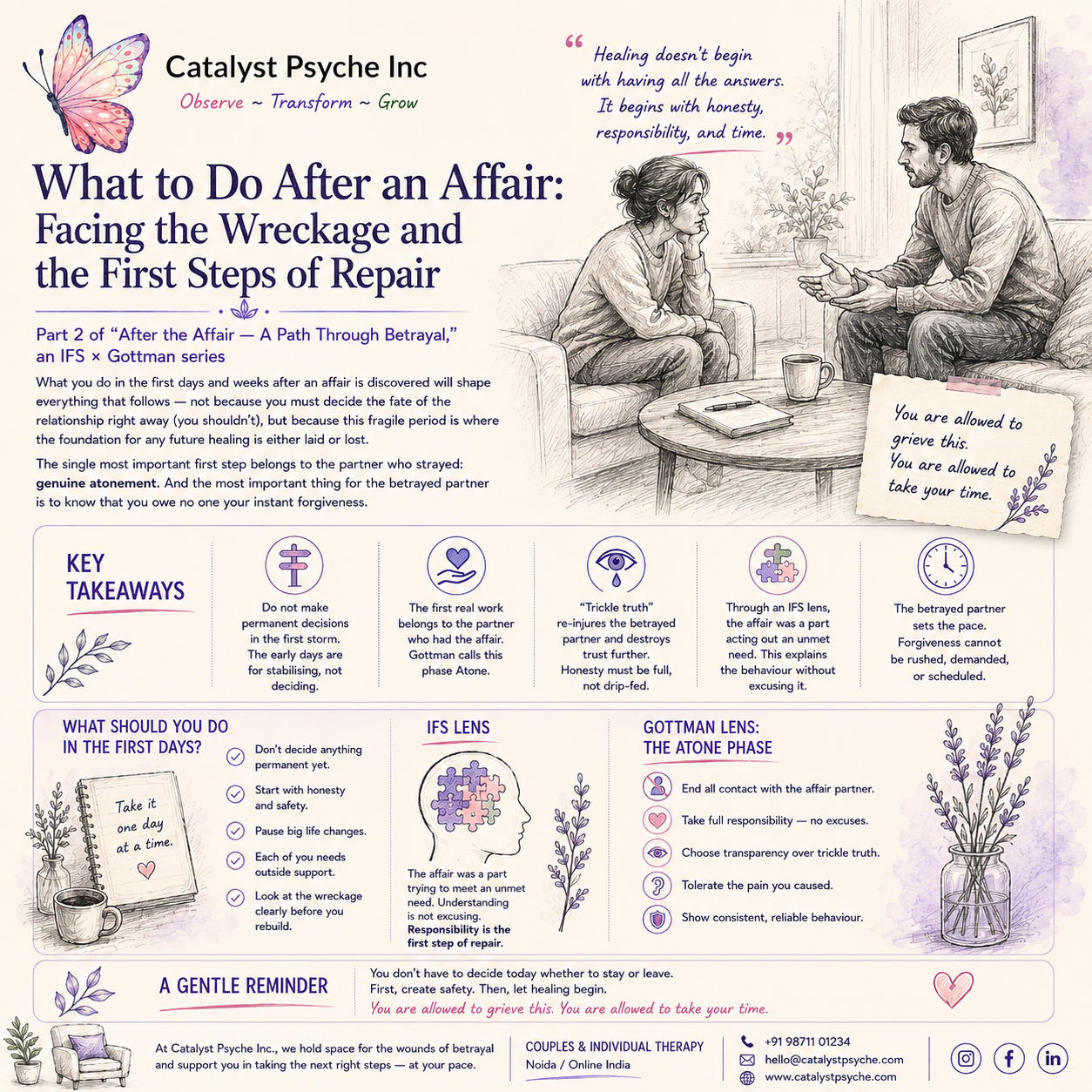
What you do in the first days and weeks after an affair is discovered will shape everything that follows — not because you must decide the fate of the relationship right away (you shouldn’t), but because this fragile period is where the foundation for any future healing is either laid or lost. The single most important first step belongs to the partner who strayed: genuine atonement. And the most important thing for the betrayed partner is to know that you owe no one your instant forgiveness.
If the first post in this series was about grief — the storm that hits the moment you find out — this one is about the question that follows close behind: Now what do we actually do?
Key Takeaways
- Do not make permanent decisions about the relationship in the first storm. The early days are for stabilising, not deciding.
- The first real work belongs to the partner who had the affair. Gottman calls this phase Atone: full responsibility, complete transparency, and ending all contact with the affair partner.
- “Trickle truth” — releasing details slowly — re-injures the betrayed partner and destroys trust further. Honesty must be full, not drip-fed.
- Through an IFS lens, the affair was a part acting out an unmet need. This explains the behaviour without ever excusing it — the person remains fully responsible for the harm and the repair.
- The betrayed partner sets the pace. Forgiveness cannot be rushed, demanded, or scheduled.
What Should You Do in the First Days After an Affair?
In the immediate aftermath, the most useful instruction is also the hardest: don’t decide anything permanent yet. A part of you may be screaming for certainty — leave now or fix this immediately — but decisions made inside acute betrayal trauma are rarely the wisest ones. The first task is simply to get both people through the day with as much honesty and as little further damage as possible.
Practically, that means establishing some basic ground: honesty going forward, a pause on life-altering announcements, and ideally one outside source of support for each person. It does not mean pretending to be fine, and it does not mean papering over what happened for the sake of peace. The wreckage needs to be looked at clearly before anyone can rebuild on it.
The First Task Belongs to the One Who Strayed: Atonement
In John Gottman’s research-based model for recovering from betrayal — the Trust Revival Method — the first of three phases is called Atone. Before a couple can rebuild closeness or rekindle intimacy, the partner who had the affair has to do the unglamorous, humbling work of atonement. There are no shortcuts through this stage, and skipping it is the single most common reason couples fail to heal.
End all contact with the affair partner
Atonement is impossible while a foot is still in the other relationship. Continued contact — even “just friends,” even “just to end it properly,” even at work where it feels unavoidable — keeps the wound open and makes trust impossible to rebuild. Where contact genuinely cannot be eliminated, it must become fully transparent. The betrayed partner cannot heal while a part of the betrayer’s life remains a locked room.
Take full responsibility — without excuses
This is the heart of atonement. The partner who strayed has to own the choice completely, without sliding into “but you were distant,” “but I was unhappy,” or “but it just happened.” Those conversations about the state of the relationship may have a place much later, but in this phase they function as escape hatches from responsibility. Gottman’s research is strikingly clear here: what predicts healing is the unfaithful partner’s willingness to be accountable and transparent, more than any particular explanation.
Choose transparency over “trickle truth”
One of the most damaging patterns in affair recovery is what’s known as trickle truth — releasing the story in small, defensive instalments, admitting only what’s already been discovered. Each new revelation re-traumatises the betrayed partner and resets the clock on trust. As painful as full honesty is, it is far less corrosive than being betrayed a second, third, and fourth time by the slow leak of the truth.
Tolerate the pain you caused
Perhaps the hardest part of atonement is simply staying present for the other person’s anguish without defending, minimising, or rushing them. The betrayed partner will have waves of rage, grief, and obsessive questioning. Atonement means absorbing that — not endlessly, but for as long as it genuinely takes — rather than asking, “How long are you going to keep bringing this up?” That question, more than almost anything, tells a betrayed partner that the repair isn’t real.
An IFS Lens: The Affair Was a Part, Not the Whole of You
This is where Internal Family Systems offers something both compassionate and clarifying — and where it must be handled carefully, because it is easily misused.
IFS holds that there are no bad parts. Even the part of someone that pursued an affair was, at some level, a protector — trying to meet a real need: for aliveness, for feeling desired, for escape from numbness, for a connection that felt missing. Understanding this can help the person who strayed make sense of their own behaviour instead of collapsing into pure self-hatred, which, paradoxically, often gets in the way of genuine repair.
But here is the essential balance, and it cannot be skipped: understanding a part is not the same as excusing the act. The part explains the behaviour; it does not absolve the person. In IFS terms, when that part blended and took over, the person made choices that caused profound harm — and the Self, the grounded and responsible centre, is fully accountable for those choices and for the repair that follows. “A part of me did this” is a doorway to self-understanding, never a defence.
There is a second, practical insight here. Genuine atonement has to come from Self, not from a part. When the betrayer is blended with a shame part, they tend to grovel, collapse, or beg for reassurance — which, exhausting as it is, actually centres their own pain rather than the betrayed partner’s. When they’re blended with a defensive part, they minimise and justify. Real atonement requires the calm, present, responsible quality of Self: steady enough to hear the other’s pain without crumbling, honest enough to stop hiding, and grounded enough not to demand a faster timeline.
For the Betrayed Partner: You Set the Pace
If you are the one who was betrayed, almost everything in this phase is permission rather than instruction.
You are allowed to need information. You are allowed to ask the same question more than once as your mind tries to integrate something it can barely hold. You are allowed to have no idea yet whether you want to stay or go — and to refuse to be rushed toward an answer. Your various parts will pull in different directions, sometimes within the same hour, and none of them is wrong. The rage is protecting your dignity; the part that still loves them is not naïve; the part that wants to flee is trying to keep you safe.
What you do not owe anyone is premature forgiveness. Forgiveness, if it ever comes, is the fruit of a long process — it cannot be the entry fee. And tending to your body matters more than it sounds: betrayal is processed as trauma, so sleep, food, movement, and one safe person to talk to are not luxuries but the scaffolding that holds you up while the rest is uncertain.
What Not to Do
A few patterns reliably make things worse, and naming them helps:
- Demanding forgiveness on a timeline. “It’s been two months, can we move on?” tells the betrayed partner their pain is an inconvenience.
- Trickle truth. Drip-feeding the story to manage discomfort betrays trust all over again.
- Big, irreversible decisions in week one. Leaving, confessing publicly, blowing up the family — these can almost always wait until the first shock settles.
- Weaponising the relationship’s problems. Pre-existing issues are real and will need attention, but using them as a justification in the atonement phase shuts repair down.
- Forcing the betrayed partner to suppress it to keep up appearances. Performing “fine” is not healing.
After an Affair in the Indian Family Context
In many Indian families, the cultural pressures around an affair work directly against the slow, honest work that atonement requires. There is often an urgent push to “patch up” and bury the matter quickly — for the children, for the family name, for log kya kahenge — which can force a betrayed partner into premature forgiveness before any real accountability has occurred. Healing then gets confused with silence.
Gendered double standards complicate it further: a husband’s affair is frequently minimised (“men are like that”) while a wife’s is met with disproportionate condemnation. Joint-family living can make privacy nearly impossible, with in-laws weighing in and taking sides. And for the partner who strayed, the cultural weight placed on ego and face can make the simple act of saying “I did this, it was wrong, and I am responsible” feel almost unbearable — yet that sentence is the doorway to everything that follows. A patched-over silence is not the same as a repaired relationship.
When to Seek Professional Support
Affair recovery is genuinely hard to navigate alone, precisely because both people’s parts are so activated that calm, Self-led conversation is difficult to sustain without help. A trained couples therapist can hold the structure that the two of you cannot hold for each other right now — slowing the trickle truth, keeping atonement on track, and making space for the betrayed partner’s trauma without the whole thing collapsing into a fight. Seeking that support is not a sign that your relationship is weaker than others. It is, more often, a sign that you are taking the repair seriously.
Whether this path eventually leads to rebuilding or to a respectful parting — the subjects of the next two posts in this series — doing the first steps honestly is what makes either outcome a healthy one.
At Catalyst Psyche Inc., we support individuals and couples through the difficult early weeks after an affair — helping both partners move from reactivity toward a steadier, Self-led place from which real repair becomes possible. This is the second post in our series on healing after an affair.
Frequently Asked Questions
What should you do immediately after an affair is discovered?
Focus on stabilising rather than deciding. Avoid permanent decisions in the first storm, establish honesty going forward, and find outside support. The partner who had the affair should begin atoning — taking responsibility, becoming transparent, and ending contact with the affair partner.
Should the unfaithful partner cut all contact with the affair partner?
Yes. Rebuilding trust is nearly impossible while any contact continues. Where contact is genuinely unavoidable (such as at work), it must become completely transparent to the betrayed partner.
Should you tell the betrayed partner every detail?
You should be fully honest rather than drip-feeding the truth in instalments (“trickle truth”), which re-injures the betrayed partner. Honesty about the affair and full transparency going forward are essential, though some couples work through the specifics with a therapist’s guidance.
How soon should you decide whether to stay or separate?
Not in the early aftermath. Decisions made during acute betrayal trauma are rarely the wisest. It is usually better to let the initial shock settle and to do the early repair work before choosing a direction.
Does the person who cheated have to take all the blame for the affair?
Yes, for the choice to have the affair. Pre-existing relationship problems may be real and worth addressing later, but in the atonement phase they cannot be used to deflect responsibility for the betrayal itself.
Can a relationship survive an affair?
Many do. Gottman’s research found that when the unfaithful partner is willing to be transparent and accountable, a large proportion of couples are able to rebuild — though it requires genuine atonement, time, and often professional support.
References
- Gottman, J. M. (2011). The Science of Trust: Emotional Attunement for Couples. W. W. Norton.
- Gottman, J. M. (2012). What Makes Love Last? How to Build Trust and Avoid Betrayal. Simon & Schuster.
- Spring, J. A. (2012). After the Affair: Healing the Pain and Rebuilding Trust When a Partner Has Been Unfaithful (2nd ed.). William Morrow.
- Schwartz, R. C., & Sweezy, M. (2020). Internal Family Systems Therapy (2nd ed.). Guilford Press.
- Schwartz, R. C. (2021). No Bad Parts: Healing Trauma and Restoring Wholeness with the Internal Family Systems Model. Sounds True.