Why do people stay in abusive relationships? A psychologist explains the types of intimate partner violence, trauma bonding & self-blame. "Why Doesn't She Just Leave?" — The Question That Misses Everything About Abuse You have probably heard someone ask it. Maybe you've asked it yourself, watching a friend, a cousin, a colleague go back to …

Why do people stay in abusive relationships? A psychologist explains the types of intimate partner violence, trauma bonding & self-blame.
Table of Contents
Toggle“Why Doesn’t She Just Leave?” — The Question That Misses Everything About Abuse
You have probably heard someone ask it. Maybe you’ve asked it yourself, watching a friend, a cousin, a colleague go back to a partner who hurts her. If it’s really that bad, why doesn’t she just leave him ?
It sounds like a reasonable question. It is actually the wrong one — and asking it is often the first thing that keeps a person stuck.
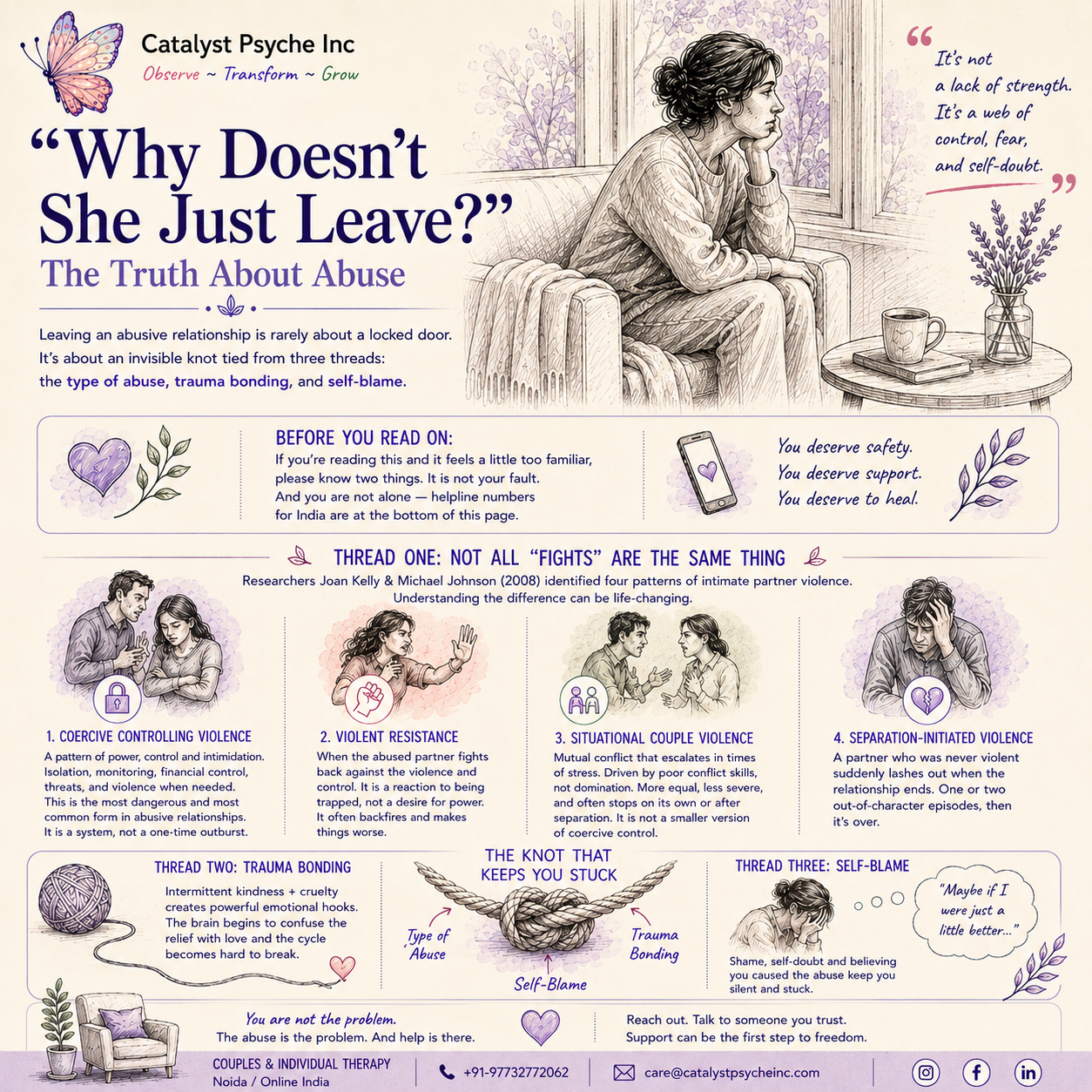
Because leaving an abusive relationship is almost never about a locked door. It is about an invisible knot tied from three separate threads: the kind of abuse it is, a strange kind of loyalty called trauma bonding, and a quiet, corrosive belief that whispers, “Maybe if I were just a little better, he wouldn’t have to do this.”
Let’s untie the knot, one thread at a time. Not with clichés — with what decades of research actually shows.
Before you read on: If you’re reading this and it feels a little too familiar, please know two things. It is not your fault. And you are not alone — helpline numbers for India are at the bottom of this page.
Thread One: Not all “fights” are the same thing
Here is where most of our thinking goes wrong. We lump everything under one word — “domestic violence” — as if a couple who scream and slam doors during a bad patch is the same as a man who tracks his partner’s every move. They are not remotely the same, and researchers have spent thirty years proving it.
The most useful map comes from psychologists Joan Kelly and Michael Johnson (2008), who identified four very different patterns hiding under that single label.
1. Coercive Controlling Violence — the one we should fear most
Picture Meera. To relatives, her husband seems charming. But at home, he decides what she wears, checks her phone every night — demanding to know why a call to a friend lasted fifteen minutes — controls every rupee so she has to ask for money even to buy something for her own sister, and cuts her off slowly from her friends and her family. He rarely needs to hit her — a look is enough, because the few times he did, she learned. This is coercive control: not an outburst, but a system. The violence, when it comes, is one tool inside a whole toolbox of intimidation, isolation, and fear (Pence & Paymar, 1993). It is more frequent, more severe, and far more likely to injure than any other type, and in heterosexual relationships it is overwhelmingly carried out by men (Johnson, 2008). This is the thread that ties the tightest knot.
2. Violent Resistance — fighting back
One night, after he twists her arm and slaps her hard enough to split her lip, Meera finally shoves him back, or throws something. Researchers call this violent resistance — a person hitting back against someone who controls them (Kelly & Johnson, 2008). It looks like “she’s violent too,” but it is a reaction to being trapped, not a bid for power. And it usually backfires; most women learn quickly that fighting back only makes things worse (Pagelow, 1981).
And then comes the part no one sees. The next morning, the bruise on her arm becomes “someone tried to snatch my purse near the market.” The mark on her cheek becomes “I slipped on the stairs.” The sprained wrist becomes “I banged it on the cupboard door.” She covers for him to her own parents, to her friends, to the colleague who notices her wince — partly from shame, partly to protect him, and partly because admitting the truth out loud would make it too real to go back to. This hiding is one of the most common and heartbreaking signs of what she’s living through — and one of the biggest reasons the people around her have no idea.
3. Situational Couple Violence — the common blow-up
Now picture a different couple, Rohan and Ananya. No one controls anyone. But money is tight, tempers are short, and one ugly argument boils over into a shove or a slap that both of them are ashamed of the next day. This is situational couple violence — the most common form in the general population, driven by poor conflict skills, not domination (Kelly & Johnson, 2008). It is genuinely more equal between men and women, tends to be less severe, and often stops on its own or after separation. It is not a smaller version of coercive control. It is a different animal.
4. Separation-Instigated Violence — the shock of being left
A partner who was never violent suddenly loses it — smashing something, lashing out — for the first time ever when the marriage collapses (Kelly & Johnson, 2008). One or two out-of-character episodes, then it’s over.
Why does this map matter? Because when families, police, or even counsellors treat all of these as the same, they get it dangerously wrong. The data proves the point: in general population surveys, roughly 89% of the violence is the situational, blow-up kind — but in the samples that end up in courts and shelters, the majority is coercive control (Johnson, 2006). Same word. Completely different realities.
Everything that follows in this article is about that first, most dangerous thread — coercive control — because that is where the knot gets tied.
Thread Two: Trauma bonding — why the heart won’t listen to the head
Here is the part outsiders find impossible to understand: she still loves him.
She knows what he does. And still, when he cries, apologises, brings her favourite gifts, plan an amazing vacation, promises it will never happen again — something in her softens, hopes, believes. From the outside it looks like weakness. It is actually one of the most powerful bonds the human mind can form, and it has a name.
Psychologists Donald Dutton and Susan Painter (1981, 1993) called it traumatic bonding. They found that a deep, stubborn attachment reliably grows when two ingredients are present:
- A power imbalance — one person increasingly small, dependent, uncertain.
- Kindness and cruelty, taking turns — the abuse is never constant. It alternates with tenderness.
That second ingredient is the trap. When something good comes unpredictably, our brains latch on far harder than when it comes every time. It is the exact mechanism that keeps a person glued to a slot machine, pulling the lever one more time. Dutton and Painter (1993) showed that this “sometimes-good, sometimes-terrible” rhythm builds an attachment that is remarkably hard to break.
You can almost feel it in the classic cycle Lenore Walker (1979) described decades ago: tension builds, an explosion happens, and then comes the “honeymoon” — the flowers, the tears, the “main badal jaunga” (I’ll change). Every honeymoon isn’t a break from the abuse. It is the glue that sets the bond harder. In India, this cycle often plays out with a whole supporting cast — in-laws who smooth it over, a mother who says “sab theek ho jayega” (it’ll all be fine), a society that treats the marriage itself as sacred and unbreakable.
So when she goes back, she is not being foolish. Her nervous system is responding to one of the most potent conditioning patterns known to psychology. The bond feels like love because, chemically, it is running on the same wiring.
Thread Three: “I’m a good person. I can fix him.” — the self-blame that seals the knot
Now the third thread, and the quietest one. It is the belief that lives inside her own head:
I am a good person. If I love him enough, cook well enough, argue less, keep the house perfect, don’t provoke him — he’ll change. And when he does hurt me… well, I did shout back. I burnt the dal. I answered my mother’s call when he told me not to. So really, it’s partly my fault.
This is not stupidity. It is a predictable product of the abuse — and in the Indian context, it is reinforced by the entire world around her.
Consider a startling number. India’s own National Family Health Survey (NFHS-5, 2019–21) found that 45% of women and 44% of men believe a husband is justified in beating his wife in at least one situation — and the single most agreed-upon “reason” was disrespecting the in-laws (IIPS & ICF, 2021). Sit with that. Women — has been taught that if the culture says the violence is her fault, why wouldn’t she believe it too?
Psychologists distinguish two kinds of self-blame (Janoff-Bulman, 1979). One is behavioural: “I made a mistake I can fix” — which at least leaves room for hope. The other, far more damaging, is characterological: “There is something wrong with me as a person.” Coercive control slowly pushes people from the first into the second, and that second kind is tightly linked to depression.
And notice the awful logic of it: blaming yourself can actually feel safer than the alternative. If it’s your fault, then you still have some control — “I can fix this by being better.” The alternative is admitting that nothing you do will ever be enough, a helplessness so bleak that Lenore Walker (1979) documented it directly in abused women (see also Seligman, 1975). The “I can save him” identity is, in part, the mind’s last defence against despair.
The abuser rarely has to install this belief alone. It comes pre-loaded — from the mother-in-law who says “thoda adjust kar lo” (just adjust a little), from parents who tell a crying daughter that a woman’s job is to keep the home together, from every serial and film where a woman’s love finally reforms a cruel man. By the time she realises the abuse won’t stop, the bond is strong and the blame is already hers to carry (Dutton & Painter, 1993).
How the three threads pull together
See how the knot ties itself?
Coercive control builds the power imbalance and swings between cruelty and kindness → that rhythm creates the trauma bond → and the whole system, backed by family and culture, installs self-blame, which convinces her the answer is to try harder rather than to leave.
And here’s the crucial flip side: these three threads are mostly absent in the ordinary blow-up kind of violence. Rohan and Ananya, fighting over money, are not trauma-bonded captor and captive, and Ananya isn’t rebuilding her whole identity around fixing him. That’s exactly why treating every troubled relationship as “the same” fails people — a coercive-control situation needs safety and escape, while a high-conflict-but-not-controlling relationship might need communication and anger tools (Kelly & Johnson, 2008). It can be the difference between the right help and dangerous advice.
A gentler way to see the “I caused this” voice
In our therapy work, we find one more idea deeply freeing. That voice saying “it’s my fault, I can fix him” is not the truth about who you are. Think of it as a part of you — a loyal, exhausted caretaker part that learned, long ago, that love means fixing, and that keeping the peace keeps everyone safe (Schwartz, 1995).
You don’t heal by attacking that part or hating yourself for having it. You heal by gently stepping back from it — enough to notice the difference between you and the belief.
The moment a person can finally say, “A part of me still feels this was my fault… and I can also see, clearly, that it never was” — that is the moment the knot starts to loosen. Being able to look at the blame, instead of drowning in it, is where recovery begins.
What actually helps
- Name the pattern. Realising “this is coercive control, this is a strategy — not my failing” is often the first crack of light.
- Rebuild your people. Isolation is a weapon; quietly reconnecting with even one trusted person begins to disarm it.
- Stop trying to “fix” him — start planning for safety. With coercive control, no amount of being a “better wife” changes the pattern. Change requires his accountability, not your perfection.
- Get trauma-informed support. Approaches like IFS, EMDR, ACT, and CBT can help process what happened and set down the self-blame you were never meant to carry.
- Remember: men and people in same-sex relationships can be victims too. Abuse doesn’t check your gender before it enters the room.
If you need help — India
You are not to blame. Help exists, and reaching out is an act of courage, not weakness.
- 181 — Women Helpline (24×7, all states): emergency response, counselling and referrals.
- 112 — Emergency (police / medical): national number for any emergency.
- National Commission for Women (NCW): 14490 — trained counsellors for domestic-violence support.
- 1098 — Childline: for any child in danger.
Catalyst Psyche Inc. offers confidential, trauma-informed therapy (IFS, EMDR, ACT, CBT) for individuals and couples in Noida (Delhi NCR) and online. If any part of this article felt like your own story, speaking to a qualified mental-health professional is a safe and worthwhile first step.
Read More – After the Affair — A Path Through Betrayal: Part 2 The Grief of an Affair: Why Betrayal Feels Like Mourning a Death
References
Campbell, J. C., Webster, D., Koziol-McLain, J., Block, C., Campbell, D., Curry, M. A., … Laughon, K. (2003). Risk factors for femicide in abusive relationships: Results from a multisite case control study. American Journal of Public Health, 93(7), 1089–1097.
Dutton, D. G., & Painter, S. L. (1981). Traumatic bonding: The development of emotional attachments in battered women and other relationships of intermittent abuse. Victimology: An International Journal, 6(1–4), 139–155.
Dutton, D. G., & Painter, S. (1993). Emotional attachments in abusive relationships: A test of traumatic bonding theory. Violence and Victims, 8(2), 105–120.
International Institute for Population Sciences (IIPS) & ICF. (2021). National Family Health Survey (NFHS-5), 2019–21: India. Mumbai: IIPS.
Janoff-Bulman, R. (1979). Characterological versus behavioral self-blame: Inquiries into depression and rape. Journal of Personality and Social Psychology, 37(10), 1798–1809.
Johnson, M. P. (2006). Conflict and control: Gender symmetry and asymmetry in domestic violence. Violence Against Women, 12(11), 1003–1018.
Johnson, M. P. (2008). A typology of domestic violence: Intimate terrorism, violent resistance, and situational couple violence. Northeastern University Press.
Kelly, J. B., & Johnson, M. P. (2008). Differentiation among types of intimate partner violence: Research update and implications for interventions. Family Court Review, 46(3), 476–499.
Pagelow, M. D. (1981). Woman-battering: Victims and their experiences. Sage.
Pence, E., & Paymar, M. (1993). Education groups for men who batter: The Duluth model. Springer.
Schwartz, R. C. (1995). Internal family systems therapy. Guilford Press.
Seligman, M. E. P. (1975). Helplessness: On depression, development, and death. Freeman.
Stark, E. (2007). Coercive control: The entrapment of women in personal life. Oxford University Press.
Walker, L. E. (1979). The battered woman. Harper & Row.