If you live with fibromyalgia or long-term chronic pain, you have probably heard some version of "have you tried…" more times than you can count. Specialists, scans, medications, supplements, yoga, diets. Some helped a little. Nothing changed the fundamental fact: the pain is still here, and life has quietly shrunk around it. So when someone …

If you live with fibromyalgia or long-term chronic pain, you have probably heard some version of “have you tried…” more times than you can count. Specialists, scans, medications, supplements, yoga, diets. Some helped a little. Nothing changed the fundamental fact: the pain is still here, and life has quietly shrunk around it.
So when someone suggests therapy, the honest reaction is often: “Are you saying it’s in my head?”
Let me answer that directly, because it matters. No. Your pain is real. Fibromyalgia involves a nervous system that has become highly sensitized — the alarm system itself has changed how it fires. Nobody is imagining anything.
But here is what a decade of clinical research has made clear: while pain is produced by the body, suffering is amplified by the struggle against pain — the bracing, the monitoring, the cancelled plans made “just in case,” the exhausting inner argument with your own body. That struggle layer is not imaginary either. And unlike the pain itself, it responds to psychological work.
Table of Contents
ToggleWhat Is ACT Therapy for Chronic Pain — and Why It’s Different From What You’ve Tried
The approach I use is called Acceptance and Commitment Therapy (ACT). It is one of the few psychological approaches with a genuine evidence base in chronic pain: the UK’s national clinical guideline on chronic primary pain (NICE NG193) specifically recommends ACT as a psychological therapy for these conditions [1], it has been tested in more than 30 randomised controlled trials involving over 2,000 patients [2,3], and it has been studied in fibromyalgia specifically — in face-to-face, group, and online formats [4–6].
Here’s the uncomfortable truth ACT starts from: everything you’ve tried so far has probably shared one goal — make the pain go away first, then live your life. When that strategy has failed for years, the problem may not be your effort. It may be the sequence.
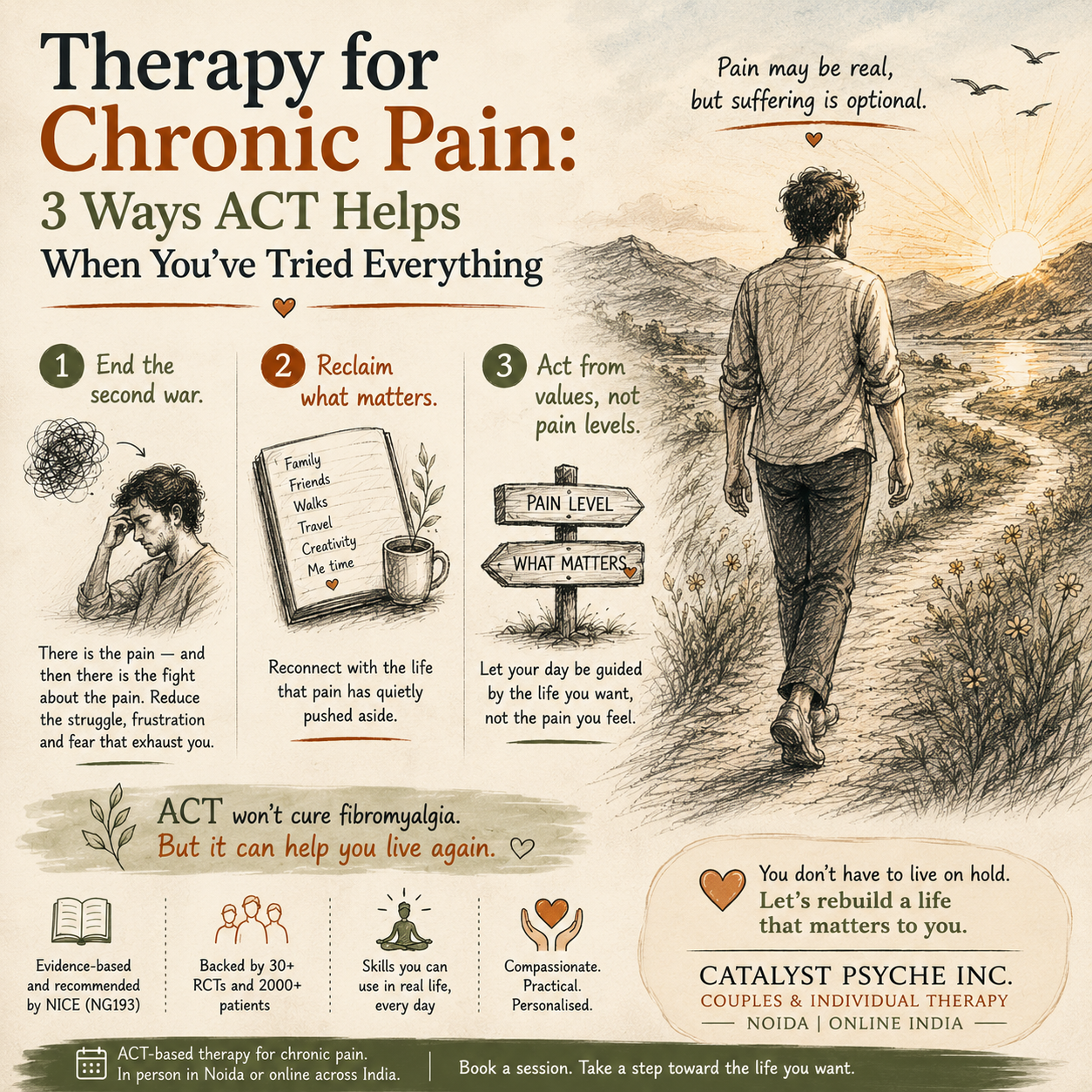
ACT reverses it. Instead of putting life on hold until pain is solved, we work on three things:
3 Ways ACT Therapy Helps With Chronic Pain and Fibromyalgia
1. Ending the second war. There is the pain — and then there is the fight about the pain: the frustration, the fear of flare-ups, the constant body-scanning. That second war consumes enormous energy — and research links this struggle (what pain psychologists call catastrophizing) to greater disability and distress, while ACT has been shown to measurably reduce it [2,7]. We train a different relationship with sensation — one where pain is present but no longer running the control room.
2. Reclaiming what matters. Chronic pain shrinks life in small, reasonable-seeming steps — skip the family function, drop the morning walk, stop making plans. In our context, there’s often an extra layer: pushing through silently because log kya kahenge, or because rest feels like letting the family down. We map what you’ve given up, and rebuild toward it — not recklessly, but deliberately, in steps your body can negotiate.
3. Acting from values, not from pain levels. The core shift: your day stops being decided by the morning’s pain score and starts being decided by what kind of life you’re building. Paradoxically, trials consistently find that people who make this shift report not just fuller lives, but improved day-to-day functioning that holds at six- and twelve-month follow-ups — including less interference from the pain itself [2,3].
What ACT Therapy for Fibromyalgia Looks Like in Practice
Sessions are structured, practical, and skills-based — this is not lying on a couch talking about childhood. You learn concrete techniques, test them between sessions in your real life, and we adjust based on what your body and your week actually show us. Most clients know within three to four sessions whether the approach is moving something.
Does Therapy Work for Chronic Pain? An Honest Answer
ACT will not cure fibromyalgia. Anyone who promises a cure is selling something. Even in the research, effect sizes are modest — real, replicated, but modest [3,7]. What the evidence does support is this: ACT changes how much of your life the pain gets to keep — disability, mood, quality of life, and functioning improve, and the gains hold over time [1,2]. For many people who have “tried everything,” that turns out to be the thing worth trying.
If you’re skeptical, good. Don’t take my word for it — test it from the inside. One session is enough to judge whether this is different.
Catalyst Psyche Inc. offers ACT-based therapy for chronic pain, in person in Noida and online across India. Book a session at [booking link]
Read More –>You Are Not Your Anxiety: Understanding the Self in Internal Family Systems (IFS) & 8 C’s
References
- National Institute for Health and Care Excellence (NICE). Chronic pain (primary and secondary) in over 16s: assessment of all chronic pain and management of chronic primary pain. Guideline NG193, 2021. Recommendation 1.2.3 advises considering ACT or CBT for chronic primary pain. https://www.nice.org.uk/guidance/ng193
- Martinez-Calderon J, García-Muñoz C, Rufo-Barbero C, Matias-Soto J, Cano-García FJ. Acceptance and Commitment Therapy for Chronic Pain: An Overview of Systematic Reviews with Meta-Analysis of Randomized Clinical Trials. The Journal of Pain, 2024;25(3):595–617.
- Lai L, Liu Y, McCracken LM, Li Y, Ren Z. The efficacy of acceptance and commitment therapy for chronic pain: A three-level meta-analysis and a trial sequential analysis of randomized controlled trials. Behaviour Research and Therapy, 2023;165:104308.
- Wicksell RK, Kemani M, Jensen K, et al. Acceptance and commitment therapy for fibromyalgia: A randomized controlled trial. European Journal of Pain, 2013;17(4):599–611.
- Luciano JV, Guallar JA, Aguado J, et al. Effectiveness of group acceptance and commitment therapy for fibromyalgia: A 6-month randomized controlled trial (EFFIGACT study). Pain, 2014;155(4):693–702.
- Simister HD, Tkachuk GA, Shay BL, et al. Randomized Controlled Trial of Online Acceptance and Commitment Therapy for Fibromyalgia. The Journal of Pain, 2018;19(7):741–753.
- Eastwood F, Godfrey E. The efficacy, acceptability and safety of acceptance and commitment therapy for fibromyalgia — a systematic review and meta-analysis. British Journal of Pain, 2024.