Anticipatory Anxiety: Why Do We Worry About Things That Haven't Happened Yet? Have you ever found yourself worrying about a conversation that hasn't happened, an interview that is still a few days away, or a family event that you have you are supposed to attend? Perhaps you have an important presentation coming up. Your mind …

Anticipatory Anxiety: Why Do We Worry About Things That Haven’t Happened Yet?
Have you ever found yourself worrying about a conversation that hasn’t happened, an interview that is still a few days away, or a family event that you have you are supposed to attend?
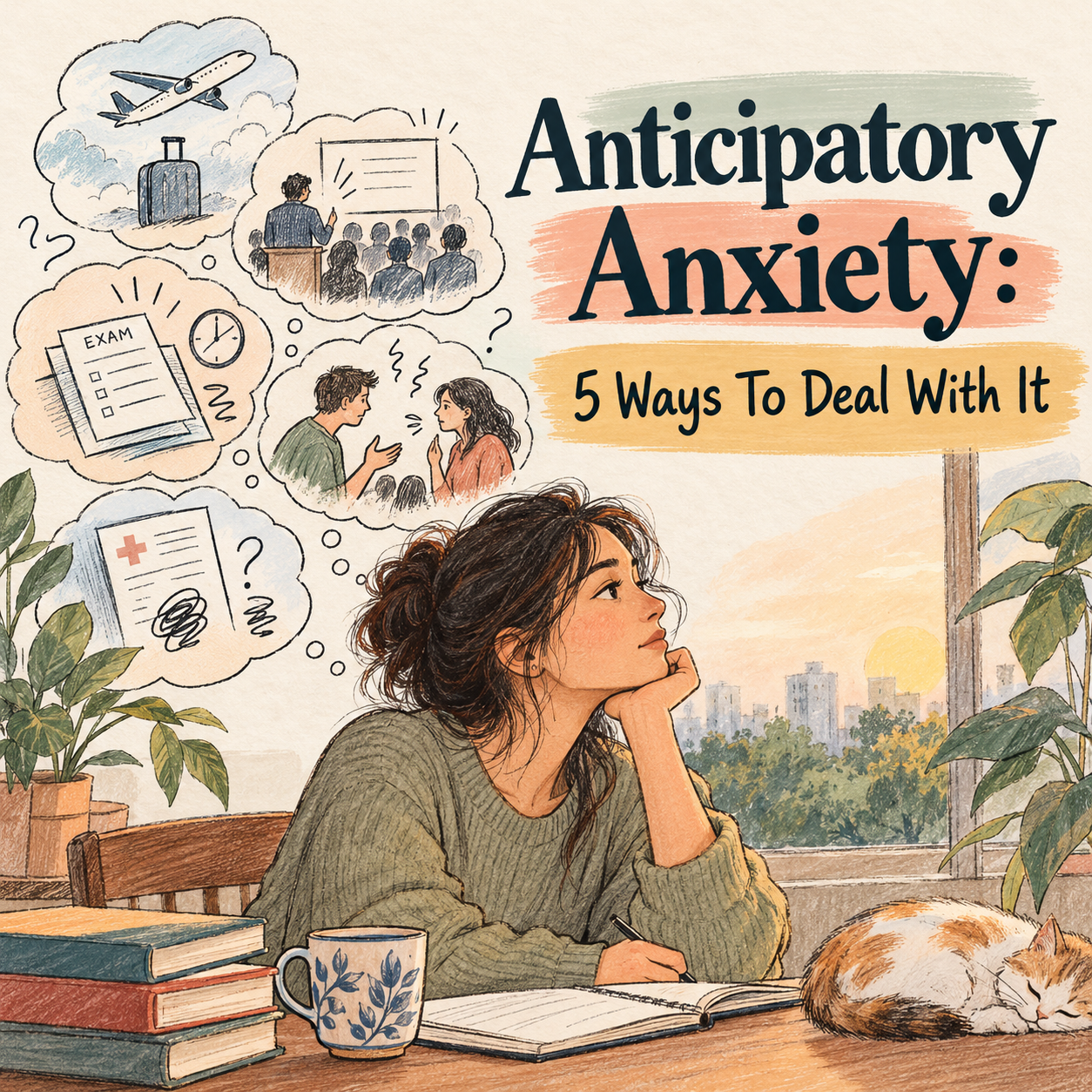
Perhaps you have an important presentation coming up. Your mind keeps imagining what could go wrong. What if you forget what to say? What if someone asks a question you cannot answer? What if people notice that you are nervous? What if things escalate?
Sometimes, the event itself isn’t particularly frightening. It is the anticipation of the event that becomes overwhelming.
You may spend hours thinking about different possibilities, rehearsing conversations in your head, seeking reassurance from people around you, or trying to prepare for every outcome. By the time the actual event arrives, you are already mentally exhausted.
This experience is often described as anticipatory anxiety.
It is that uncomfortable feeling of being anxious about something that hasn’t happened yet. Your mind moves into the future, imagines possible threats and begins responding to them as though they are already taking place.
And while thinking ahead is a natural part of being human, sometimes our attempts to prepare for the future leave us feeling unable to enjoy the present.
What exactly is anticipatory anxiety?
Anticipatory anxiety refers to the fear, apprehension or distress we experience when thinking about a future situation or an uncertain outcome.
It can happen before something we genuinely find difficult, such as a job interview, an examination, a medical procedure or an uncomfortable conversation. It can also occur before relatively ordinary experiences, such as meeting people, travelling somewhere unfamiliar or attending a social gathering.
Consider someone who has to speak in a event (personal or professional) next month. They begin imagining that their colleagues/relatives/friends might disagree with them, that they may struggle to express themselves, or that they might say something embarrassing. These thoughts create anxiety even though the meeting is still several days away.
Over time, the person may find themselves preparing excessively, avoiding the meeting altogether or repeatedly asking people whether they are good enough.
The interesting thing is that the anxiety is not necessarily coming from the event itself. It is coming from what the person believes might happen.
Our brains are naturally designed to anticipate possible threats. This ability helps us prepare, make decisions and protect ourselves. However, when uncertainty becomes difficult to tolerate, the mind may start generating increasingly elaborate negative possibilities.
Instead of helping us prepare, this mental activity can become repetitive and exhausting and can take away our ability to think rationally.
Why does the mind keep imagining the worst?
One important psychological concept that helps explain anticipatory anxiety is intolerance of uncertainty.
Most of us prefer knowing what is going to happen. We like having a sense of control, particularly when something important is at stake. But life rarely offers complete certainty.
We cannot know exactly how someone will respond to a difficult conversation, whether an interview will go well, or what the outcome of a medical investigation will be.
For some people, this uncertainty becomes particularly uncomfortable. The mind responds by trying to find answers, predict outcomes and mentally prepare for every possible scenario.
The difficulty is that thinking more does not necessarily create more certainty.
In fact, it can create a cycle in which every imagined possibility generates another question. What if this happens? And if it does, what will happen next? What if I cannot manage that either? The “What-If” loop makes the things worst in our mind than they actually are and keep increasing the anxiety.
Research has consistently identified intolerance of uncertainty as an important factor associated with excessive worry and generalized anxiety. Psychological interventions, particularly CBT-based approaches, can help people develop a more flexible relationship with uncertainty.
Another factor is our tendency to overestimate the likelihood or consequences of negative events. We may treat a possibility as though it is almost certain, while overlooking our ability to cope if things do not go according to plan.
This is why anticipatory anxiety can sometimes feel much bigger than the situation we are actually facing.
Five ways to manage anticipatory anxiety
The aim of managing anticipatory anxiety is not to convince yourself that nothing bad will ever happen. Nor is it to eliminate every anxious thought.
It is about learning to recognise when your mind is trying to solve an uncertain future, distinguishing useful preparation from repetitive worry, and developing confidence in your ability to cope.
Here are five evidence-based approaches that can help.
-
Table of Contents
ToggleRecognise when you are preparing and when you are worrying
There is an important difference between preparing for something and repeatedly worrying about it.
Imagine that you have an interview next Monday. Preparing might involve researching the organisation, practising a few responses and getting your documents ready. These activities have a clear purpose and help you feel more equipped.
Worry, on the other hand, might involve repeatedly imagining that you will fail, wondering whether the interviewer will like you, or mentally rehearsing every possible question without reaching a point where you feel ready.
The two can look quite similar, but they serve different purposes.
A useful question to ask yourself is: Am I doing something that will help me respond to this situation, or am I simply thinking about what might go wrong?
If there is something practical you can do, take that action. If you have already done what is reasonably within your control, continuing to think about it may not be particularly helpful.
This distinction is central to Cognitive Behavioural Therapy (CBT), which helps individuals identify unhelpful thinking patterns and develop more constructive ways of responding to them.
-
Learn to question your anxious predictions
When we feel anxious about the future, our thoughts can begin to sound like facts.
You might think, “I’m going to embarrass myself“, “They will definitely reject me“, or “I won’t be able to handle it.”
But how do we know that these things will happen?
Anxiety often encourages us to focus on the worst possible outcome or catastrophizing while overlooking other, equally plausible possibilities.
Rather than immediately trying to replace a negative thought with a positive one, pause and examine what you are telling yourself. And observing ‘its just a thought’, it helps in not blending with it and maintain a distance from it.
For instance, if you are worried about an upcoming conversation with your partner, you might be predicting that it will turn into an argument. Ask yourself what evidence supports this prediction. Is there a possibility that your partner might respond differently this time? And even if the conversation becomes uncomfortable, what could you do to manage it – focus on your locus of control and circle of influence.
The objective is not to persuade yourself that everything will go perfectly. It is to make room for a more balanced understanding of what might happen.
A thought worth practising is: I don’t know exactly how this will turn out, but I don’t have to assume the worst.
This process of identifying, examining and restructuring anxious thoughts is a core component of CBT, which has substantial research support in the treatment of anxiety disorders.
-
Gradually face the situations you have been avoiding
When something makes us anxious, avoiding it can feel like the easiest solution.
You may postpone a difficult conversation, decline an invitation, avoid speaking in meetings or repeatedly delay an important decision.
And initially, avoidance works. Your anxiety comes down because you no longer have to face the situation.
But there is a catch.
Your brain may begin to associate avoidance with safety. Over time, the situation can feel even more threatening because you have had fewer opportunities to discover that you can manage it. This is where exposure-based approaches become useful.
Instead of forcing yourself into the most frightening situation immediately, begin with manageable steps. If public speaking makes you anxious, you might first practise speaking alone, then record yourself, then speak in front of someone you trust, and eventually participate in a small group discussion.
The idea is to give yourself opportunities to experience the situation rather than continuously imagining it.
Importantly, exposure is not about waiting until you feel completely calm before taking action. It is about discovering that you can participate in meaningful activities even when some anxiety is present.
Research on exposure-based treatments supports their effectiveness across several anxiety disorders, including social anxiety, specific phobias and panic disorder.
-
Set aside time for worrying instead of letting it occupy your entire day
Have you noticed how a worry can interrupt almost anything?
You could be working, eating dinner or spending time with someone you care about, and suddenly your mind returns to an upcoming event. Trying to force these thoughts away often doesn’t work particularly well. A more practical approach is to acknowledge the worry without immediately engaging with it.
One technique used in CBT and metacognitive approaches is called worry postponement.
When a worry appears, write it down and gently remind yourself that you will return to it at a specific time later in the day. You might decide to spend 15–20 minutes reviewing your worries in the evening.
When that time arrives, look at what you have written. Some concerns may have become less important. Others may have a practical solution. And some may simply be uncertainties that you cannot resolve right now.
This practice is not about suppressing your thoughts or pretending that your concerns don’t matter. It is about developing some choice over when and how much attention you give them.
Research on worry postponement has shown promising results, including a randomized controlled trial published in Clinical Psychology in Europe in 2024 that reported reductions in worry among individuals with generalized anxiety disorder.
-
Bring your attention back to the present moment
One of the defining features of anticipatory anxiety is that our attention gets pulled away from what is happening now and becomes absorbed in what might happen later. You might be sitting comfortably at home, but mentally you are already at tomorrow’s meeting, next week’s examination or a conversation that may not even take place.
Mindfulness-based practices can help us notice this shift without becoming completely absorbed in it.
For example, when you notice yourself worrying about an upcoming event, take a moment to observe what is happening around you. Notice your breathing, the sensation of your feet on the floor, the sounds in the room or the activity you were engaged in before the worry appeared. You could also practise slow, comfortable breathing, allowing your exhalation to be slightly longer than your inhalation.
The purpose is not to force yourself to stop thinking about the future. It is to gently remind yourself that the future is not happening right now.
Mindfulness-based interventions have demonstrated benefits in anxiety management, while breathing-based interventions have also shown promising effects on stress and anxiety.
With regular practice, these approaches can help you become more aware of anxious thinking without automatically following every thought it produces.
What if the worst actually happens?
This is perhaps one of the most important questions to consider when dealing with anticipatory anxiety.
Sometimes, the things we worry about do happen. An interview may not go well. A conversation may become uncomfortable. We may receive disappointing news or make a mistake in front of others.
Psychological well-being does not come from believing that nothing unpleasant will happen. It comes, in part, from developing the confidence that we can respond when difficult things do happen.
Instead of asking yourself only, “What if this goes wrong?”, try asking, “If this doesn’t go the way I hope, what could help me get through it?”
You may realise that you have handled difficult situations before. You may have supportive people around you. You may be able to seek help, make another attempt or simply give yourself time to process what happened.
This is an important shift: moving from trying to control every possible outcome to developing confidence in your ability to cope with different outcomes.
A small exercise: The next time you feel anxious about the future
The next time you notice yourself getting caught up in an upcoming event, try pausing for a moment.
Ask yourself what exactly you are afraid might happen. Is there something useful you can do about it today? If yes, identify one small action and take it.
If there isn’t, acknowledge that you are dealing with uncertainty rather than an immediate problem.
Then ask yourself what you would do if the situation did not go as planned. You don’t need a perfect answer. Even identifying one or two possible ways of coping can help you recognise that you have more options than your anxious mind is suggesting.
Finally, return to whatever you were doing.
You may still feel anxious. That is okay.
You don’t have to wait for the anxiety to disappear before continuing with your day.
When should you consider professional support?
Occasional anxiety about the future is a normal human experience. However, if you find yourself worrying excessively, losing sleep, avoiding important situations or struggling to concentrate because of thoughts about what might happen, it may be helpful to speak with a mental health professional.
Anticipatory anxiety can occur across different anxiety-related conditions, including generalized anxiety disorder, social anxiety disorder, panic disorder and specific phobias. Understanding the underlying pattern is important because the most appropriate treatment may differ from person to person.
CBT, exposure-based interventions and other evidence-based psychological approaches can help individuals understand their anxiety, develop healthier coping strategies and gradually regain confidence in situations they have been avoiding.
At Catalyst Psyche Inc, we believe that understanding your emotional experiences is an important first step towards responding to them with greater awareness and compassion.
A final thought
Perhaps the most difficult part of anticipatory anxiety is that it makes us feel as though we need to figure everything out before we can relax.
We want to know that the conversation will go well, that the result will be favourable, that people will understand us and that nothing unexpected will happen.
But life doesn’t offer that kind of guarantee.
And perhaps learning to live with a little uncertainty is not about becoming careless or giving up control. It is about recognising that we can prepare for the things within our control without spending our lives worrying about everything outside it.
You don’t have to solve tomorrow today.
You can prepare for the future while still allowing yourself to live in the present.
Read more – You Are Not Your Anxiety: Understanding the Self in Internal Family Systems (IFS) & 8 C’s
References and further reading
- Carpenter, J. K., et al. (2018). Cognitive behavioral therapy for anxiety and related disorders: A meta-analysis of randomized placebo-controlled trials. Depression and Anxiety, 35(6), 502–514.
- Arslan, I. B., et al. (2023). The impact of psychological treatment on intolerance of uncertainty in generalized anxiety disorder: A systematic review and meta-analysis.
- Krzikalla, C. (2024). Worry postponement from the metacognitive perspective: A randomized waitlist-controlled trial. Clinical Psychology in Europe, 6(2).
- Hofmann, S. G., et al. (2010). The efficacy of cognitive behavioral therapy: A review of meta-analyses. Cognitive Therapy and Research, 36, 427–440.
- NICE. (2020). Generalised anxiety disorder and panic disorder in adults: management (CG113). National Institute for Health and Care Excellence.
- Fincham, G. W., et al. (2023). Effect of breathwork on stress and mental health: A meta-analysis of randomised-controlled trials. Scientific Reports, 13, 432.
This article is intended for psychoeducation and does not replace individual psychological assessment or treatment.