
You Are Not Your Anxiety: Understanding the Self in Internal Family Systems (IFS) & 8 C's and what it means to become Self-led. I have been working with different modalities in therapy including CBT, ACT, IFS & EMDR. I found clients resonate better with IFS, however, face a question from clients with the inner work …

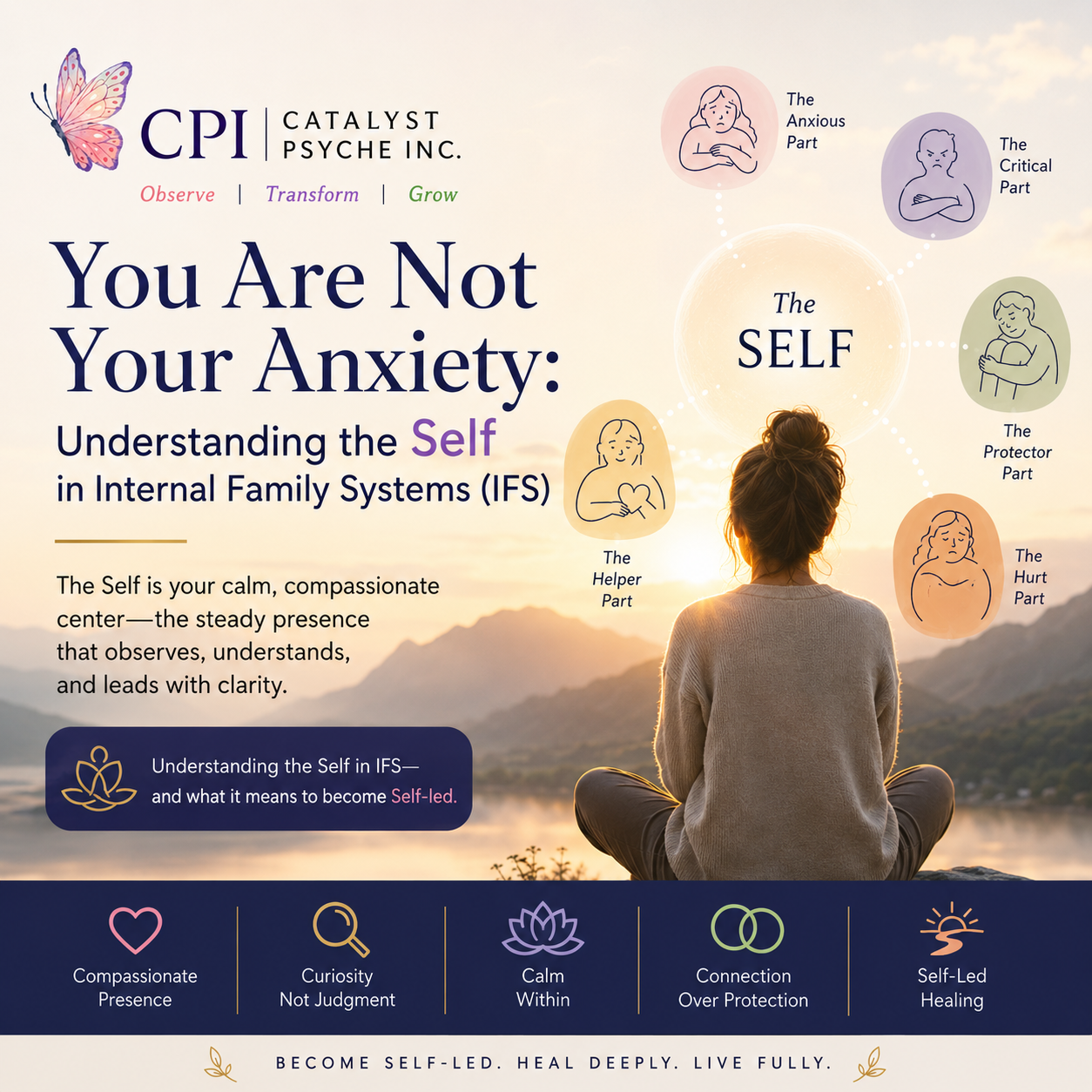
You Are Not Your Anxiety: Understanding the Self in Internal Family Systems (IFS) & 8 C’s and what it means to become Self-led.
I have been working with different modalities in therapy including CBT, ACT, IFS & EMDR. I found clients resonate better with IFS, however, face a question from clients with the inner work – what is Self – a core concept in IFS. I think it’s quiet a question hiding underneath all the inner work we do.
When you notice your anxiety, when you listen to your inner critic, when you feel tenderness toward the frightened part of you that still flinches at conflict — observe – who is doing the noticing? Who is the one listening? Who is the one capable of feeling tenderness rather than just being swallowed by fear?
You can observe your parts. You can soothe them, argue with them, get exhausted by them. But the very act of observing implies an observer. Someone is home. In Internal Family Systems, we call that someone the Self.
This is the part of IFS that people find most beautiful and, honestly, most confusing. Many clients sit across from me and say some version of: “I understand the idea of parts. But I have no idea what ‘Self’ is supposed to feel like or how do I access the Self. Isn’t that just another part?” It’s a fair question, and working it out is often the turning point of the whole journey. So let’s slow down and explore it together.
Table of Contents
ToggleThe Self – seat of consciousness has many names
What IFS calls the Self is not a new invention. Contemplative traditions across the world have circled the same inner reality for centuries, each giving it their own name. The Hindus thought points to Atman, Buddhists describe a kind of awake, luminous awareness. Sufi poetry calls it the Beloved, the divine living quietly within. Different vocabularies, different cultures, often pointing toward the same felt experience: a centre of consciousness that is calm, spacious, and quietly awake beneath all our noise.
IFS doesn’t ask you to adopt any particular spiritual belief. It simply observes, clinically and repeatedly, that this centre is real, that everyone has access to it, and that it can be reached far more easily than most people imagine. You were born with it, and nothing can break it.
Here is one of the most reassuring claims in all of IFS: the Self is not something you have to build, earn, or develop in stages. You don’t borrow it from your therapist. You don’t grow it through years of effort. You already have it, fully intact, and you always have. More than that — the Self cannot be damaged. No matter what you’ve lived through, no matter how heavy the trauma, the Self has not been broken. This is a radical thing to tell someone who has spent their life believing they are fundamentally damaged goods.
So if the Self can’t be harmed, why does it so often feel absent? The answer is a single, important word: ‘blending with parts’
What blending is — and why you confuse parts with yourself
Your inner world is populated by parts. The anxious planner, the harsh critic, the people-pleaser, the part that wants to numb out at the end of a hard day, the perfectionist, the moralist. These parts are not flaws or symptoms. They are members of your inner family, each carrying a story, each trying — sometimes clumsily — to protect you.
When a part blends with you, it temporarily takes over your experience. You stop seeing the part; you start seeing the world through its eyes. When you’re fully blended with your inner critic, you don’t think “a critical part of me is active right now.” You think, simply, “I am worthless.” , “I am not lovable” or “I am too much for the world and need to hide”. The part’s voice becomes indistinguishable from your own.
This is the root of the confusion. People assume they are their loudest part, because in the moment of blending there seems to be no space between them and it. And when several parts blend at once — say, one part pushing you to achieve and another part collapsing under the pressure — you live inside an exhausting internal argument, with no peace anywhere to be found.
Here’s the crucial shift: the Self isn’t somewhere far away that you have to journey toward. The Self is already present the moment a part steps back. When parts unblend even slightly, what fills the space is not emptiness. It’s you — centred, curious, a little lighter. The Self was never gone.
The self is like Sun or Sky, on a cloudy day you can’t see it. Clouds have taken over but it doesn’t imply the sun or the sky doesn’t exist. The cloud is real but so is the Sky. But, in that moment of blending with the part (cloud), you end up believing that’s who I am.
So what does Self actually feel like?
This is the question that matters most, because the Self is recognized by its felt qualities, not by intellectual understanding.
When clients genuinely unblend from an extreme part, they tend to describe something remarkably consistent: a sense of feeling centred, calm, and light. A quiet confidence. An openheartedness that wasn’t there a moment ago. A feeling that they have choices again, rather than being trapped in a single reaction. Many describe an unexpected sense of connection — to other people, even to something larger than themselves.
8 C’s to experience the Self
In IFS we describe the Self through eight qualities that, charmingly, all happen to begin with the letter C or so we called 8 C’s
- Curiosity — a genuine, agenda-free interest in your inner experience. Not “why am I like this, what’s wrong with me,” but “huh, I wonder what that part is so worried about.” Curiosity disarms even the most defended parts.
- Calm — not a forced relaxation, but a steadiness that is both physical and mental. The nervous system settles. You stop bracing.
- Confidence — a quiet trust in your own capacity to heal and to handle what comes.
- Connectedness — the felt sense that you are not as separate from others as your fear insists.
- Clarity — perception without the distorting fog of extreme beliefs and emotions. You see the situation as it actually is.
- Creativity — solutions and possibilities that arrive on their own once the inner noise quiets down.
- Courage — the Self is not passive. It can be steady and even forceful in the face of injustice; it’s what lets you turn toward the terrifying places inside.
- Compassion — the warm desire to help a part that is suffering, rather than to silence or banish it.
If, while reflecting on a struggle, you notice even a flicker of these — a little curiosity instead of judgment, a little warmth instead of contempt — that is a signpost. That’s the Self beginning to come through. A note on the strange, beautiful duality of Self – The Self has a dual nature that’s worth naming, because it can otherwise feel contradictory. Sometimes the Self shows up as an active inner leader — an “I” who relates to your parts, hears their competing concerns, comforts them, makes decisions. At other times, it’s experienced as something far more expansive: a spacious, boundaryless sense of presence, a stillness in vast connectedness.
Both are real. Both are you. Think of how physicists describe light as behaving sometimes like a particle and sometimes like a wave — not a contradiction, just two faces of one thing. The Self is the same. It can be the leader and the spacious sky, depending on the moment.
Why this is so hard — and so worth it
Many of us were, in subtle or overt ways as a child – punished for our spontaneity, our spirit, our independence — the very qualities that flow naturally from the Self. So, our protective parts learned to keep the Self quiet and tucked away, believing that staying small and vigilant was safer. To them, the prospect of letting the Self lead can feel genuinely frightening, because for years they have been carrying the full weight of keeping you safe.
The deeper reason the Self is hard to find is that your protectors actively guard against it by blending.
This is why so much of IFS is gentle negotiation rather than force. You cannot command yourself to feel compassion. You can’t try harder to be in Self — effort itself is usually a part. What you can do is get curious about a part that’s in distress, ask the parts that fear it to relax just enough to make a little room, and notice what naturally emerges in the space. The moment parts separate even slightly, Self-energy is already there. You don’t manufacture it. You uncover it.
There is one quiet requirement, though: a willingness to find the Self and enough curiosity to actually pay attention when it shows up. Without that openness, the moments of calm and clarity get dismissed as flukes — “that was nice, but it won’t last.” The more you trust that the Self is there, just beneath your parts, the more accessible it becomes.
Becoming Self-led
To be Self-led is not to get rid of your parts. It’s the opposite. It’s becoming the kind of inner leader your parts can finally relax around — one who listens to the anxious planner without being run by it, who hears the critic without believing every word, who can hold the grief of an old wound without drowning in it.
Picture a frightened part of you — perhaps a younger self who was shamed into silence, or an angry adolescent who once stood up and got punished for it. When the Self turns toward that part with genuine warmth, something shifts. The part no longer has to carry its burden alone. It begins, slowly, to transform back into who it was always meant to be.
That is the whole movement of this work. Not fixing yourself, because you were never broken. Not becoming someone new, because the one who heals was here all along. Just clearing the clouds, patiently and kindly, until the sky underneath becomes visible again and you can be your own illuminated sun.
You are the one who has been doing the looking this entire time. The work is simply learning to trust that.
If you’re navigating your own inner world and would like support in this process, our team at Catalyst Psyche Inc. works with IFS and related approaches to help you reconnect with your Self. Reach out to begin the conversation.
Read More – Internal Family Systems (IFS) Therapy for Trauma & Anxiety in India | Catalyst Psyche Inc, 7 Signs of Complex Trauma and How Trauma Therapy in Noida Can Help, Willpower, Shame, and Religion: A Brief Psychological Perspective
[bookly-form staff_member_id=”1″]