5 Reasons You Keep Chasing the Next Best Thing — And How Present Moment Awareness and Gratitude Can Finally Set You Free Why does life never feel fully enough — even after achieving the things you once desperately wanted? Explore the psychology of present-moment awareness, gratitude, mindfulness, and emotional wellbeing for young adults in India. …

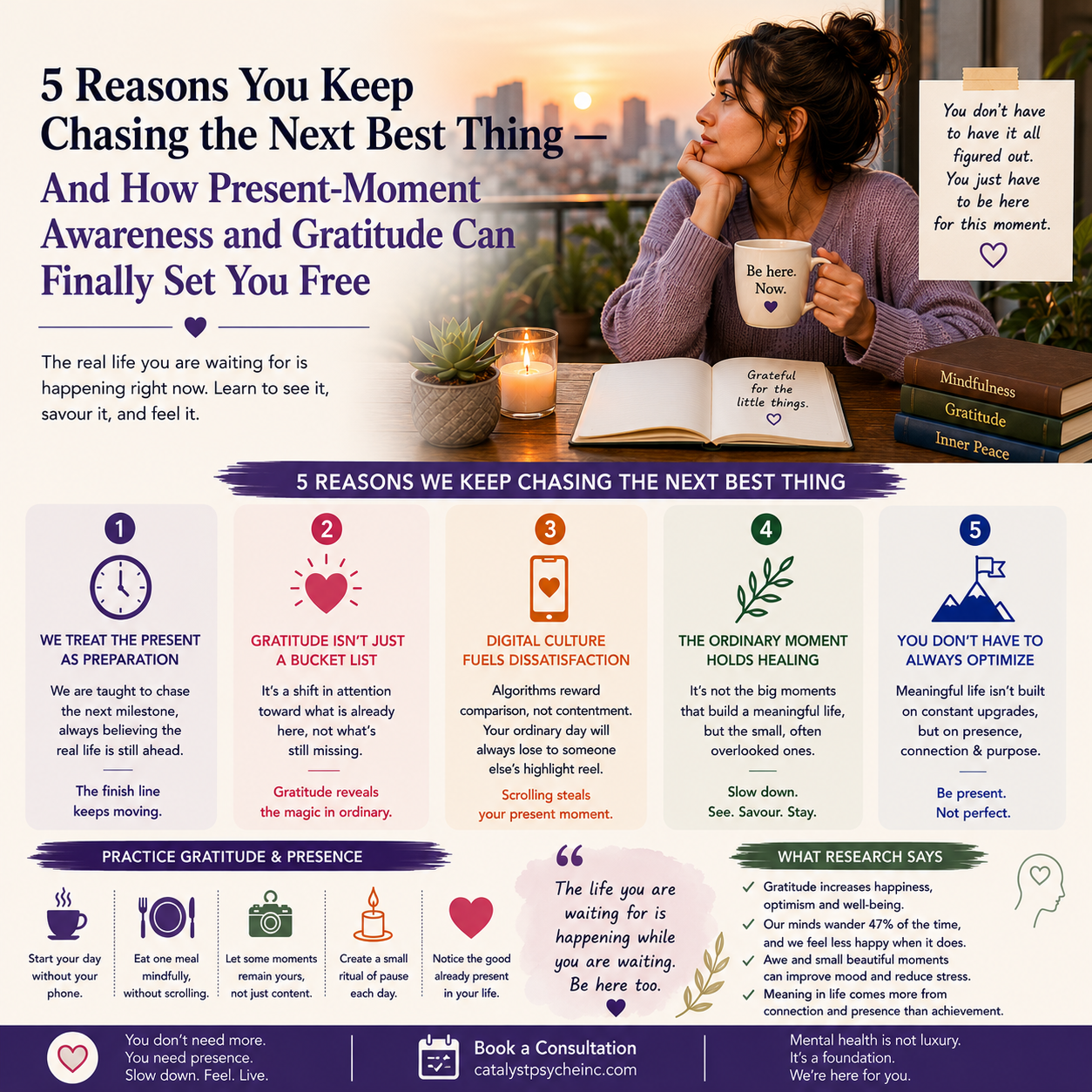
5 Reasons You Keep Chasing the Next Best Thing — And How Present Moment Awareness and Gratitude Can Finally Set You Free
Why does life never feel fully enough — even after achieving the things you once desperately wanted? Explore the psychology of present-moment awareness, gratitude, mindfulness, and emotional wellbeing for young adults in India.
You finally get the thing you wanted.
The job in the city.
The college seat you studied years for.
The relationship that felt like it was written for you.
And for a brief, beautiful moment, it feels like enough.
Then almost silently, the mind moves again.
What’s next?
What could be better?
What am I missing?
It is one of the quieter forms of suffering.
Not dramatic enough to immediately notice. Not visible enough for people to ask about. But persistent enough to slowly shape how we experience life. The feeling that your current life is somehow the waiting room for the “real” version.
This blog explores why present-moment awareness feels so difficult in modern life, why ordinary moments often stop feeling meaningful, and how gratitude and mindful living can help us reconnect with the life we are already living.
1. We Were Taught to Treat the Present as Preparation
For many people in India, life is structured around the next milestone.
You study for board exams.
Then for college entrances.
Then for placements.
Then promotions.
Then marriage.
Then stability.
The present moment often becomes less about living and more about preparing.
A young woman once described this beautifully during therapy:
“I got into IIM after years of working for it. I remember opening the acceptance offer email and almost immediately thinking — okay, what now?”
She had barely arrived before her mind had already left again. Psychologists refer to this tendency as hedonic adaptation — the mind’s ability to quickly normalize achievements, possessions, and positive changes. What once felt life-changing slowly becomes ordinary. And so the brain keeps searching for the next thing that might finally create lasting satisfaction.
Not because we are ungrateful.
But because modern culture rarely teaches us how to fully arrive inside our own lives.
The present moment is the only place where life actually happens — and yet it is the one place we are most trained to leave.
2. Gratitude Is Not Toxic Positivity — It Is a Shift in Attention
The word gratitude has become strangely performative online.
Sometimes it is reduced to:
– productivity advice
– aesthetic journaling
– forced positivity
– or pretending difficult emotions do not exist
But genuine gratitude is not denial. It is attention. Research by Emmons and McCullough (2003) found that individuals who intentionally focused on gratitude experienced greater emotional wellbeing, optimism, and positive affect over time.
The important part was not the journaling itself. It was the retraining of attention. Because the human mind naturally scans for what is missing. Gratitude gently teaches it to also notice what is already here.
The chai someone remembers to make for you.
The familiar voice of a parent calling in the evening.
Rain arriving after unbearable summer heat.
The friend who sends you memes at 1 a.m. because they knew you were having a difficult day.
These moments often go unnoticed precisely because they are ordinary. But ordinary does not mean emotionally insignificant.
3. Social Media Trains the Mind to Stay Dissatisfied
For young adults today, comparison is no longer occasional. It is constant. Social media platforms are designed around forward movement:
– upgrades
– glow-ups
– transformations
– achievements
– “better versions” of life
Your ordinary Tuesday is constantly being compared against someone else’s highlight reel. And slowly, the present moment starts feeling emotionally inadequate.
Research by Killingsworth and Gilbert (2010) found that people spend nearly 47% of their waking hours thinking about something other than what they are currently doing — and they reported significantly lower happiness during those moments of mental wandering.
A wandering mind is not always a creative mind. Sometimes it is simply an exhausted one. One that has forgotten how to stay.
In a culture that profits from dissatisfaction, learning to appreciate your present life becomes a quiet form of emotional resistance.
4. The Ordinary Moment Holds More Healing Than We Realise
It is interesting how people often begin valuing ordinary moments only after experiencing loss, illness, heartbreak, or burnout.
Suddenly:
– evening walks feel meaningful
– family dinners feel precious
– ordinary mornings feel softer
– small conversations feel memorable
But perhaps these moments were always meaningful. We were simply moving too fast to register them. Traditional Indian life quietly contains many forms of present-moment awareness.
Lighting a diya in the evening.
Pausing before meals.
Morning prayers.
Temple bells at dusk.
Sitting together for chai without multitasking.
These rituals were never only religious. They were psychological pauses. Small invitations to arrive in the present moment before rushing into the next one.
Research on awe and emotional wellbeing suggests that moments of beauty, wonder, and meaning increase emotional connection, reduce stress, and expand our perception of time. And awe does not require extraordinary travel or achievement. Sometimes it exists quietly in:
– monsoon rain
– old music
– rangoli outside a neighbour’s home
– the silence of a temple courtyard
– sunlight entering a room differently one morning
The healing hidden inside ordinary life is rarely loud. But it is real.
5. You Do Not Have to Constantly Optimize Your Life to Make It Meaningful
Modern life often teaches us to approach ourselves like ongoing improvement projects. There is always:
– another habit to fix
– another version of yourself to become
– another productivity system
– another life upgrade
And eventually, living starts feeling like performance. But emotional wellbeing does not always emerge from optimization. Sometimes it emerges from receptivity. The willingness to let life happen slowly enough that it can actually touch you.
Research on eudaimonic wellbeing — wellbeing rooted in meaning and authenticity rather than temporary pleasure — consistently shows that deeply fulfilling lives are shaped more by presence, connection, and engagement than achievement alone. Some of the most meaningful moments in life are unplanned.
A conversation on a train.
An unexpected evening with friends.
A song arriving at the exact moment you needed it.
Someone sitting beside you quietly when words fail.
These moments cannot be optimized into existence. They can only be noticed.
5 Small Ways to Practice Present-Moment Awareness & Gratitude
These are not productivity hacks. They are gentle shifts in attention.
- Lower the emotional pressure on what counts as a “good moment.” Not every meaningful experience needs to be extraordinary.
- Spend the first few minutes of your morning without immediately checking your phone.
- Eat at least one meal today without scrolling.
- Allow something beautiful to remain undocumented. Not every moment needs to become content.
- Create a small ritual of pause — evening chai, lighting a candle, stepping outside briefly at sunset.
These moments seem small. But emotional life is often built from small things repeated consistently.
The Radical Act of Arriving
There will always be another milestone. Another city. Another goal. Another imagined version of yourself. The question is not whether growth will continue.
It will.
The deeper question is this: Can you also be here while your life is happening? Can you notice:
– the warmth already present
– the people already here
– the beauty that does not announce itself loudly
– the life you keep postponing your attention toward?
Because presence is not passivity. It is participation. The diya is already lit. The chai is already warm. The person you love is already beside you. Be here too.
You Don’t Have to Navigate This Alone
At Catalyst Psyche Inc, we work with young adults, professionals, and organisations navigating:
– burnout
– anxiety
– emotional exhaustion
– perfectionism
– self-worth struggles
– and the deeper questions of meaning and wellbeing
using evidence-based and trauma-informed approaches.
If this resonated with you, support can help you reconnect not just with achievement — but with life itself.
Read more “I Could Have Done Better”: What To Do With That Thought After CBSE Result Understanding Emotional Boundaries 01: Why Saying “No” Feels So Guilty The Science Behind Building Healthy Relationships (Backed by Psychology)

References (APA 7)
Frederick, S., & Loewenstein, G. (1999). Hedonic adaptation. In D. Kahneman, E. Diener, & N. Schwarz (Eds.), Well-being: The foundations of hedonic psychology (pp. 302–329). Russell Sage Foundation.