"I Could Have Done Better": What To Do With That Thought After CBSE Results By Catalyst Psyche Inc | Mental Health & Wellbeing "Everyone's asking me my marks… and I don't even want to look." For millions of students across India, CBSE result day doesn't feel like celebration. It feels like: Heart racing before you …

“I Could Have Done Better”: What To Do With That Thought After CBSE Results
By Catalyst Psyche Inc | Mental Health & Wellbeing
“Everyone’s asking me my marks… and I don’t even want to look.”
For millions of students across India, CBSE result day doesn’t feel like celebration.
It feels like:
- Heart racing before you open the scorecard
- A strange silence after you see the number
- Replaying every mistake on a loop — that chapter you skipped, that paper you mismanaged, those distractions
- Watching friends’ results flood your phone and immediately comparing
- Imagining disappointed faces before anyone has said a single word
And underneath all of it, one thought keeps surfacing:
“I could have done better.”
Not because you didn’t care. Not because you didn’t try at all. But because your mind is doing what minds do — going back, picking through every decision, building a case against you.
And slowly, quietly, disappointment curdles into something heavier: self-blame.
Before we go further — let’s talk about what’s actually happening here, and what might actually help.
Table of Contents
ToggleWhen a Number Starts Feeling Like Your Whole Identity
In India, board results are rarely treated as “just marks.” They become: a measure of your intelligence, a symbol of your family’s status, a comparison point with every cousin, classmate, and neighbour’s child, a prediction of your career, your college, your life
A student who scores in 60s or 70s can feel like a failure simply because someone else scored 95. Not because 60s or 70s is objectively bad — but because the emotional weight attached to marks becomes crushing.
Many students describe a feeling of grief after results. And it makes sense — what they’re grieving is real: the expectation they had of themselves, the future they’d imagined, the version of themselves they thought they’d become.
When the gap between expectation and reality opens up, it can feel like falling.
Real People Who “Failed” Board Exams — And What Happened Next
Before we talk about how to cope, let’s talk about something your brain urgently needs to hear right now.
Azim Premji, one of India’s most respected industrialists and philanthropists, had to drop out of Stanford when his father passed away. He returned to run a struggling vegetable oil company — not the trajectory anyone would have predicted. That company became Wipro.
Dhirubhai Ambani never had the option of stellar academic credentials. He worked as a petrol pump attendant in Yemen before returning to India to build what became one of the largest conglomerates in the world – Reliance Industries. His story wasn’t written in a marksheet.
APJ Abdul Kalam, India’s beloved “Missile Man” and former President, failed to get selected for the Indian Air Force — a devastating rejection at a defining moment. He went on to lead India’s space and defence programmes and became one of the most admired figures in the country’s history.
Globally, the pattern repeats. Richard Branson struggled severely in school due to dyslexia and dropped out at 16. His teacher reportedly told him he’d either end up in prison, or become a millionaire. He built Virgin, a group of over 400 companies. Steve Jobs dropped out of Reed College after one semester. J.K. Rowling was a struggling single mother on welfare when she wrote Harry Potter — after years of what the world would call “failure.”
These aren’t motivational posters. They’re data points.
The story that one exam determines your future is not supported by evidence. It is, however, aggressively supported by anxiety.
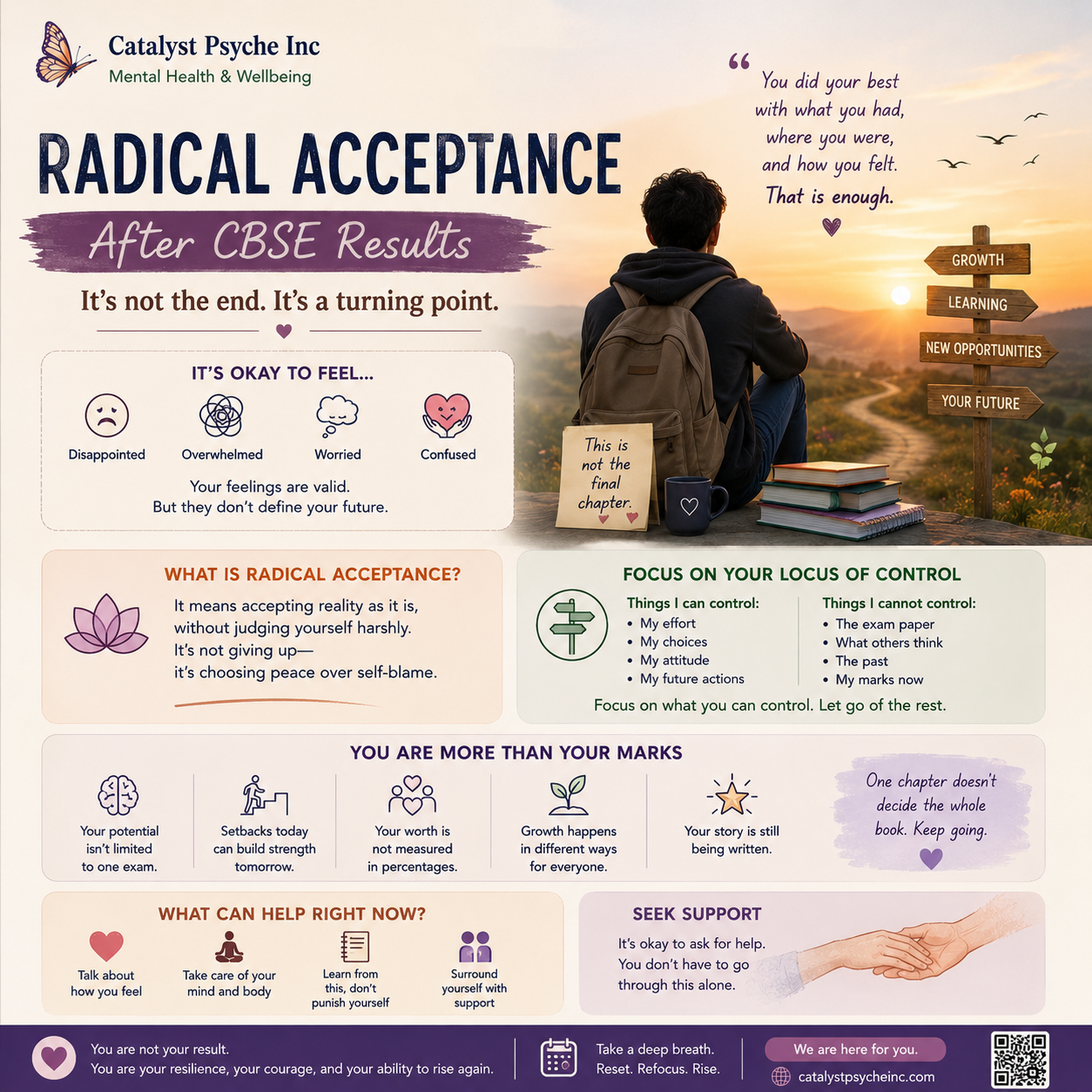
Radical Acceptance: It Doesn’t Mean “Just Get Over It”
When people hear the phrase Radical Acceptance, they often flinch. It sounds like giving up, or pretending not to care.
It isn’t.
Psychologist Marsha Linehan, who developed Dialectical Behaviour Therapy (DBT), describes Radical Acceptance as fully acknowledging reality as it is — instead of endlessly fighting what has already happened. Because suffering often isn’t just pain. It’s: Pain + Resistance = Prolonged suffering
The pain here is real: “I didn’t score as much as I hoped.”
The resistance is the additional layer we pour over it:
- “My life is ruined.”
- “I’m a disappointment.”
- “Everyone else is ahead of me.”
- “I’ll never recover from this.”
- “I am a disappointment to my family”
Radical Acceptance asks us to separate what actually happened from the story we are building around it.
It sounds like: “I don’t like this result. I’m disappointed. And — this is where I am right now.”
Not: “I’m fine.” Not: “It doesn’t matter.” But also not: “This single number is the final verdict on my worth as a human being.”
“But I Really Did Waste My Time — That’s Not a Story, That’s the Truth”
This is one of the hardest thoughts to sit with. And for some students, there is a genuine reckoning here.
Maybe you did procrastinate. Maybe you underestimated the pressure. Maybe you got distracted in ways you could have managed better.
Radical Acceptance doesn’t ask you to deny that. It asks: Can you acknowledge what happened without turning it into a verdict against your worth as a person?
Because here’s what the research actually shows: self-compassion outperforms self-punishment as a recovery strategy — every time.
Dr. Kristin Neff’s research on self-compassion consistently demonstrates that people who respond to setbacks with self-compassion — rather than harsh self-criticism — show greater emotional resilience, healthier motivation, lower anxiety and depression, and better long-term outcomes.
Being cruel to yourself is not the same as being honest with yourself. And it doesn’t produce better results next time. It just makes the present moment harder to survive.
Why Your Brain Genuinely Believes This Is “The End”
After disappointing results, many students experience what psychologists call catastrophic thinking — the mind jumps from:
“I scored lower than expected” → “My career is over” → “My life is over”
This happens because during intense emotional distress, the brain struggles to separate present pain from permanent reality. Research in cognitive psychology consistently shows that during high emotional distress, people significantly overestimate long-term negative consequences by catastrophizing.
In plain terms: your emotional state right now is making your future look much smaller than it actually is. The feeling that ‘it’s over’ is real. The conclusion that it’s actually over is not accurate.
One Exam Cannot Measure the Whole of a Human Life
This is genuinely hard to believe when you’re sitting inside the disappointment. But let’s look at it clearly. Life outcomes are shaped by an enormous range of factors that no board exam touches:
- Adaptability and the ability to recover from setbacks
- Emotional intelligence and relationships
- Creativity and unconventional thinking
- Communication — how you understand people and are understood
- Persistence over long periods
- Self-awareness, built often through difficulty
- Timing and opportunity
- Mental health and the capacity to keep going
Research on resilience consistently shows that setbacks don’t predict failure as strongly as our ability to adapt afterward. Some of the most emotionally mature, flexible, and self-aware adults are people who struggled academically — because difficulty, when met with support, builds something that ease cannot.
The Locus of Control Framework: Your Future Is Still In Your Hands
Here’s something worth pausing on.
While you’ve been reading this, time has been moving forward. And with it — opportunity.
JEE. NEET. CLAT. CUET. State entrance exams. Skill certifications. Gap year possibilities. Alternative pathways you haven’t fully explored yet.
The board result is behind you. What’s in front of you is still being written.
Psychologist Julian Rotter’s concept of Locus of Control is simple but powerful: at any given moment, some things are within your influence and some things aren’t. The students who recover fastest — and go furthest — are the ones who learn to ruthlessly focus their energy on the first category and consciously disengage from the second.
Right now, here’s what that looks like for you –
What Is Outside Your Control (and deserves none of your energy)
- Relatives making comments at family gatherings
- Classmates who scored higher and won’t let you forget it
- Parents comparing you to someone else’s child
- People questioning whether your tuition fees were “worth it”
- Anyone calling you a failure, directly or indirectly
- The result that has already been declared
These things are real. They will happen. Some of them will sting.
But here is the psychological truth: every minute you spend replaying those comments, defending yourself in your head, or trying to change what people think or feeling guilty — is a minute you are giving your power away.
The noise outside doesn’t get quieter by fighting it. It gets quieter when you have somewhere more important to direct your attention.
What Is Completely Within Your Control Right Now
Time. This is your most valuable currency — not marks, not other people’s opinions, not a board result. And right now, you have it. How you choose to invest it in the coming weeks and months will matter far more than what happened on results day.
Entrance exam preparation. JEE, NEET, CUET, and dozens of other exams are sitting in your future. These are fresh starts — clean slates where your board result does not walk into the room before you. Students who scored in the 60s have cleared NEET. Students who “failed” Class 12 by conventional standards have cleared JEE on their second attempt. The exam ahead of you doesn’t know what’s behind you.
Skill-building. We are living in a moment where coding, design, data analysis, content creation, financial literacy, communication, and dozens of other skills are genuinely learnable — often free or at low cost — and directly translate to opportunity. A board result cannot build a skill. But you can, starting today.
Your relationship with learning itself. Many students come out of board exam preparation burned out and disconnected from genuine curiosity. The weeks ahead are an opportunity to ask: What do I actually find interesting? What problems do I want to solve? What kind of work would I stay up late doing willingly? These questions are not luxuries — they are career intelligence.
Who you spend time with and what you consume. The people around you, the content you absorb, the conversations you have — these quietly shape how you think about yourself and what’s possible. You have more control over this environment than you realise.
Your body and mental health. Sleep, movement, nutrition, sunlight. These are not soft suggestions — they are the physiological foundation of focus, motivation, and emotional resilience. Investing here is investing in everything else.
The board result measured one thing, at one point in time, under one set of conditions. It did not measure your capacity to learn, adapt, and grow from here. That capacity is still fully intact — and entirely in your hands.
What Radical Acceptance + Locus of Control Looks Like Together
Put these two frameworks together and you get something quite practical:
Step 1 — Acknowledge reality: “This is what happened. I didn’t score what I hoped.”
Step 2 — Separate controllable from uncontrollable: “Here is what is in my hands Now & what isn’t.”
Step 3 — Refuse the total story: “I can be disappointed about what I could have done differently — without concluding that I am permanently broken.”
Step 4 — Orient forward: “My locus of control shifts back to me right now. What can I actually do from here?”
This isn’t toxic positivity. It isn’t spiritual bypassing. It’s the most honest and evidence-based path from “I’m stuck in this moment” to “I can move through it.”
What Most Students Actually Need Right Now
Not lectures. Not comparisons. Not “Sharma ji ka beta…”
Research on emotional regulation shows that validation helps people recover from distress more effectively than criticism or minimisation. What students need most in the days after results is:
- Emotional safety — space to feel what they feel without it being immediately fixed or dismissed
- Reassurance that their worth isn’t determined by this number
- Help rebuilding perspective, not replacing pain with forced optimism
- Support in separating what they can still influence from what has already passed
Sometimes healing begins with one sentence:
“You are allowed to feel disappointed — and still believe your life is bigger than this moment.”
If You’re Struggling Right Now, Read This Slowly
Your marks matter. They are real, and your feelings about them are valid.
And — They are not the full measure of your intelligence, your worth, your future, or the kind of life you can build.
Azim Premji didn’t see the company he’d create. Kalam didn’t know what the Air Force rejection was making room for. The people whose stories we admire rarely knew, in their worst moments, that those moments weren’t the end.
You are a person experiencing disappointment. Not a failed human being.
This moment — as heavy as it feels — does not have the authority to define your entire future.
You might want to read on this as well The Conflict Within: To Connect vs. To Disconnect & Why You Feel Lost & How to Find Purpose: Meaning of Life – a Psychology Perspective
[bookly-form category_id=”1″ service_id=”4″ staff_member_id=”1″]