You Keep Repeating the Same Patterns: 4 Reasons — You’ve had this conversation with yourself before. Maybe at 2 am, staring at your phone. Maybe after yet another argument with your father or your partner that somehow ended the exact same way. Maybe after promising yourself — again — that you wouldn’t go back to …

You Keep Repeating the Same Patterns: 4 Reasons — You’ve had this conversation with yourself before. Maybe at 2 am, staring at your phone. Maybe after yet another argument with your father or your partner that somehow ended the exact same way. Maybe after promising yourself — again — that you wouldn’t go back to that relationship, that job, that habit.
You know what you keep doing. You can trace it. You’ve probably journalled it, talked to friends about it, maybe even been to therapy. And yet — the same pattern shows up. Different situation, same feeling. Different person, same dynamic.
If this sounds familiar, you’re not alone — and more importantly, you are not weak. According to a 2025 report by Sapien Labs, young adults in India aged 18–34 ranked 60th out of 84 countries in mental health and wellbeing, with academic pressure, social isolation, and unprocessed stress cited as key contributors (Sapien Labs, 2025). Nearly 60% of mental health disorders in India are diagnosed in individuals under 35 (Indian Psychiatric Society, cited in Sapien Labs, 2025). The struggle is real, widespread — and deeply human.
So what is actually happening? Why does knowing what’s wrong not make it stop?
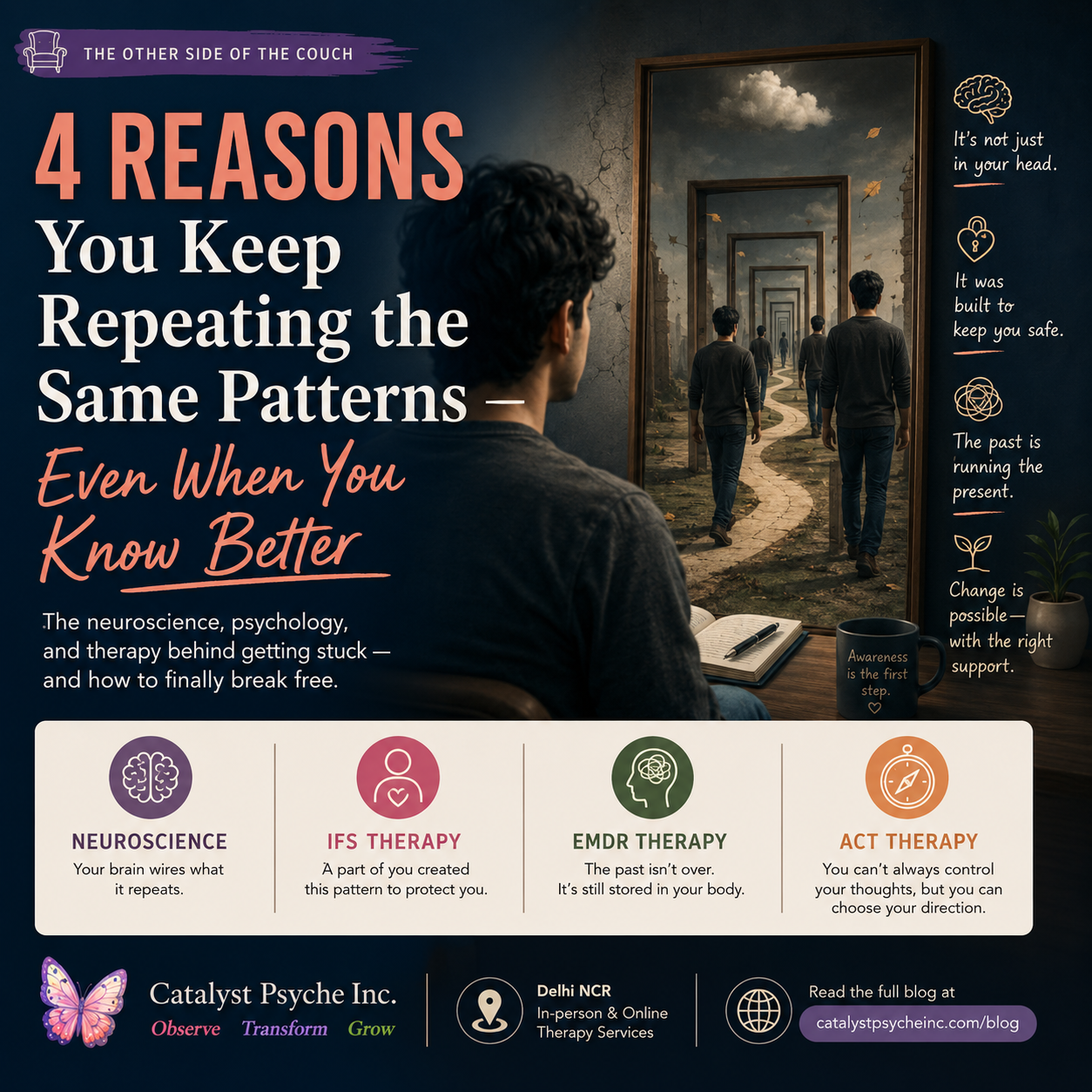
As a psychologist trained in IFS (Internal Family Systems), ACT (Acceptance and Commitment Therapy), CBT, and EMDR — and as someone who has sat with hundreds of people across this exact question — here are the four reasons that matter most.
1. Repeating The Same Patterns: Your Brain Has Physically Wired the Pattern In
In 1949, Canadian neuropsychologist Donald Hebb proposed a principle that changed how we understand behaviour: “Neurons that fire together, wire together” (Hebb, 1949). Every time you think a thought, feel an emotion, or take an action, a specific cluster of neurons fires. Each repetition of that same sequence strengthens the neural connection — making the pathway faster, more automatic, and more resistant to change.
This is brilliant when you’re learning to ride a bicycle or speak a language. The brain automates the useful so you don’t have to consciously think every time. The problem is, the brain does not distinguish between what is useful and what is painful. It simply records what is repeated.
So if you grew up in a home where love felt conditional, where silence was the safest response to conflict, where asking for help was seen as weakness — those patterns got wired in with the same efficiency as any skill. Siegel (2012) describes this in his work on interpersonal neurobiology: early relational experiences literally shape the architecture of the developing brain, creating response templates that operate largely outside conscious awareness.
| Your brain isn’t broken. It’s running the pattern it has had the most practice with. |
Understanding this intellectually, however, does not unwire it. Because insight lives in the prefrontal cortex. These patterns live deeper — in the body, in the nervous system, in what researchers call implicit memory: the kind that activates before a single conscious thought has formed.
2. IFS – There Is a Part of You That Built This Pattern to Keep You Safe
This is where neuroscience alone reaches its limits, and where Internal Family Systems therapy — developed by psychologist Richard Schwartz — offers something more precise. IFS proposes that we are not one unified self. We are a system of parts, each carrying its own perspective, emotion, and protective function. Some of these parts formed very early — in childhood — in response to something that hurt (Schwartz, 1995).
Imagine a part of you that learned, at eight years old, that if you made yourself agreeable enough, useful enough, quiet enough — the people around you would not withdraw their love. That part worked. It kept you safe. So it kept doing its job.
The problem is: that part is still eight years old. It does not know you are 26 now. It does not know the original threat has passed. It is still running the same protective pattern because nobody has told it the context has changed.
IFS is now listed on SAMHSA’s National Registry of Evidence-Based Programs and Practices (Sweezy, 2011). Research indicates that these protective parts do not respond to intellectual understanding alone — they respond to being genuinely seen and heard by the Self. Willpower, in this framework, is not a virtue. It is a manager telling an eight-year-old to sit down and shut up. It rarely works for long.
In an Indian family context, this is particularly resonant. The conditioning to be a ‘good child’ — obedient, high-achieving academically, emotionally contained — starts early. The parts that formed to meet those expectations are often among the most tenacious, and the most in need of compassionate attention. These parts also carry a burden of inner shame (exile part) because if that 8 year old isn’t doing what is expected out of him/her, it leads to disappointment in the attachment figures (usually parents). The kid takes it internally thats its his/her fault and it needs to adapt to the expectations and learn the behaviours and thought patterns to become ‘good’ kid.
3. EMDR – The Memory Itself Is Stored in Your Nervous System — Not Just Your Mind
This is perhaps the most underappreciated reason why patterns persist: some of them are not stored in language or thought at all. They are stored in the body’s nervous system as sensory, somatic memories — and they require a different kind of access to shift.
This is where EMDR — Eye Movement Desensitization and Reprocessing — enters the picture. Developed by psychologist Francine Shapiro in 1987 and now endorsed by both the World Health Organisation and the American Psychiatric Association (APA, 2025), EMDR works not by changing what you think about an experience, but by changing how that experience is stored in the brain.
| Some patterns don’t shift through talk alone because they are not stored in the language centres of the brain. They are stored in the body. |
The mechanism involves what researchers call memory reconsolidation — every time we recall a memory, there is a brief window in which it becomes malleable, like soft clay, before it is stored again. During EMDR, bilateral stimulation (typically guided eye movements, or alternating taps) keeps this window open while the nervous system processes what was previously stuck (Shapiro, 2001). Research by de Jongh et al. (2024) in the Journal of Traumatic Stress demonstrates that individuals can stop meeting diagnostic criteria for PTSD in as few as five EMDR sessions following a single-incident trauma.
The implications extend beyond trauma in the clinical sense. Many of the ‘stuck patterns’ young Indian adults describe — the freeze before important conversations, the automatic withdrawal, the compulsive people-pleasing — have a somatic, nervous-system dimension that pure talking cannot fully reach.
4. ACT – You Are So Merged With the Pattern That You Cannot See It — Only Be It
The fourth reason is perhaps the most counterintuitive. Psychologist Steven Hayes, founder of Acceptance and Commitment Therapy (ACT), spent decades researching a phenomenon he called cognitive fusion — the state in which we are so psychologically merged with a thought, belief, or pattern that we cannot observe it from the outside. We can only enact it (Hayes et al., 2006).
When you are inside a repeating pattern — already withdrawn, already said yes when you meant no, already sent that message you knew you’d regret — you are not standing outside thinking ‘there I go again.’ You are the pattern. It is running you.
Research confirms that psychological inflexibility — the ACT term for this state of being fused with unhelpful patterns — is a transdiagnostic factor underlying anxiety, depression, OCD, and relationship difficulties (Kashdan & Rottenberg, 2010). It cuts across diagnoses because it is not about what the pattern is, but about the relationship between the person and the pattern.
What therapy creates — when it works — is not the elimination of the pattern. It is enough psychological distance from the pattern that you can see it in real time. Not just know it intellectually. See it, while it is happening, with enough space to make a different choice.
| Change does not require perfection. It requires enough distance from the pattern to notice it before it has already run. |
Why This Matters Especially for Young Indians Right Now
The cultural context cannot be ignored. Research on young adults in higher education across eight major Indian cities found that nearly 70% reported moderate to high anxiety, and 60% reported significant depression — yet a minimal number had accessed mental health services, primarily due to stigma and cultural biases (ScienceDirect, 2025).
UNICEF India (2023) reports that half of all mental health disorders begin by age 14, and 75% by the mid-20s. The patterns forming now — in students, in young professionals, in people navigating family pressure and identity questions — are the patterns that will shape the next decades of their lives if left unaddressed.
The Indian cultural context adds its own layers. The pressure to perform, to be a ‘good son or daughter,’ to not bring problems home, to manage emotions privately, therapy still carrying a social stigma around and many adults do not support it — all of this makes it harder to name what is happening, let alone seek support. But it also means that when the work is done, it can be genuinely transformative.
So What Does Change Actually Require?
If you have taken anything from this, let it be this: the gap between knowing and changing is not a character flaw. It is neuroscience.
Change requires:
- Working at the level of the nervous system — not just the thinking mind (Hebb, 1949; Siegel, 2012)
- Genuinely meeting the parts that built the pattern — not suppressing or arguing with them (Schwartz, 1995)
- Processing what is stored in the body, not only what can be articulated in words (Shapiro, 2001)
- Creating enough psychological distance from the pattern to observe it in real time (Hayes et al., 2006)
None of this requires you to have it all figured out before you begin. It requires a willingness to be honest about what keeps repeating — and to find the right support.
If there is a pattern in your life that you understand but cannot seem to change on your own, that is not a sign that change is impossible. It is a sign that you may need a different kind of help than insight alone can provide.
Read more Internal Family Systems (IFS) Therapy for Trauma & Anxiety in India | Catalyst Psyche Inc Understanding Emotional Boundaries 01: Why Saying “No” Feels So Guilty Why do I keep overthinking every conversation?
| Ready to work on the patterns that keep repeating?
At Catalyst Psyche Inc., we work with individuals navigating stuck patterns, relationship dynamics, anxiety, and identity — using evidence-based approaches including IFS, EMDR, ACT, and CBT. In-person sessions: Sector 75, Noida (Delhi NCR) Online sessions: Available across India and world for Indians Book a session → catalystpsycheinc.com/book-a-session WhatsApp → +91 97737 72062 |

References
American Psychiatric Association. (2025). Eye movement desensitization and reprocessing (EMDR) therapy. https://www.apa.org/ptsd-guideline/treatments/eye-movement-reprocessing
de Jongh, A., et al. (2024). State of the science: Eye movement desensitization and reprocessing (EMDR) therapy. Journal of Traumatic Stress. https://doi.org/10.1002/jts.23012
Hayes, S. C., Luoma, J. B., Bond, F. W., Masuda, A., & Lillis, J. (2006). Acceptance and commitment therapy: Model, processes and outcomes. Behaviour Research and Therapy, 44(1), 1–25. https://doi.org/10.1016/j.brat.2005.06.006
Hayes, S. C. (2019). A liberated mind: How to pivot toward what matters. Avery/Penguin.
Hebb, D. O. (1949). The organization of behavior: A neuropsychological theory. Wiley.
Indian Psychiatric Society. (2025). As cited in Sapien Labs Global Mind Health Report 2025.
Kashdan, T. B., & Rottenberg, J. (2010). Psychological flexibility as a fundamental aspect of health. Clinical Psychology Review, 30(7), 865–878. https://doi.org/10.1016/j.cpr.2010.03.001
Sapien Labs. (2025). Global Mind Health Report 2025. https://sapienlabs.org
Schwartz, R. C. (1995). Internal family systems therapy. Guilford Press.
Schwartz, R. C. (2021). No bad parts: Healing trauma and restoring wholeness with the internal family systems model. Sounds True.
Shapiro, F. (2001). Eye movement desensitization and reprocessing (EMDR): Basic principles, protocols, and procedures (2nd ed.). Guilford Press.
Siegel, D. J. (2012). The developing mind: How relationships and the brain interact to shape who we are (2nd ed.). Guilford Press.
Sweezy, M. (2011). The teenager’s confession: Regulating shame in internal family systems therapy. American Journal of Psychotherapy, 65(2), 179–188.
UNICEF India. (2023). Mental well-being for young people. https://www.unicef.org/india/mental-well-being-young-people
ScienceDirect. (2025). Mental health of young adults pursuing higher education in Tier-1 cities of India: A cross-sectional study. https://doi.org/10.1016/j.ajp.2025.xxx