The Grief of an Affair: Why Betrayal Feels Like Mourning a Death; Part 1 of “After the Affair — A Path Through Betrayal,” an IFS × Gottman series Catalyst Psyche Inc. • Couples & Individual Therapy, Noida / Online India The grief of an affair is the deep, disorienting mourning that follows the discovery of …

The Grief of an Affair: Why Betrayal Feels Like Mourning a Death; Part 1 of “After the Affair — A Path Through Betrayal,” an IFS × Gottman series
Catalyst Psyche Inc. • Couples & Individual Therapy, Noida / Online India
The grief of an affair is the deep, disorienting mourning that follows the discovery of betrayal — not for a person who has died, but for a relationship, a future, and a version of reality that suddenly no longer exist. It is one of the most under-acknowledged forms of grief there is, partly because the person you are grieving is often still sitting across the dinner table.
If you have just found out, you may be moving through your days in a strange fog, functioning on the outside while something inside has gone very quiet, or very loud. You might cry without warning. You might feel nothing at all, which frightens you more. People keep asking if you’re okay, and you don’t have the words. This blog is an attempt to give you some.
Key Takeaways
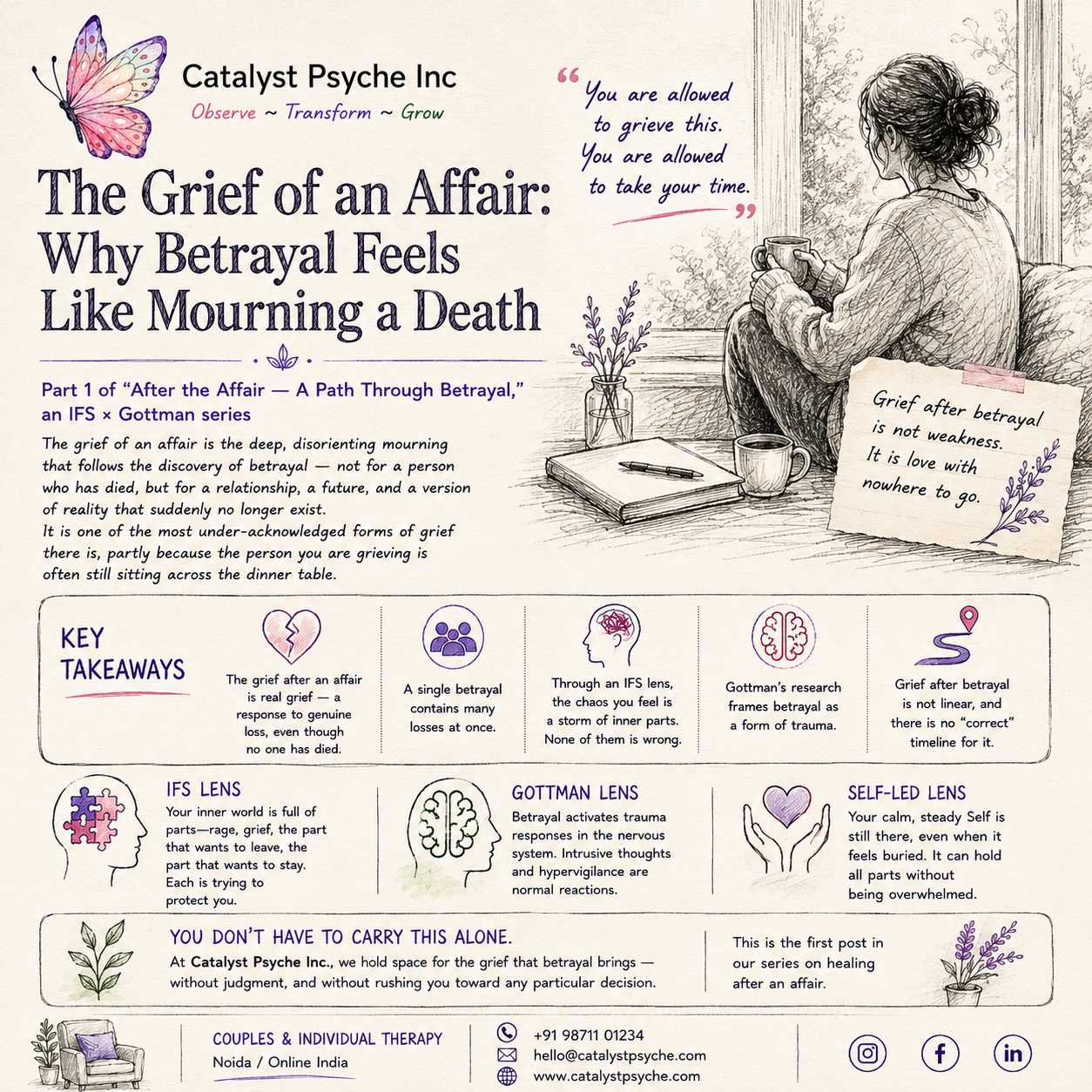
The grief after an affair is real grief — a response to genuine loss, even though no one has died.
A single betrayal contains many losses at once: the relationship as you knew it, your imagined future, your trust in your own judgment, and the image of your partner.
Through an IFS lens, the chaos you feel is a storm of inner parts — rage, grief, the part that wants to leave, the part that wants to stay — all activated at once. None of them is wrong.
Gottman’s research frames betrayal as a form of trauma, which is why intrusive thoughts, hypervigilance, and emotional flooding are so common.
Grief after betrayal is not linear, and there is no “correct” timeline for it.
Table of Contents
ToggleWhy Does an Affair Cause Grief?
We usually reserve the word grief for death. But grief is the natural human response to any significant loss, and an affair detonates several losses at once. The psychologist Pauline Boss called this kind of experience an ambiguous loss — a loss without a body, without a funeral, without the rituals that help us mourn. There is no casserole brought to your door, no leave granted from work, no socially sanctioned space to fall apart. And yet something enormous has ended.
That lack of recognition is its own wound. You are grieving, but the world doesn’t treat it as grief. Many people carry this alone, in silence, wondering why they can’t just “get over it.”
The Many Losses Hidden Inside One Betrayal
Part of why this grief feels so overwhelming is that it is not one loss but several, layered on top of one another:
- The relationship as you knew it. The shared history now reads differently. Memories you treasured may be contaminated by the question, was it already happening then?
- The future you imagined. The plans, the growing old together, the picture of your life you had quietly built. That future died, and almost no one acknowledges it.
- Your trust in your own judgment. If you didn’t see this, what else can’t you see? Betrayal shakes your faith not just in your partner but in your own perception of reality.
- The image of your partner. You are grieving someone who is still alive — mourning a version of them that may never have fully existed.
- Your sense of self. Many people quietly grieve an identity: I am someone whose marriage works. I am someone who would know.
Naming these losses matters. When you can see that you are grieving five things at once, the size of your pain finally makes sense. You are not overreacting. You are responding, accurately, to a great deal of loss.
An IFS Lens: The Storm of Parts After Betrayal
If your inner world feels like a riot right now, Internal Family Systems offers a gentler way to understand it. IFS sees the mind as an inner family of “parts,” each with its own feelings and role. After a betrayal, many of these parts get activated at once, often pulling in opposite directions — which is exactly why you can feel five contradictory things in a single hour.
There is the enraged part that wants to scream. There is the devastated part underneath, simply heartbroken. There is the part that wants to leave and the part that wants to make it work, locked in a tug-of-war that exhausts you. There may be a part that blames you, and a hypervigilant part now scanning every phone notification for evidence.
Here is the IFS reframe that can bring some relief: none of these parts is bad, and you are not “crazy” or “too much.” Each part is trying to protect you. The rage is guarding your dignity. The hypervigilance is trying to make sure you are never blindsided again. The self-blame, painful as it is, is often a part trying to restore control — if it was my fault, then I can fix it. When you stop fighting your own reactions and get curious about what each part is trying to do for you, the storm becomes a little more bearable. You don’t have to act on every part. You only have to notice them, and let them know you’ve heard them.
A Gottman Lens: Betrayal as Trauma
John Gottman’s decades of research on trust and betrayal point to something many people are relieved to hear named: the discovery of an affair often produces symptoms that look like trauma. Intrusive images you can’t switch off. Sleep that won’t come. A nervous system stuck on high alert. Sudden emotional flooding triggered by a song, a place, a particular word.
This is not weakness or melodrama. It is a nervous system that has registered a profound threat to one of its most fundamental needs — safety in attachment — and is responding the way nervous systems do to trauma. Understanding this can soften the harsh self-judgment so many people add on top of their pain: why am I still not over this? You are not failing to cope. You are healing from an injury, and injuries take the time they take.
Why the Grief Isn’t Linear
You may have heard of the “stages of grief” and expected to pass neatly through them. Betrayal grief rarely cooperates. You can wake up feeling almost peaceful and be flattened by rage by lunchtime. You can think you’ve reached acceptance, then discover a new detail and find yourself back at the beginning. Good days are not betrayals of your pain, and bad days are not evidence that you’re not healing.
In IFS terms, different parts simply take the lead on different days. The work is not to force a particular feeling, but to make room for whichever part shows up — and to keep returning, as best you can, to the calm, steady centre underneath them all. That centre, what IFS calls the Self, is still there, even now, even if it feels buried. It is the part of you that can hold all the others without being destroyed by any of them.
Grief After an Affair in the Indian Context
In many Indian families, this particular grief carries an extra weight. There is often immense pressure to keep the betrayal hidden — log kya kahenge, what will people say — which means the one place you might find support can become another place you have to perform being fine. Some are pushed to forgive and “move on” for the sake of the marriage, the children, or the family’s reputation, long before they have had any space to mourn. Others are told, subtly or openly, that a “good” wife or husband simply tolerates these things.
If this is your situation, please hear this clearly: your grief is valid whether or not anyone around you has permission to see it. Choosing privacy is not the same as being fine. You are allowed to find one safe space — a trusted friend, a therapist — where you do not have to hold it together.
What Helps You Carry This Grief
This first stage is not about deciding the future of your relationship. It is far too early for that, and any part of you demanding an immediate decision can be gently told not yet. For now, the work is simply to survive the wave and to be kind to yourself inside it.
A few things that genuinely help: naming what you’ve lost, rather than minimising it. Letting the contradictory parts of you coexist without forcing a verdict. Finding even one person with whom you don’t have to pretend. Protecting your sleep and your body where you can, because grief is physical. And reminding yourself, on the worst days, that feeling this much is not a sign that something is wrong with you — it is a sign of how much the relationship mattered.
Whether you eventually choose to rebuild or to part ways — the subjects of the posts that follow in this series — you will make a wiser, more Self-led choice once the first storm of grief has been allowed to move through you, rather than around you.
You are allowed to grieve this. You are allowed to take your time.
At Catalyst Psyche Inc., we hold space for the grief that betrayal brings — without judgment, and without rushing you toward any particular decision. If you are carrying this alone, reaching out for support can be a first, gentle step. This is the first post in our series on healing after an affair.
Read more – Gottman’s Four Horsemen: Criticism, Contempt, Defensiveness & Stonewalling & An IFS Perspective on Relationship Conflict Balancing Individuality and Togetherness in a Relationship Relationship Counseling : When Love Feels Stuck, Therapy Can Help
Frequently Asked Questions
Is it normal to grieve after an affair even if no one has died?
Yes. Grief is the natural response to significant loss, and an affair involves many real losses at once — the relationship as you knew it, your imagined future, and your trust. Psychologists call this kind of non-death grief an “ambiguous loss,” and it is entirely normal.
Why does betrayal feel like trauma?
Discovering an affair threatens a fundamental human need: safety within an attachment relationship. Gottman’s research notes that betrayed partners often experience trauma-like symptoms, including intrusive thoughts, hypervigilance, sleep difficulties, and emotional flooding.
How long does grief after an affair last?
There is no fixed timeline. Betrayal grief is non-linear, with good days and bad days that don’t follow a neat sequence. Healing takes the time it takes, and a sudden new detail can reopen the wound — which is normal, not a sign of failure.
Do I have to decide whether to stay or leave right away?
No. The early stage of grief is not the time for permanent decisions. It is usually wiser to let the initial shock and grief settle before choosing a direction, so the choice can come from a calmer, more grounded place.
Should I tell my family about the affair?
This is deeply personal and cultural. Privacy is a valid choice and is not the same as being “fine.” What matters most is having at least one safe space — a trusted person or a therapist — where you don’t have to pretend you’re okay.
References
- Gottman, J. M. (2011). The Science of Trust: Emotional Attunement for Couples. W. W. Norton.
- Gottman, J. M. (2012). What Makes Love Last? How to Build Trust and Avoid Betrayal. Simon & Schuster.
- Boss, P. (1999). Ambiguous Loss: Learning to Live with Unresolved Grief. Harvard University Press.
- Schwartz, R. C., & Sweezy, M. (2020). Internal Family Systems Therapy (2nd ed.). Guilford Press.
- Schwartz, R. C. (2021). No Bad Parts: Healing Trauma and Restoring Wholeness with the Internal Family Systems Model. Sounds True.