
Therapy Rupture - 3 Signs: Why Feeling Disconnected From Your Therapist Can Actually Help You Heal The Quiet Power of Rupture and Repair in Therapy. Why the moments therapy almost falls apart may be exactly where the healing happens. There is a particular kind of silence that can fall in a therapy room. Maybe the …

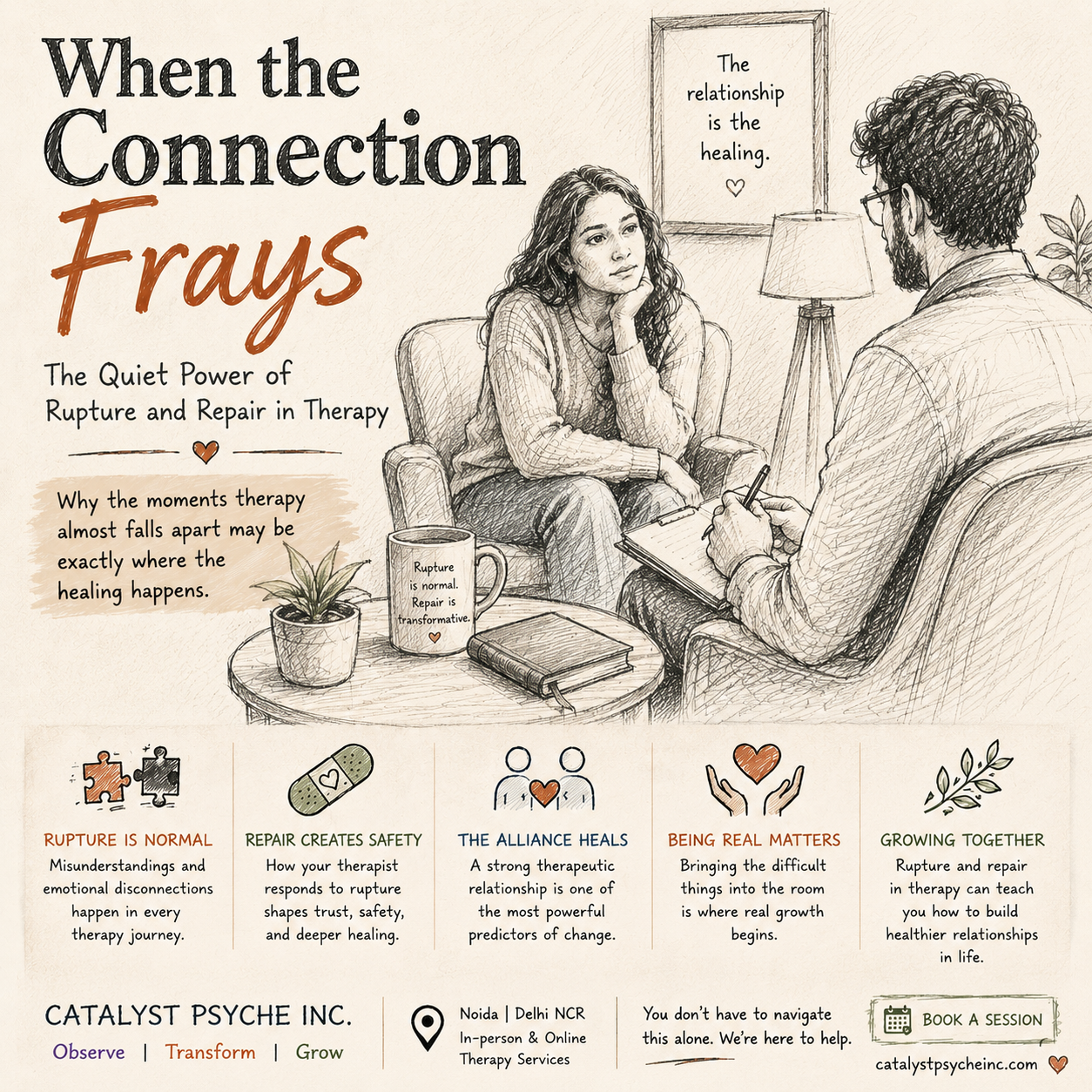
Therapy Rupture – 3 Signs: Why Feeling Disconnected From Your Therapist Can Actually Help You Heal
The Quiet Power of Rupture and Repair in Therapy. Why the moments therapy almost falls apart may be exactly where the healing happens.
There is a particular kind of silence that can fall in a therapy room.
Maybe the client gave a slightly clipped answer. Maybe they said “no, no, it’s fine” a little too quickly. Maybe the therapist offered an interpretation that landed wrong, and something in the air cooled by a few degrees. Both people felt it. Neither named it. The session carried on, politely, while something underneath quietly pulled tight.
If you have ever sat in that moment — as the client who suddenly didn’t want to come back, or as the therapist who sensed the room go flat — you have met a rupture. And here is the thing almost nobody tells you: that moment is not the failure of therapy, it can also become the most healing part of it.
Table of Contents
ToggleWhat Is a Therapy Rupture? Understanding Rupture and Repair in Therapy
In everyday language, “rupture” sounds dramatic — a blow-up, a walkout, a relationship breaking apart. In the therapy research, it means something far broader and gentler. A rupture in simple words is a deterioration in the working relationship between client and therapist.
It shows up in one of three ways: (1) a disagreement about the goals of therapy, (2) a breakdown in collaboration on the tasks of therapy, or (3) a strain in the emotional bond between the two people. This is the definition that Jeremy Safran and Christopher Muran built much of modern alliance research around, and it covers everything from a barely perceptible tension to a serious rift.
“Rupture” in therapy may look like — a blow-up, a walkout, a relationship breaking apart.
The most freeing fact in this entire field is how ordinary ruptures are. Researchers who have studied recorded sessions estimate that some form of rupture appears in anywhere from one in five sessions to nearly every single one. They happen in therapies that fail and in therapies that succeed beautifully. The presence of a rupture tells you almost nothing about whether therapy is working. What it does tell you is that two human beings are genuinely engaged with each other — and wherever there are two humans, there will be moments of misattunement.
Common Types of Therapy Rupture: Withdrawal and Confrontation
Safran and Muran noticed that ruptures tend to wear one of the two faces.
The first is withdrawal. Here the client moves away. They go quiet. They give short, dutiful answers. They change the subject when something gets close to the bone. They agree with everything the therapist says — a little too smoothly. They “forget” the between-session exercise, or they cancel, reschedule, and slowly drift.
The second is confrontation. Here the client moves against. They express irritation or anger directly. “This isn’t helping.” “You keep saying the same thing.” “You don’t actually understand my life.” It can feel sharp in the moment, but confrontation is, in a strange way, a gift: the client trusts the relationship enough to push against it.
In the Indian therapy room, withdrawal is often the more common face — and it is easy to miss. Many of us were raised to treat anyone in a position of expertise, a doctor, a teacher, a guru, an elder, with deference. Disagreeing openly can feel not just uncomfortable but actually disrespectful. So a client who is quietly unconvinced rarely says “I don’t think this is working.” Instead they say, “you’re right,” nod warmly, and then don’t book the next appointment. The “no” arrives as politeness, as a missed call, as a slow fade. A therapist attuned only to confrontation will never see it coming.
Consider a few familiar shapes this takes:
- A young professional keeps agreeing that she should “set boundaries” with her mother, thanks the therapist sincerely each week, and grows quieter and quieter — because the advice, however sound, doesn’t fit a reality where she still lives at home, shares finances, and loves her mother fiercely. The rupture isn’t in what she says. It’s in what she has stopped saying.
- A man finally snaps mid-session: “You keep telling me to do what I But in my family, there is no such thing as just me.” That is a confrontation rupture — and also, if the therapist can stay open, the truest thing he has said in months.
- Therapist said they will schedule the next session but didn’t and client kept waiting feeling abandoned.
- A queer client senses the therapist make a small heteronormative assumption — a pronoun, and something in the bond closes. Nothing is said. But trust has thinned.
- A client who came expecting clear solutions, the way one might consult a family elder or a specialist, grows frustrated by a therapist who keeps reflecting questions back. This is a goals rupture: two people quietly wanting different things from the same hour.
Why a Therapy Rupture Can Feel So Emotionally Painful
A misattunement with your therapist can sting out of all proportion to what actually happened. There is a reason for that.
For many people, the therapy relationship is one of the first places they have been truly listened to. When that relationship wobbles — when the one person who seemed to get it suddenly seems not to — it can echo every earlier time someone important looked away. The parent who was emotionally unavailable. The teacher who humiliated you in front of the class. The elder whose approval was always just out of reach. The rupture in the room reaches back and touches the rupture from long ago.
This is also precisely why repair matters so much. When an old wound gets re-activated in the present, it can, for once, be met differently.
Research on Therapy Rupture and Repair: Why Repair Improves Therapy Outcomes
Here is where the science turns genuinely hopeful. In 2018, Catherine Eubanks, Christopher Muran, and Jeremy Safran pulled together the available studies — covering more than thirteen hundred clients — and asked a simple question: does it actually matter whether ruptures get repaired? The answer was a clear yes. They found a moderate, statistically meaningful link between rupture resolution and good therapy outcomes. Repaired ruptures predicted clients staying in therapy and getting better.
But the finding that turns the whole intuition on its head is this: therapy that moves through a rupture and out the other side can sometimes lead to better results than therapy with no visible ruptures at all. The repair is not damage control. The repair is the medicine.
Think about what a successful repair actually teaches a person, in their body, not just their head: A relationship can bend without breaking. I can be a problem, or have a problem, and still be held. Conflict does not mean abandonment. For someone whose history taught them the opposite, no insight delivered in calm weather could land that lesson half as deeply.
How Therapists Repair a Rupture in the Therapeutic Relationship
Safran and Muran mapped how repair tends to unfold, and stripped of its technical language, it is deeply human.
First, someone notices. The therapist (or sometimes the client) registers that something has shifted — the coolness, the politeness, the edge — and chooses to turn toward it rather than smooth it over. This alone is countercultural. Most of us are trained to paper over awkwardness, especially with someone we respect.
Then comes the invitation to explore, together. The therapist might say something like, “I noticed things felt a little different after what I said earlier. I might have gotten something wrong. Can we look at it?” Crucially, the therapist does not get defensive, does not over-explain, and does not need to be right. They take responsibility for their part with genuine openness.
Next, the client is helped past the urge to avoid. For someone who finds it almost physically impossible to criticise an authority figure, this is tender, careful work. The therapist makes it not just safe but welcome to say the unsayable: “Actually, yes — that comment annoyed me.” The therapist receives it as useful information rather than an attack.
And finally, beneath the irritation or the withdrawal, a real need surfaces. The annoyance at being told to set boundaries reveals a longing to be understood within her family rather than pulled out of it. The frustration with the questioning reveals a wish to feel less alone with the decision. The rupture, followed all the way down, becomes a doorway into exactly what the client came to therapy for.
How Rupture and Repair in Therapy Improves Relationships Outside Therapy
There is something quietly radical in all of this, especially in a culture where so many of us were never shown how to repair.
In a great many Indian families, conflict is handled by waiting it out. Nobody apologises; the storm simply passes, and a week later everyone is eating together again as if nothing happened. The hurt is real, but it goes underground. We learn, early and well, how to avoid a rupture and how to outlast one. We almost never learn how to walk back into one and mend it, face to face.
The therapy relationship can become a small, safe laboratory for precisely that missing skill. When a client experiences a rupture being named without shame, explored without blame, and repaired without anyone being cast out — they are learning, perhaps for the first time, that relationships can be talked back to life. That is a skill they carry home. To a marriage. To an ageing parent. To a child they do not want to raise the way they were raised.
What To Do If You Feel Disconnected From Your Therapist
If you are a client and something between you and your therapist feels off — the disappointment, the irritation, the urge to quietly stop going — consider that this might not be a sign to leave. It might be the most important conversation you haven’t had yet. You are allowed to say, “Something didn’t sit right last week.” A good therapist will not crumble or retaliate. They will lean in.
And if you are a therapist, the cooling of the room is not your failure to be flawless. Ruptures are woven into the work; the research is unambiguous about that. Your task was never to avoid them. It is to notice them, to turn toward them without armour, and to trust that the mending matters more than the perfection.
The bond between two people in a therapy room will fray. That is not the end of the story. Very often, it is where the real story begins.
Read our other blogs – 7 Signs of Complex Trauma and How Trauma Therapy in Noida Can Help Willpower, Shame, and Religion: A Brief Psychological Perspective Internal Family Systems (IFS) Therapy for Trauma & Anxiety in India | Catalyst Psyche Inc
A note on the research
This piece draws on the rupture-and-repair framework developed by Jeremy Safran and Christopher Muran (Negotiating the Therapeutic Alliance, 2000), their identification of withdrawal and confrontation rupture types, and the meta-analysis by Eubanks, Muran, and Safran (Psychotherapy, 2018), which found a moderate relationship between rupture resolution and positive client outcomes across 11 studies and more than 1,300 clients.
At Catalyst Psyche Inc., we see the therapeutic relationship — including its honest, difficult moments — as central to healing. If something in your own therapy feels unresolved, or you’re looking for a space where the hard conversations are welcome, reach out to begin.
[bookly-form]